

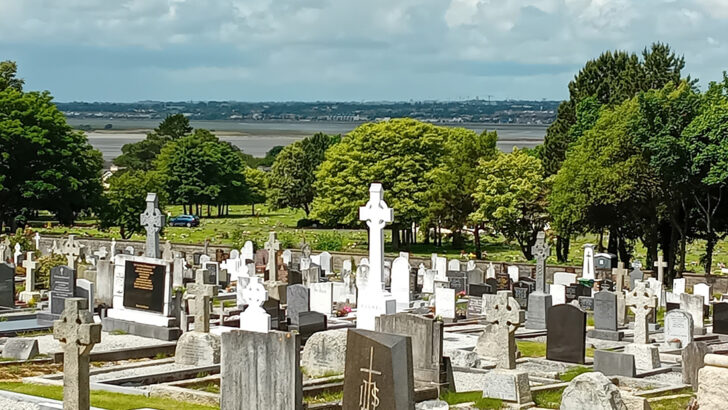
 St Fintan’s, looking down on lawn cemetery and Dublin Bay. Photo: Donal McMahon.
 Cemetery Masses are being held all over Ireland during these summer months. Yes, we remember our deceased relatives and friends in November with its feast of All Souls, but the long days and good weather of summer allow us to hear Mass in a unique way in the open air and to pray, almost in their presence, for the souls of the deceased members of our family. These Masses take place too at the highest point in the liturgical year, after the great feasts of Easter, Ascension, Pentecost and Trinity, a fitting moment, then, to delve into the deep mysteries to do with our life and afterlife.

Pilgrimage
And so, on the second Sunday of June every year, my wife and siblings head out on what we could call our annual pilgrimage to the cemetery of St Fintan high up on the hill of Howth. Hundreds can be seen doing the same. Keeping an eye on the time (Mass at 12 pm), we overtake some, are overtaken by others, as we make our way hurriedly upwards with our folding stool, rain gear, etc. The majority turn in at the entrance to the lowest and most recent section of St Fintan’s, the lawn cemetery, while we head on up to our McMahon family plot in among the older graves on the next level. Higher still are graves from the 19th century and, at the highest point of all, overlooking Dublin Bay, the small medieval Church of St Fintan.
The altar lies among trees in the distance on lawn level, too far away for us to see the celebrant, ministers or choir. Instead, we concentrate on listening to the sound of their voices relayed by loudspeakers on high poles. Such intent listening on the part of little groups scattered all over the vast cemetery creates a strange, ethereal sense of community. Though physically dispersed, spiritually we seem to form a close-knit congregation, everyone doing their best, despite the gusts of wind, to follow the words of the Mass, that great Mystery of Faith, while every now and then, on glancing around or up at the sky, being seized by a sense of the immense wonder of it all.
Peace
As the years go by, there are fewer and fewer people at graves nearby in our section to whom we can offer the sign of peace. In due course, by loudspeaker invitation, we turn to our deceased family members and sprinkle holy water on them: father, John F. (1908-1963), brother, Sean (1948-2003), and mother, Catherine (Ina) (1920-2008). After Communion, the St Fintan’s parish choir ring out the words of the glorious promise: “And he who eats of this bread, he shall live forever (2), and I will raise him up (3) on the last day.”
Not far from us lies the grave of the poet, Padraic Colum (1881-1972), whose autograph Sean and I got in 1964. “Mavourneen is going from me and from you, / Where Mary will fold him with mantle of blue” (from A Cradle Song, a poem we learned in school). For those who have fallen asleep here in St Fintan’s and in cemeteries everywhere, let us pray, in the words on our family headstone: “Requiescant in pace”, adding, “in spe resurrectionis” (May they rest in peace, in hope of the Resurrection).
***
Whenever I look at my father’s and mother’s names on the headstone, I realise I wouldn’t be here at all to do this if they had not met, married in 1947, and had their first children, twins Sean and myself, in 1948. After living with her widowed aunt in Mandelieu, near Cannes, for seven years, Ina returned to her native Listowel in 1946. It was there (right place) and then (right time) that she met her future husband, John (Jack) McMahon. Was that meant to be or was it just chance? Do things happen haphazardly or, as Hamlet says, by the will also of a “divinity that shapes our ends”? Is Divine Providence with us as we make the life-choice of our vocation? And deepest question of all, might humanity itself have a vocation as it makes its slow, unsure way through history (“Seek and you will find!” whispers Faith) towards the great apocalyptic goal of finding itself at the same time as finding God?