

 Breda O'Brien
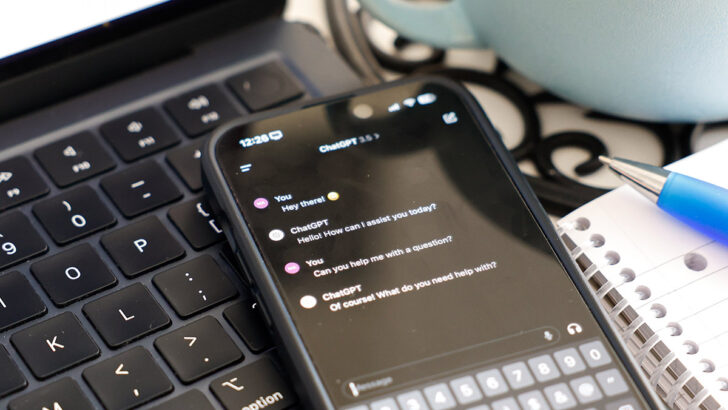 The ChatGPT app is seen on a phone placed atop a keyboard in this photo taken in Rome, March 8, 2024. Photo: CNS / Lola Gomez.
 As schools close for the summer, I wonder how many teachers in Catholic schools realise that Pope Leo has high praise for the role of teachers in his encyclical on AI, Magnifica Humanitas?
He insists that the dignity of the human person must remain central in this “change of era” brought about by AI.
He sees education as vital in this task of celebrating and maintaining our common humanity. He says that an alliance between parents, educators and policy-makers is needed, as none can succeed alone.
The challenges are immense. The impact of constantly living in a digital “culture of immediacy and hyper-stimulation” is at odds with education, which he calls “a long journey requiring patience.” Educationalists say something similar when they talk about “necessary friction”.
Learning is supposed to challenge us to think. This is not always comfortable. A skilled teacher tries to ensure that students are neither overwhelmed in the sense of feeling completely at sea, or under-stimulated by doing repetitive tasks that are too easy for them. But without the optimum level of friction, learning does not take place.
Achievement
Long before AI, learning theorists recognised that it is easy to give the illusion of learning. For example, you re-read your notes and the material seems familiar. This is not at all the same as being fluent in or exhibiting mastery of a topic.
But now, when you can enter a prompt for an essay into a large language model (LLM) and have it spit out an acceptable answer within seconds, the temptation is to give up on trying to learn at all.
Teachers cannot take shortcuts, either. There have been documented occasions in US universities where teachers use AI to create their lesson plans, notes and questions, the students use AI to write answers, and those answers are fed back into an AI to be corrected.
A single language, a single technology, a single direction. However, the project concealed a profound danger”
This is a travesty. Pope Leo presents instead a deeply human vision. At the beginning of the encyclical, he contrasts two biblical images, the Tower of Babel and the rebuilding of Jerusalem by Nehemiah.
In the account of the Tower of Babel in Genesis, the better-known story, the Pope acknowledges the scale of the achievement: “a single language, a single technology, a single direction. However, the project concealed a profound danger. It was a project conceived without reference to God, supported by a uniformity that eliminated diversity and that chose homogenisation over communion.”
Ultimately, the project fails, leading only to division and chaos. In contrast, when Nehemiah returns to the destroyed Jerusalem, he first prays and fasts, and then examines the situation in silence. He consults the people, and assigns everyone a role in re-building. Unlike Babel, this is the work of a community, undertaken in humble service to God.
Guidance
Pope Leo describes teachers as “artisans of education” who are given a specific “section of the wall” to rebuild for the common good.
He emphasises that ongoing formation is essential so that teachers can engage with new technologies rather than succumbing to them.
This vision of education will be profoundly attractive to teachers, even those who are not believers”
The teacher’s role is to provide critical guidance: to help students use technology responsibly, critically, and creatively, teaching them specifically when and for what purpose AI should not be used.
The temptation with any new technology is to see only its time-saving aspects, but real wisdom lies in knowing when to avoid using it. I believe this vision of education will be profoundly attractive to teachers, even those who are not believers, because so many of whom are appalled by the direction that education is heading.
Wisdom
There is a difference between intelligence and wisdom. It is possible to be highly intelligent and lacking in wisdom.
Reading some of the ‘tech bros’, who are undoubtedly highly intelligent and capable, it is clear that they have embraced a transhumanist, quasi-religious ideology, where they are hell-bent (pun fully intended) on creating an artificial general intelligence which will render mere humans out-of-date. In their view, human limitations will be overcome by technology.
It is not as though the titans of tech have tried to conceal their ultimate aims. Instead, they have been vocal about them.
Pope Leo’s wisdom in the face of this modern Babel comes at a crucial time. Humans are both fragile and magnificent. Our common humanity must be at the centre of every advance.
Pope Leo reminds us that parents and educators cannot be ‘passive spectators of social and cultural fractures’”
There are few issues about which one can say the future of humanity is at stake, but AI is one of them.
The temptation is to become fatalistic about AI, that it cannot be stopped, no matter what the danger to employment and the environment.
Pope Leo reminds us that parents and educators cannot be “passive spectators of social and cultural fractures, nor mere commentators on what is crumbling”, but must inform themselves and take action. The call to rebuild, like Nehemiah, is both inspiring and urgent.