

 Martina Purdy
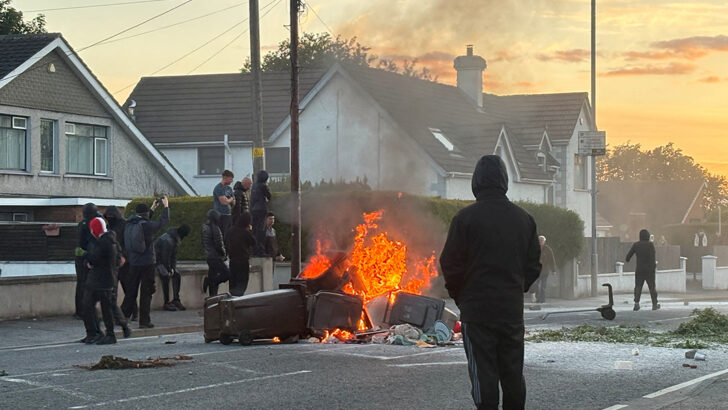 A fire burns in bins as anti-immigrant protesters clash with police at Antrim Road, following a knife attack on June 8, which left a man seriously injured and prompted police to declare a critical incident, in Belfast, Northern Ireland, June 10, 2026. Photo: OSV News / Isabel Infantes, Reuters.
 Christians in Belfast took to the hills last week – after violence and hatred erupted in our city once again.
Frankly, I was ready for the hills myself at the thought of returning to the bad old days when Belfast made headlines for all the wrong reasons.
But then, on the Feast of the Sacred Heart, a sign appeared on the hillside. Written in white on Black Mountain, was the name of Jesus – a reminder from some industrious Christians that Jesus, who is gentle and humble of heart, offers the loving solution to our disordered world. “A moment of hope!” was Bishop Alan McGuckian’s response.
The Bishop of Down and Connor was in Maynooth when Belfast man Stephen Ogilvie was savagely knifed, not far from the Bishop’s home and offices.
Stephen Ogilvie suffered horrific injuries and when it emerged that the suspect was from Sudan – there were disgraceful scenes, masked men, mostly youths, targeting family homes and businesses belonging to people who have come from other countries to live and work among us.
What a depressing sight to see vulnerable people leave their homes under police escort due to violence and intimidation.
“People,” said the Bishop, “who have lived among us for years as good neighbours, friends and co-workers are now living in terror, for themselves and their children.”
“They are our friends. As a community we must stand in solidarity with them.”
Evil
This evil has echoes of 1969 when families fled their homes in fear. My parish of St Michael the Archangel in West Belfast became home to many Catholics who had to flee other parts of Belfast through violence, or intimidation. One parishioner left with just the clothes on his back and another moved out of the predominantly loyalist Village after many anxious nights, sleeping beside a packed suitcase.
As a small child, in west Belfast, my parents moved me and my brothers to the back bedroom for fear of a petrol bomb coming through the front window. In 1971, we left for Canada though I returned in my twenties – and experienced the tail end of the Troubles. Frankly I could not face living through that again, the conflict in a new form, where people are targeted and scapegoated because of their skin colour, or creed.
Everyone suffers in this atmosphere. I had to cancel plans last Wednesday evening – a small thing compared to what others endured – as restaurants closed and many people stayed indoors. How tragic to hear that the Filipino community cancelled a community celebration, keeping their heads down, because they feared trouble.
Bishop McGuckian spent an hour at the Royal Victoria Hospital, offering solidarity and a listening ear to health workers who are from other countries and are living in real fear. “One poor man,” he told me, “spent the whole night peeping out through the blinds, just terrified of what could happen, that the door could be kicked in or the place set on fire.”
Others he learned had a sense of safety on their own street – but were afraid of being confronted as they travelled through the city to and from work.
Do not be overcome by evil, but overcome evil with good”
“I heard of networks of people in the population,” he said “ready on a WhatsApp group to go and pick somebody else up, and drive them home, or drive them to work. So there are some signs of just real grace at work as well.”
In conversation, the Bishop shared a “wee glimpse of hope”. “One of the priests was telling me that one of his parishioners, an African, went to fill his car at a petrol station. A car pulled up beside him. A man got out, filled his tank, and abused this man using the ‘N-word’ and speaking really, really, horribly to him and then went in to pay and a child in the car apologised to the man who had been abused for his father’s behaviour.”
Evil never has the last word. As St Paul tells us the Lord works for the good of those who love him and he instructs us Romans 12:21: “Do not be overcome by evil, but overcome evil with good.”
Bishop McGuckian challenged those who displayed the worst of human nature. “Shame on all those who have sought to mobilise, agitate, weaponise and politicise the fear and concerns of others over the last few days. All of us have a responsibility to de-escalate societal tension rather than stoke the flames of racism.”
Sadly there are some in our society who will not accept anyone who is different.
The fact is Northern Ireland has relatively few refugees or illegal immigrants compared to the rest of Ireland, Great Britain and Europe.
Immigration brings benefits but is not without its challenges and requires good governance.
Critics who complained about housing shortages – due to the dramatic rise in immigration south of the border – were too often dismissed as racist and far-right. But finally leading Irish politicians in the Dail are admitting the sharp rise in immigration is a significant factor in the housing crisis.
Of course there are ignorant people in Belfast and beyond, full of hatred for anyone who is different; they will not tolerate newcomers of any description. They are, I think, a minority, though a dangerous one.
At the same time, security should be a consideration when we open our borders. Having legitimate concerns about community safety is not necessarily racist.
Anecdote
I heard an anecdote this week about an alleged row between a Sinn Fein representative and a group of constituents. The politician robustly defended the right of newcomers to be here. But when challenged about people from other cultures carrying ceremonial knives, he supposedly retorted: “The knives are not sharp!”
If this account is correct, I’m not sure how reassuring that is.
Bishop Alan called on politicians, community leaders and statutory agencies “to listen and act”. “As a society we have a responsibility to address the real and tangible community concerns regarding safety and accountability, fears that demand honest, respectful attention.”
Some politicians and commentators, cloaked in political correctness, pretend there are no challenges in our midst from violent extremists.
Irish politicians lecturing us about “white privilege” and pretending racism is a one way street is offensive and unhelpful. Even former First Minister of Scotland Humza Yousaf – who complained, quite audaciously, about too many white people in senior positions in Scotland – now says that negative media portrayals of young men – and phrases such as “white privilege” – help to push youths in his own Glasgow constituency towards extreme online influencers.
Shame
At the same time we ought to feel shame at the way some newcomers, especially those of colour, are treated by some Irish people. “If we Irish, said the Bishop, “are like me, we feel almost a terrible sense of guilt that there are these people in our midst who are serving us, like an African nurse who left children at home – children that she would be worried about – to go to her work because of a sense of duty to her colleagues and to the patients, and it is they who are in danger.”
The Ogilvie family is a Christian family who have given us a wonderful example, calling for calm as they cared for their brother, even leaving his bedside to think of others. “Given what they are suffering,” said the Bishop, “gathering around their brother in the position he is in, they have been exemplary.”
We would all do well to follow their loving example and heed the words of the Psalmist and look to the mountain, from whence shall come our help – Jesus.