

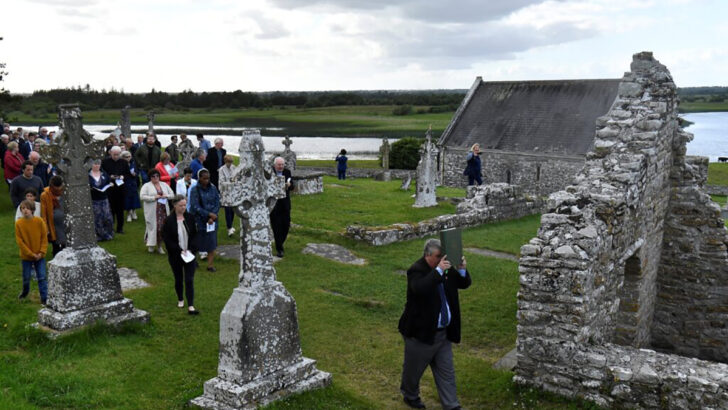
 A delegate holds a Bible leading a prayer walk at a pre-synodal assembly in the 6th-century ruins of Clonmacnoise Monastery in Ireland June 18, 2022. It was part of the universal synod convened by Pope Francis for 2021-2023. Photo: CNS / Clodagh Kilcoyne, Reuters.
 The future of the Irish Church
Last week we argued that the Irish Church is managing decline rather than deciding what it wants to become. The question left hanging was what a real answer would look like.
What we have actually done about the collapse in priest numbers can nearly be accounted for in three moves; ask priests not to retire if possible, recruit from abroad, cluster parishes into larger units. As a holding operation they make sense but none answers the question a priest in Kildare & Leighlin put to us plainly: “When that older priest with bad health is gone, who is going to replace him?”
Recruitment from abroad is the move nobody wants to interrogate too closely. In what was the Diocese of Elphin, well over half the priests are now from overseas, and fewer than twenty Irish priests under 75 remain. The Bishop of Clogher has said plainly that he intends to bring in more from abroad to cope. The stock defence of this practice is that we are only receiving back what we once gave — we sent missionaries out for a century, now missionaries come to us.
The comparison doesn’t hold. Irish priests went out to build dioceses; churches, schools, seminaries, and handed over as local vocations grew. What is happening here is not that. Priests arriving now are covering Mass rotas, cut off from the vigour of the young church communities they came from, often warmly received by parishioners and just as often not fully understood by them.
Resources
They look out at a population often barely catechised and have neither the resources nor, often, the standing to do anything about it. That is not a long-term solution to this crisis and where does it stop? What number of foreign priests turns an Irish diocese into something else entirely, led by a majority of clergy formed for a different Church?
The assumption that underpins clustering is that a Catholic detached from a priestless parish/closing church will attach to a nearby one. There is remarkably little evidence for this. No Irish diocese has published retention figures after a restructuring, which is itself telling. “People have no interest in going to someone else’s church,” one priest told us.
A lay source with long experience of parish life put it this way: “No one wants to be part of a parish of families that doesn’t hold on to their own identity.” Her read on the direction of travel is blunt: instead of 60 faith communities in a diocese there will be eight or nine, and “that looks and sounds like defeat, and they’re all doing it”.
Parishes are proud of their church, their history and their name. That pride is not sentimentality to be managed around. It is the social fabric holding a Catholic community in existence, and a restructuring that treats it as an obstacle works against itself.
It has probably already lost its bank, its post office and its Garda station, will the Church abandon it too?”
In France there is a discussion around the 30 years of parish reconfigurations, with some saying that these restructurings are now showing their limits, having largely gathered scattered communities together without addressing what was failing underneath. Albert Rouet, Archbishop of Poitiers from 1994 to 2011, made the argument at the time: parish groupings gather the already-convinced at one point while stripping other places of the forces they need to survive.
If a village loses its priest, shouldn’t we encourage it to stand alone rather than move itself sacramentally to the next parish? It has probably already lost its bank, its post office and its Garda station, will the Church abandon it too?
Futures
So what else is there you might ask? If a parish will not have a resident priest week to week — and many will not, within five years or less — it has two futures. It can be absorbed into a larger unit and slowly cease to be itself. Or it can be empowered to become a small faith community taking charge of its own affairs, with a priest responsible for a number of such communities, providing the sacraments and a measure of oversight.
The latter is not a radical proposal. It is provided for in canon law.
Canon 517.2 allows a bishop, where there is a genuine shortage of priests, to entrust a share of the pastoral care of a parish to a deacon or to a lay person, with a priest appointed to direct that care. American dioceses have used it for decades. The lay leader is installed in a liturgical rite in the parish, supervised by a priest, and supported by a sacramental minister who provides the weekend Eucharist. It keeps parishes open. More importantly, it keeps them themselves.
Around 60% of parishes and ecclesial groupings in the Amazon are now led by lay people, predominantly women religious”
It is also what Rome has already asked for. In Querida Amazonia, Pope Francis wrote that a Church facing this exact shortage needs “the stable presence of mature and lay leaders endowed with authority”, and that such services must carry stability, public recognition and a commission from the bishop. Around 60% of parishes and ecclesial groupings in the Amazon are now led by lay people, predominantly women religious.
In France one bishop built a network of local communities, each carrying its own responsibility through a core lay team called forth by that community, with a priest, from lay people as helpers of a priest around whom everything turns, to communities themselves responsible.
And the clock is ticking. Kildare & Leighlin has 16 permanent deacons and, by the bishop’s account, 25 lay pastoral ministry students entering the second year of a diploma. Being trained is not the same as holding an office. Bishop Nulty asks lay people to “step up into greater roles”. He names no role. A role is a thing somebody has to create.
Jobs
Presumably these pastoral workers, once they complete two years of training, will be offered actual jobs — and on a salary above minimum wage, say €40,000 each, 25 of them comes to €1 million a year. Nobody has said where that money is coming from. But the key question is what will they be asked to do, help in parishes or take on a greater lay role that has a basis in canon law?
An internationally respected canon lawyer put the choice to this paper directly. “I think the Amazon has indeed some of this, where lay persons do almost everything, even baptising, assisting at weddings etc.” Putting parishes together, in this lawyer’s view, is not the answer: “I think what is needed is a clear conversation on where to go. Putting parishes together is in my view not doing justice to the needs.”
The instrument exists in canon law. The theology has been written by a pope. The model has run elsewhere”
That conversation has not happened, and it will not happen between bishops alone. It has to happen between priests, bishops and laity, together, and soon.
That is what we are asking for. Not another map, but a decision about what a parish without a resident priest is permitted to become. The instrument exists in canon law. The theology has been written by a pope. The model has run elsewhere.
A priest in Portlaoise told us the pastoral areas need to become “more than colours on a map”. The colours are drawn. Somebody now has to decide what they mean for laity and clergy.