

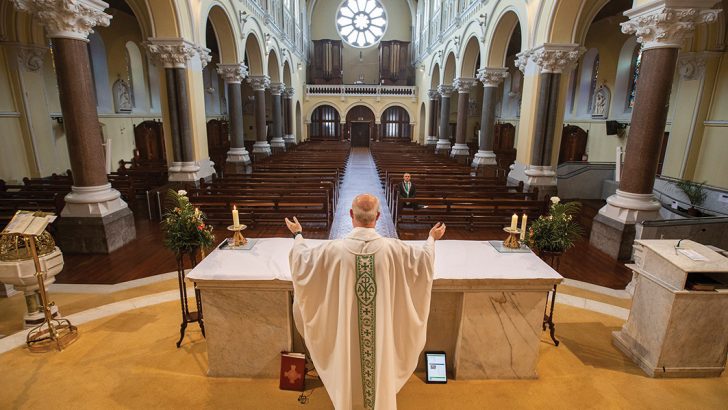
 Fr Michael Toomey’s offering Mass on RTÉ in an empty church has become an iconic symbol of the pandemic
 “The Synod is watering the garden, but the house is on fire.”
That is not The Irish Catholic talking. It is the verdict of an experienced parish priest in the Diocese of Kildare & Leighlin, a man who supports the synodal pathway and has given years to it, speaking after this summer’s appointments were announced. “Priests were very deflated when those appointments came out,” he told us. “It was grim. And I can’t say next year will be better.”
This newspaper is pro-synodal — if synodality means empowering the laity and easing the load on priests carrying far too much for far too long. But it has to mean dealing with realities as well as abstractions, however theologically weighty. Five years of synodal process, the same priest observed, and it would still be a surprise if anything came of it. That should trouble anyone who believes in the process, precisely because it comes from someone who does.
Bishop Denis Nulty’s pastoral letter of August 25 is franker than most documents of its kind. He names the age profile of his priests, many serving “long beyond the acceptable retirement age in the secular world”. He names the money, admitting that any conversation about reducing Masses carries “the fear of a reduction in income” — a sentence most dioceses leave out. He asks parishioners, unusually, to lower their expectations of their priest. And he has told his priests they may retire at 75 and hold their heads high, which matters because the feeling among ageing clergy is that stepping down in this crisis is somehow letting others take more of the burden and letting them down. That attitude in itself is a testimony to the dedication of priests. The priests we spoke to said the bishop has tried his best.
But Kildare & Leighlin has redrawn itself repeatedly: seven deaneries originally, then three, then clusters, and now 11 pastoral areas. Three reorganisations across three decades, and the diocese has arrived at this point anyway. One priest pointed us to projections made in 1998 that looked twenty years ahead. The numbers were known. “We knew it was coming,” he said, “but the boot is on our throat now.” Successive restructurings haven’t worked, they just buy a little more time.
The figures the Bishop’s letter doesn’t give, is that Kildare & Leighlin currently offers (approximately) 124 Sunday Masses and 59 Saturday vigils — roughly 183 regular weekend Masses, every weekend, across 117 churches and 56 parishes. That is more than three per parish and close to seventeen for each pastoral area. That has to be carried by a presbyterate the bishop himself describes as including priests ageing well past retirement. And that’s only Masses. A K&L priest, asked what he does beyond the altar, listed the schools, the funerals, the sick calls, the care of the bereaved and housebound, and the community duties that attach to the office whether or not anyone asked whether they should. Reduce the number of priests and none of that reduces. It redistributes onto fewer and older shoulders.
When this newspaper rang parishes across the diocese, a considerable number of priests declined to comment or referred us to the bishop’s letter. Priests have many reasons for not talking to reporters but perhaps many are tired of talking about it and want vision. Those who did talk described uneven pressure — less pronounced in rural south Carlow, sharper in the urban centres — and pastoral areas still too new to assess.
Underneath all of it sits a design fault that long predates the shortage. “The priest should never have been placed in a position of so much responsibility,” a lay source told us. “He didn’t have to be the chair on every committee, board, etc. The accountant, the therapist, the parish manager.” The result, she argues, is an exhausted priesthood and a passive laity that will not act until it is too late.
Bishop Nulty sees this, which is why he asks parishioners not to make unreasonable demands. But an overloaded role is not eased by good manners. And a diocese staffed substantially by men in their seventies and eighties cannot ask them to serve as change managers. That is not a criticism of those men. It is a description of what we are asking of them.
The house is on fire. Next week we will try look at ways of quenching the blaze.