

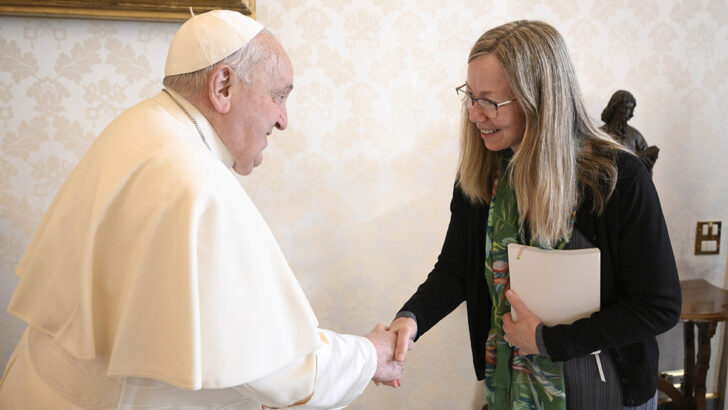
 Pope Francis greets Lorna Gold, recently after her appointment as executive director of
the Laudato Si’ Movement, during a private audience at the Vatican on January 30, 2025.
Photo: OSV News / Vatican Media via CPP.
Pope Francis greets Lorna Gold, recently after her appointment as executive director of
the Laudato Si’ Movement, during a private audience at the Vatican on January 30, 2025.
Photo: OSV News / Vatican Media via CPP. One year on from the passing of Pope Francis, the world feels, in many ways, more fragile than it did when he left us. Conflict has deepened in parts of the Middle East. Political discourse has hardened, with the rise of polarisation, nationalism and, at times, outright hostility. Multilateral cooperation—so essential to addressing global crises—appears increasingly strained.

And yet, to stop there would be to miss something vital.
Because if we step back—if we take a longer view—we begin to see that Pope Francis did not leave behind despair. He left behind a framework for hope. Not a naïve or sentimental hope, but a grounded, demanding, deeply human hope—one rooted in action, solidarity and a reimagining of how we live on this Earth.
At the heart of that legacy stands Laudato Si’—a document that has moved far beyond the boundaries of the Catholic Church to become one of the defining moral texts of our time. In it, Pope Francis named what many had sensed but struggled to articulate: that the ecological crisis, the social crisis and the spiritual crisis all share a “common root.” We cannot solve one without addressing the others.
This was his great contribution: not simply to call for environmental protection, but to invite humanity into a deeper transformation—what he called “ecological conversion”. A shift not only in policies, but in lifestyles, values and relationships. A recognition that ‘enough’ is not about scarcity, but about balance; not about deprivation, but about dignity.
In the year since his death, that vision has not faded. If anything, it has taken on a new life.
Much of this continuity can be seen in the early actions of his successor, Pope Leo XIV. From the outset, Pope Leo has signalled clearly that the path charted by Pope Francis is not being abandoned, but deepened.
One of the most striking moments came at the ‘Raising Hope’ gathering in October last year. By choosing to attend in person—and by participating in a simple yet powerful symbolic act, placing his hands on a fragment of melting glacier ice from Greenland—Pope Leo sent a message that resonated far beyond the room. It was a gesture that reached tens of millions: a visible sign that the Church’s leadership remains committed to confronting the ecological crisis with urgency and moral clarity. In a moment of global uncertainty, this quiet reassurance spoke volumes.
They are not just reflecting on environmental issues—they are celebrating a renewed relationship with God’s creation”
But symbolism alone does not sustain a legacy. What matters is whether it is translated into relationships, structures and action.
Here too, there are clear signs of continuity and growth.
Pope Leo’s early engagement with Ecumenical Patriarch Bartholomew I—often called the ‘Green Patriarch’—points to an approach grounded in dialogue, unity and shared responsibility. In visiting Constantinople and strengthening ties with the Orthodox Church, he has reaffirmed that care for creation is not the task of one tradition alone, but a common Christian calling, and indeed a shared human one. Likewise, his meeting with King Charles III had a strong focus on collaboration on environmental issues.
Another significant development has been the approval of a new Mass for Creation. While still evolving, this liturgical step matters. It signals that care for creation is not an ‘add-on’ to the life of the Church, but something to be woven into its very prayer, its rhythms and its imagination. When communities gather on the World Day of Prayer for Creation each September, they are not just reflecting on environmental issues—they are celebrating a renewed relationship with God’s creation.
Legacy
Perhaps even more striking has been the emergence of strong leadership voices from the Global South within the Church. In the past year, groups of cardinals—many appointed by Pope Francis—have spoken out with unprecedented clarity on the need to move beyond fossil fuels and to challenge economic systems that exploit both people and planet. Many are supporting the call for a new Fossil Fuel Treaty as a way to manage the transition to clean energy.
Their joint statements ahead of global climate gatherings, including COP30, mark a shift in the Church’s internal dynamics. The moral authority of communities already experiencing the frontline impacts of climate change is coming to the fore. This is not simply a change in tone—it is a rebalancing of perspective.
And on the ground, the movement inspired by Laudato Si’ continues to grow.
Across continents, ordinary people—parish groups, schools, religious communities, grassroots leaders—are taking up the call to ecological conversion. They are divesting from fossil fuels, restoring local ecosystems, advocating for policy change, and building new forms of community rooted in solidarity and care. Here in Ireland, the Church is embracing this change through initiatives like the ‘Return to Nature’ programme. What began as a papal encyclical has become a lived reality in thousands of places.
Hope was a choice—a discipline, even. It required honesty about the scale of the crisis, but also courage to act despite it”
This may be Pope Francis’ most enduring legacy: not a single institution or initiative, but a movement. A vast, interconnected web of people committed to living differently—and to doing so together.
It is also a legacy that is deeply needed now.
Because the truth is, the crises we face have not diminished. If anything, they have intensified. Climate impacts are accelerating. Inequality remains stark. Conflict continues to fracture societies. In such a context, hope can feel like a luxury.
But Pope Francis never presented hope as something easy. For him, hope was a choice—a discipline, even. It required honesty about the scale of the crisis, but also courage to act despite it. It meant refusing both complacency and despair.
And perhaps most importantly, it meant recognising that change is possible.
In a world that often feels stuck—locked into patterns of consumption, division and short-term thinking—Pope Francis insisted that transformation can come. That systems can shift. That hearts can change. That a different future is not only necessary, but achievable.
One year on, that message still stands.
Signs
The path ahead will not be simple. The Church itself continues to wrestle with how best to embody this vision—how to integrate care for creation into all aspects of its life, including liturgy, how to speak prophetically while remaining in dialogue, how to lead by example in a complex and often resistant world.
But there are signs—real, tangible signs—that the seeds planted by Pope Francis are taking root.
This is what a legacy of hope looks like. Not a finished project, but a living journey”
In the leadership of Pope Leo XIV.
In the voices of the Global South.
In the growing unity across Christian traditions.
In the quiet, persistent work of communities around the world.
This is what a legacy of hope looks like. Not a finished project, but a living journey.
And the question now is not simply how we remember Pope Francis—but how we continue what he began.
Because ultimately, his legacy was never meant to be admired from a distance.
It was meant to be lived.