

 Peter Costello
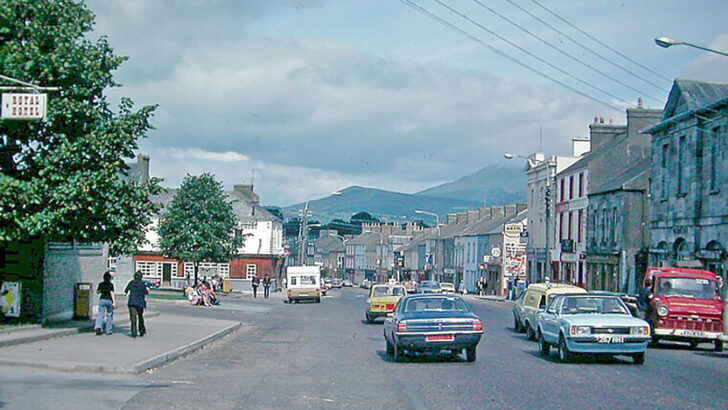 Cars passing through modern Mitchelstown. Photo: Ben Brooksbank / wiki commons
 Building Mitchelstown 1779-1830, by David A. Fanning (Maynooth Studies in Local History / Four Courts Press, €12.95 / £11.95)

These days my experience of Mitchelstown is of a place that one passes through on the way to somewhere else more interesting.
That this is an unfair estimation is revealed in this pamphlet by David A Fleming, a professor in the school of History and Geography at the University of Limerick. He is well aware of the problems of the late Georgian period in Ireland, in social, political and religious matters. Previously he was the author of a biography of an 18th-century person, Edmund Sexton Pery; here, however, he turns his critical attention to a place.
He begins his study by pointing out that Mitchelstown, Co. Cork, is one of over 750 Irish towns built or remodelled between 1690 and 1840, a very distinct period in the emergence of early modern Ireland.
We will have all seen that even on the briefest of contact there are some towns notable for their nature; I think of Adare, Tullamore, Athlone, Castlebar: aspects of their emergence and evolution marks them distinctly. So what made and sustained this Cork town?
Story
The story of the town’s origin and development is a story of the ambitions and desires of the King family, eventually ennobled as Kingsborough, as a model town with an attached domain for the Viscounts. The theme of Fanning book is that their initial development led to increasing opportunities for others, first in the building trades, later in the merchant class, which was increasingly a source of influence for the rising Catholic middle class after 1800 leading to the emancipation act of 1829. For many of them wealth moved from land to services, from grazing to distilleries, from growing turnips to brewing beer.
Fanning has carefully trawled the available records of many kinds (which for this period are at least reasonably well preserved), and is able, on an interesting, almost street-by-street basis, show how the town emerged.
He takes the story as far as 1830, but by then the nature of Irish society was changing the aristocratic eras were coming to a close, the Catholic merchant class (later to be described by a rising working class, “the plain people of Ireland”, as “gombeen men” by the time of Parnell and his party.
Having spent his money on his printers, he died of typhus contracted in the debtors’ jail in Dublin two years before he would have inherited the family fortune”
Fanning’s account is, in a way, the story of many Irish towns, and his investigations and observations will I suspect prove inspiring for those who might be thinking of writing similar short accounts of some of those other towns mentioned above. But many of those merchant families are now themselves a thing of the past, as the horizons of wealth making in modern Ireland have changed so completely. They, too, were so to speak, merely passing through on the way to somewhere else.
(To a bibliophile like myself the family is of interest because of the enthusiasms of Lord Kingsborough (1795-1837), the creator of The Antiquities of Mexico (1831) which reproduced in colour the set of the ancient Aztec manuscripts., not for their own interest, but to prove his Lordship’s theory that America had been settled by the Lost Tribes of Israel.
His fixation is a curious tale in itself which has never been told in detail. Having spent his money on his printers, he died of typhus contracted in the debtors’ jail in Dublin two years before he would have inherited the family fortune.
Strange the channels into which wealth from Irish land was streamed. Some years ago in the National Library I got out one of the nine “elephant” folio that made up this book, and it proved to be almost too large to handle. I doubted from the dust that they had been much used since the 1890s, if ever.)