

 Peter Costello
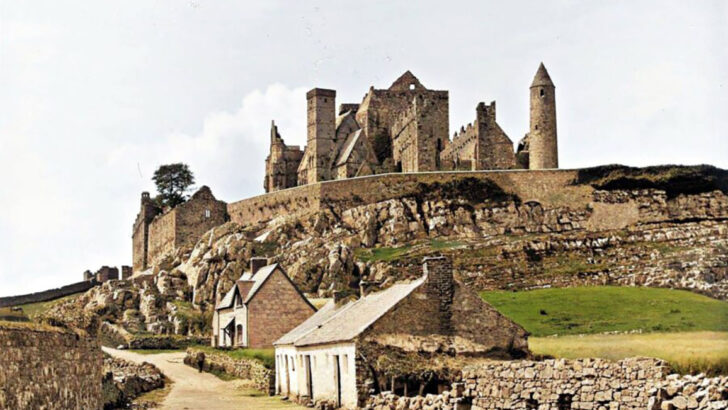 37.01 - The Rock of Castle, now in the care of the OPW, as it was in Queen Victoria’s day
 Irish Heritage Studies: The Annual Research Journal of the Office of Public Works, vol. 1, 2025, Edited by Caroline Péguy (Office of Public Works / Gandon Editions, €20.00 an issue)
When the Irish Church Act took effect in 1871 there was rejoicing in Cashel. Now at last when Queen Victoria (in the shape of her Commissioners of Public Works, now the Office of Public Works, had taken over the many properties of the Church of Ireland; the local people imagined that their cathedral looming over their houses atop the great Rock of Cashel would be reroofed and opened again, even to welcoming the Mass.

Songs were composed celebrating the Queen after the fashion of the long-established vision poem. Ballads abounded. Many years ago I went in search of these in the Traditional Music archive. The librarian’s assistant aiding me doubted whether any such compositions existed. But beyond the third item on the index she produced was indeed a popular song celebrating Victoria.
Misunderstandings about the effect of legislation are a common place in our history. And the role of the Office of Public Works (as it is now), which is sometimes maligned and misunderstood, the cost of bicycle sheds excoriated. It certainly builds things, but its main role in heritage is in preservation; the total restoration of Cashed Cathedral was never to be mooted,
It is attractively produced, with full colour illustrations, and will stand out among the other journals we are so familiar with”
Because so much of what the OPW does is misunderstood, this new journal, the first issue of which, created by Gandon Editions, has just appeared, is therefore to be welcomed. This is however no mere vanity enterprise: the contributions are peer reviewed, so it will be in a position to attract articles from young scholars eager for publication. It is attractively produced, with full colour illustrations, and will stand out among the other journals we are so familiar with. It is an excellent use of public money.
It contains some nine articles of varied length, and worth, but there is value in all of them. The issue at hand opens appropriately enough with an article relating to the Rock of Cashel, a discussion by Thomas P. Nelligan of “Theology and politics in Cormac’s Chapel: renewals, reform and reimagination in the twelfth century, pointing out that a state of change was a factor even in what so many think of as the unchanging medieval church.
But what is most appealing about the issue is the sheer variety of material. I would have some qualms about Mairéad Carew’s article on R. A. S. Macalister, in which he is characterised as an “antiquarian”. This is surely an extreme epithet to use about a scholar experienced in Palestinian archaeology before he came to Ireland, who was the post scientific archaeologist of his day in Ireland. True the second edition of his Archaeology of Ireland (1947) was something to be regretted; but his more popular book Ancient Ireland (1935) was in its time an important book for the educated class in Ireland seeking a more mature approach to Ireland›s past that is provided by other popular more patriotic accounts.
Approaches
But there are other kinds of approaches in the book as well. Many will be attracted by Brian Crowley’s discussion of how Constance Markievicz turned her prison prayer book into a revolutionary memorial by pasting into cuttings related to the struggle for independence.
For those who are deep into the lore of ancient Dublin rather than ancient Ireland, Neil Moxham’s essay “St Audoens’s Church, Dublin: a century in limbo” makes fascinating reading. All too often, Dublin was neglected by both the government and the OPW in favour of the provinces. He puts the matter into context.
Also unusual in its content is Audrey Walshe’s account of the “decolonisation and reinterpreting of the National Botanic Garden” is of great interest. One two recent visits, however, we found that the labelling and mapping of the plants and trees could be improved: we spent two rainy days in a rather unfruitful search for the trees we wish to see that came from Patagonia!
So the journal provides materials for many sorts of interests, and on this showing, one looks forward to the next issue.