

 Peter Costello
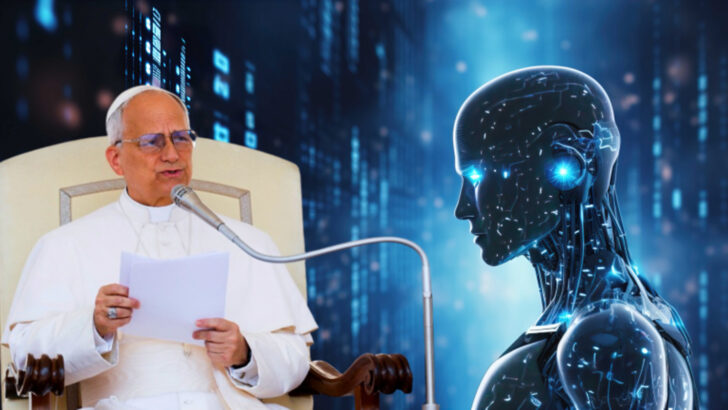 Pope Leo confronts the rise of AI. Photo: Radio Verias Asia.
 The first encyclical letter of Pope Leo XIV opens with a focused expression of what the pontiff has to say: “Humanity, created by God in all its grandeur, is today facing a pivotal choice: either to construct a new Tower of Babel or to build the city in which God and humanity dwell together.”
He brings to the attention of his audience, which will include not just Catholics and Christians worldwide, but “all persons of good will”, important reflections on a very present crisis.
The encyclical is cast in the traditional form of such documents, using images from the scriptures to focus on a problem of the immediate moment. In this case, he invokes the image of the Tower of Babel (Genesis 11:1-9) and the building of the new city wall of Jerusalem (Nehemiah 1:1 – 7:73).
“Therefore, the primary choice is not between a ‘yes’ or ‘no’ to technology, but rather between constructing Babel or rebuilding Jerusalem; between a power that claims to dominate the heavens and a people who work together in the presence of God to rebuild the walls of fraternal coexistence.”
Echo
At the heart of this letter there is surely an echo to found of the influential encyclical of Leo XIII Rerum Novarum (‘New Things’) back in 1891.
The Pope’s conclusion is not a negative one, but a reflection of what can be achieved by the human mind. He urges his audience to take part in influencing the course of change; he alludes again to Nehemiah on the building of the walls of Jerusalem as a collective task.
The Pope is calling not for insane competition, but of a collective work for the good of all humanity”
“In this era of digital transformation, I see in him a striking parable of our own vocation, which is not to be passive spectators of social and cultural fractures, nor mere commentators on what is crumbling, but men and women prepared to enter the construction sites of history — research laboratories, technology companies, schools, the media, institutions and local communities — in order to rebuild what has collapsed and protect what is threatened. Like Nehemiah, we too are called to unite listening and courage, prayer and responsibility, so that, even when a technocratic mentality or partisan interests seem to prevail, the human city may become a more fitting place to live.”
The Pope is calling not for insane competition, but of a collective work for the good of all humanity.
What we have to watch out for though is what those working in the area actually say.
The other week in Washington DC an awards ceremony was held at which the leaders in the field of AI congratulated each other on what they were doing. AI is seen by the Pope as a good thing if used with wise prudence. This was not the tone of many of those at this Washington event.
According to a report from NBC television: “The Vatican’s incoming ambassador to Washington, Gabriele Caccia, fought to be heard during his opening speech. ‘At every stage, the development and application of artificial intelligence must be guided by the dignity of the human person, by the common good of the human family,’ Caccia said over the din of clattering silverware and business-card swapping.”
A little while before the Nuncio spoke, the diners had heard from the US Army Secretary Daniel P. Driscoll, an Irish-American from North Carolina, who said AI was helping the US military “exponentially accelerate the kill chain.”
Military
He added that the military was eager to join forces with private-sector companies crafting today’s AI systems so as “to build the tools that enable our soldiers to see farther, decide faster, and strike harder than any adversary anywhere on the Earth at any time.”
It is that kind of sentiment from the heart of the present administration in the United States that should warn us that those in power in Washington do not see the world as the American-born Pope does. The Pope’s great aim in his new pontificate seems to be efforts to promote peace, co-operation and community.
These days one cannot avoid the presence of AI: it is the first thing that appears now when seeking information, even if in the end it sends one back to Wikipedia”
I am far from an expert on all that is said and done about AI. But I have found it, in my tasks, not to be the wonder worker some think it is. Perhaps my personal experience is distorted. But here it is.
These days one cannot avoid the presence of AI: it is the first thing that appears now when seeking information, even if in the end it sends one back to Wikipedia.
I was trying to check a literary allusion to the small boy who brought his mother a posy of flowers from the land around their house, saying happily that “The woods are full of them”. This expression became an American catch-word. When the proffered AI response came up, I knew it was not just incomplete, it was wrong.
I fell back, as I often do, on Bartlett’s Familiar Quotations. There it was in 11th edition from 1937. What AI failed to find, Bartlett presented at once. The expression comes from the preface by Alexander Wilson (d. 1813) to his American Ornithology [1808]. I closed the book with pleasure: clearly in the age of AI the printed page was still triumphant, which was a relief to a book-lover like me.
So despite the claims that AI is devouring all printed information in the course of its ‘training’, despite those trillions of words and millions of books, it had still failed to absorb Bartlett’s Familiar Quotations, which P. G. Wodehouse once claimed was the most essential book of reference that a writer could have by his desk. This trivial episode says a lot, to me at least, about the inadequacies of AI.
So we should all of us who value the records and achievements of humanity attend to the Pope’s warnings in his encyclical, which come at a more serious level. Those of us who have no desire “to exponentially accelerate the kill chain” can take heart from Pope Leo’s preferable insights.