

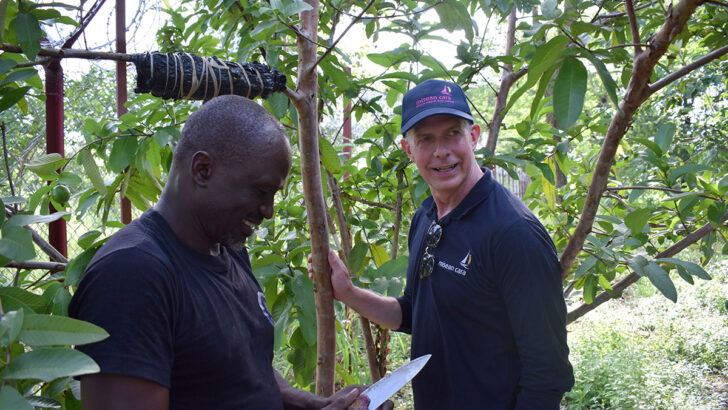
 John Moffett (right) observes an organic root propagation demo at the Multi-Educational Agricultural Jesuit
Institute (MAJIS) in South Sudan, funded through Misean Cara.
John Moffett (right) observes an organic root propagation demo at the Multi-Educational Agricultural Jesuit
Institute (MAJIS) in South Sudan, funded through Misean Cara. The morning sun beats down on the city of Wau, South Sudan. In a modest classroom with yellow concrete walls at the Catholic Health Sciences Institute (CHSI), rows of smiling nursing students await the day’s lesson. They are studying anatomy and midwifery, gaining the skills to serve their country, where maternal mortality rates remain among the highest in the world.

Sitting among them is a visitor — John Moffett, CEO of Misean Cara — smiling as he listens to their stories and hears about the work being done to strengthen local healthcare.
Since 2010, the CHSI, run by Solidarity with South Sudan, has trained nurses and midwives who now serve in hospitals and NGOs across the country, with 92% of its graduates currently employed. For Mr Moffett, scenes like this embody the new face of the Irish missionary tradition.
“There’s a real evolution,” he told The Irish Catholic. “Sometimes it’s presented as awful that there are no more Irish people joining missionary organisations, that they’re all getting old, that the whole movement is going to die out. I think that’s the wrong way to look at it.”
From Ireland to the world
For the past five years, Mr Moffett has led Misean Cara and visited numerous mission projects — seven in total, with South Sudan being the most recent. He believes the missionary story is far from over.
“Anywhere Irish missionaries have gone,” he said, “their intention has always been to set up a congregational base that will draw people in, not exclude them. They’ve left behind really strong structures embedded in communities that can continue to carry on the charism of the congregation and build on that positive legacy.”
Founded in 2004 with the support of Irish Aid, Misean Cara was created to connect the experience and networks of Irish missionaries with public funding. Two decades later, it supports 77 member organisations across Africa, Asia, and Latin America.
“It won’t be white people with Irish voices doing the development in the future,” Mr Moffett said. “It’ll be the people they’ve worked with over a long period of time, the people they’ve built up trust and engagement with. That strong charism and desire to do development work based on their faith continues.”
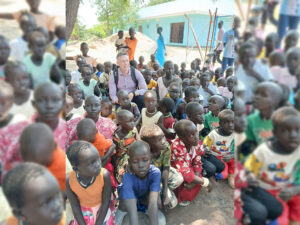
School in Akol Jal, South Sudan, supported by
Misean Cara via Irish Jesuits International.
The change is sometimes cast, as in RTÉ’s recent two-part documentary The Last Irish Missionaries, as the sunset of a heroic era. The programmes honoured that tradition but asked: who will carry the mission forward?
What Mr Moffett makes clear is that this evolution is not a clean break but a renewal. “In some ways it is sad,” he said, “but this is not an ending — it’s a new chapter.”
Snapshots of hope
On his various visits, Mr Moffett has been able to witness the ongoing arc of missionary impact.
“Yeah, I mean, there are examples of that, even from South Sudan,” he said. “Girls who’ve gone through the Loreto School in Rumbek and have then been able to go to Kenya, which, if you’re in South Sudan, is like getting into Cambridge. They come back and teach in the same programme. It’s that cycle of receiving something of benefit and giving it back to others. That’s ingrained in the missionary approach.”
Such stories are common across the Misean Cara network — former students becoming teachers, patients becoming nurses, communities rebuilding themselves. Mr Moffett described this as the “pastoral approach” at the heart of mission.
“The evidence that we have seen over that evolution over a number of years,” he said, “is that same spirit and desire to do development work based on their faith continues. We see really well-qualified, professional people who have taken up religious orders continuing to do very strong, positive work across Africa. The only difference is they’re from Africa, Asia, or Latin America, and they’re continuing to work in the places they’re from.”
When funding gets cut to missionary groups, they don’t have a choice either, they have to stay. They’ll continue to do their best”
He added: “It’s those shared values that inform Irish society today that have come from a Catholic social justice teaching tradition, which we would hold to very clearly as a society, that kind of create that opportunity for us to continue to find resonance with the work that our friends and colleagues in their missionary organisations or congregations continue to do.”
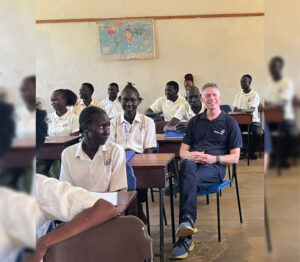
at the Catholic Health Sciences Institute in Wau, run
by Solidarity with South Sudan. Photos: Courtesy of
Misean Cara.
In contrast to short-term projects, missionary-founded initiatives often endure through uncertainty.
“When funding gets cut,” Mr Moffett explained, “NGOs don’t have a choice, they have to leave. But when funding gets cut to missionary groups, they don’t have a choice either, they have to stay. They’ll continue to do their best with the resources they have. They’re incredibly efficient, incredible value for money, and they work for and on behalf of the community. That’s their driver, not the funding.”
Looking forward
As Mission Sunday (October 19) approaches, Mr Moffett reflects on how the organisation continues to evolve after marking its 20th anniversary last year. It is not nostalgia that drives this reflection, but conviction, a belief that the Irish missionary spirit endures through transformation.
“Good practice in development is that you’re looking to the future,” he said. “You have to be constantly flexible and adaptable. The context changes, and the way our members work changes. We have to evolve to meet the needs of the time.”
This adaptability, he believes, is the legacy Irish missionaries handed down to the global Church, a faith that acts, stays, and serves.
As Misean Cara looks to the years ahead, it does so not to look back, but to recognise the living legacy that continues to grow. The missionaries of today may no longer come from Ireland, but they carry forward the same flame.