

 Peter Costello
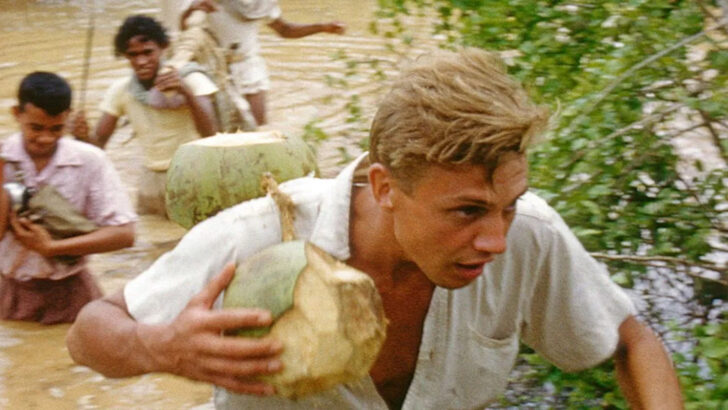 The young David Attenborough on an early expedition in the East.
 The centenary of Sir David Attenborough has been marked with tributes around the globe, wherever indeed his various full-colour television series on the natural world since 1979 have been shown. These have done a great deal to arouse in many people a passionate interest in the world around us. The tributes were certainly well deserved.
But there is an earlier black and white Attenborough, who is often overlooked, certainly in these centennial tributes. He joined the BBC in 1952 and was immediately thrust into the running of the then celebrated TV show, in those toddler days of television, Animal, Vegetable or Mineral, chaired by the archaeologist Prof. Glyn Daniel.
But the programme which brought Attenborough to public attention was the series he initiated called Zoo Quest. An outcome of these series was a series of books written by Attenborough and illustrated often with his own photographs from the Lutterworth Press. This firm, then a dozen years old, had evolved out of the Victorian publishers, the Religious Tract Society (which sought the support of every Christian group, except Unitarians and Catholics).
Asked years later by Gay Byrne on the Late, Late Show about his religious beliefs, Attenborough said he saw science as one kind of language and philosophy (which would include religious belief) as another. He was reported later on as saying that he was an agnostic rather than an atheist: he had simply “never thought about believing in God”.
However, as his father came of a devout Methodist family, we might perhaps question this, given the academic background and liberalism of his parents – his mother was a supporter of votes for women and was involved in helping refugees from Spain and from Germany in the 1930s.
But when his first book appeared in 1956, it was published by Michael E. Foxell at Lutterworth Press, who are still involved in the rights to Attenborough’s early writings. This connection may have arisen naturally from Foxell having other BBC connections (he produced the first Blue Peter Annual, a landmark event in British middle-class culture); but the firm itself sought to publish “wholesome” readable books, avoiding anything risqué.
Later on, in 1975, The Tribal Eye was both a mini-television series and a BBC book, based on his collection of tribal carvings and artefacts which he had collected on his travels and which still fill his house in Richmond, near Kew.
The Life on Earth films deal with animals and nature; but other parts of Attenborough’s own life have explored the more spiritual, imaginative and religious aspects of humanity’s life on earth”
He was a friend of the anthropologist Audrey Butt of Oxford University – an eminent student of man who is also 100 this year. She is an expert on the religious beliefs of the South American Indians, with their mingled of tribal beliefs with imported Christian ideas, for that very first expedition. This side of Attenborough, dealing with humanity on earth, so to speak, an aspect of the world which seems to have been overshadowed by the huge success of the long Life on Earth series.
The Life on Earth films deal with animals and nature; but other parts of Attenborough’s own life have explored the more spiritual, imaginative and religious aspects of humanity’s life on earth.
I suspect that he really has more experience of the religious experience and philosophical insights of non-technical people than has been so far revealed by his programme making. Perhaps we will hear more about this in Sir David’s second century.
Fluent in the language of science, it seems that Sir David has already taken his first steps in learning the very different language of philosophy, art and the deeply human impulse towards the spiritual.
David Attenborough’s book The Tribal Eye (BBC Books, 1975, £25.50) is still widely available, but not the video series.