

 Peter Costello
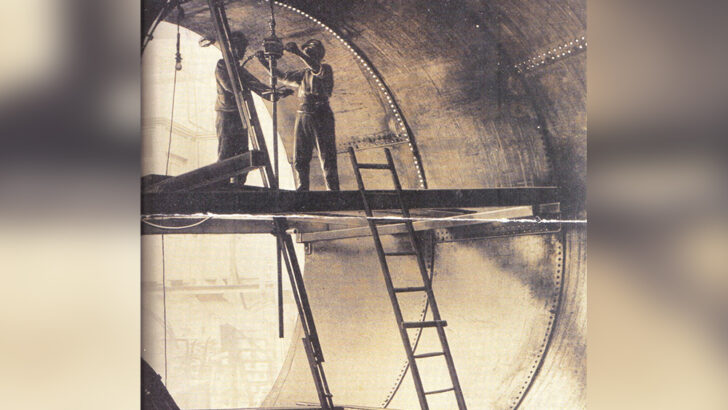 Workers on the Shannon Scheme begin the task of creating a new Ireland. Photo: National Archives.
 The Story of Us: Independent Ireland and 1926 Census,
Edited by Orlaith McBride and John Gibney
(Irish Academic Press, €24.99 / £22.99)
This book, prepared to accompany the release of the forms from the Irish Free State Census in 1926, is surely misnamed. What in fact is the communal collective of the title intended to describe?
We live in an Ireland where Irish-Nigerian children delight in the joys of playing Gaelic games; where Sikh businessmen and their families attend a temple in Sandymount, and where Galway city in the heart of the West of Ireland has its own Muslim mosque. This book does not deal in any real way with the largely urban, largely middle class, increasing professional population of Ireland today.
Naturally enough one turns the pages and scans the index to seek out what it exposes about the life and character of religion on that day”
What it does do though is show us what the newly independent state was like. In a strange way one illustration, the picture of a group of families helping a neighbour take in his harvest, reminded me surprisingly enough of the Ireland portrayed in John Ford’s much-loved film The Quiet Man.
This was how things were on the evening of the April 18, 1926. The book consists of some 29 essays or commentaries on various aspects of the census and what it reveals.
Naturally enough one turns the pages and scans the index to seek out what it exposes about the life and character of religion on that day. In this respect three articles are of special interest. One by Gregory Walls, on language, politics and religion in 1926 census; Andy Bielenberg on the minority population in the south of Ireland between 1911 and 1926; and finally Terence Dooley on the Anglo-Irish aristocracy in the 1926 census – the Earl of Granard filled up the form for his household on a typewriter, a rare thing in any Irish household in those days.
There is also a topical essay by John Gibney of the Royal Irish Academy Irish Academy about inward migration in 1926. This discusses an Italian family in a rural town who ran a fish and chip shop – as did many of the Italians in Ireland. Many came from one district of Italy.
(I understand though that much later when a researcher was planning to write a history of this community, he was awarded a grant so long as there was no discussion in his text of their politics. There were in this period regular black-shirted Italian Fascisti in the country then, a group of which would walk in the funeral cortege of Kevin O’Higgins slain the following year. The complications of politics in Ireland were then a well-established matter.)
Emphasis
The emphasis is on rural life, which is understandable given the date. But the city of Dublin is represented by an essay on 16 Diggers Street and another on Marlborough Street. This hardly covers the conurbation of Dublin at that date. One wonders why there is no coverage of Rathmines or Drumcondra, no essay on the inhabitants of the mansions on Shrewsbury Road (or indeed Cross Avenue).
But we have to recall as well that this was in Ireland in recovery, hinted at in a photograph of O’Connell Street showing Clerys flourishing “monster store”, but in the background rise steel framework of what must be the Hamman Building (on the site of the Hamman Hotel, a Republican garrison in the civil war).
These speak to modern industrialisation: an essay by Rob Goodbody on this all too often neglected aspect of Ireland since the 1860s as shown in the 1926 census, is illustrated by two metal workers in Joe McGrath’s teams building the Shannon Hydro Electric Scheme. This would lead to the electrification of rural Ireland, a total lifestyle transformation in the coming decades.
In the Dáil the Minister responsible for this scheme referred to by his critics as Paddy McGilligan’s “White Elephant”, answered back by promising that there would be “free electricity” in ten years; so there would have been have been if people had not discovered all the things they could with electricity, like illuminated advertising displays along the upper levels of the streets of central Dublin.
The catch-all determination of “Non-Catholic” had also decreased by 32.5%. which covered Anglicans, Presbyterians, Methodists, Jews and Baptists”
To return to the matter of religion in 1926. These forms were filled up that night in 1926. The tabulated data from them was released, however, in 1929 by the Central Statistics Office, in “volume III, part 1: religions” of their report on the Census. (This data, long in the public domain, can now also be read online).
This showed there were 2,761, 269 Catholics, a decline of 2.2 % since the last census in 1911, due to emigration, of course. The catch-all determination of “Non-Catholic” had also decreased by 32.5 %. which covered Anglicans, Presbyterians, Methodists, Jews and Baptists.
But there is a final category under religion of some 719 “other” – how one wishes this sector had been more carefully categorised. I suppose it must have included the shadowy number of those of “no religion” who are now so prominent in our social life.
However, protestant doctors and professional people left the Free State because they had come to believe that under the new Irish government they would have to carry on their work through the Irish language, which they felt unable to do.
Few and far between are the Irish language documents one sees in the annual release of state files”
The idea that the administration would be in Irish was a mistaken one, as by and large the civil service and life in general continued to operate in English, as it still does to a large extent; indeed few and far between are the Irish language documents one sees in the annual release of state files.
What is left largely undiscussed in detail in these pages is the increasingly urbanised, increasingly middle-class Ireland that was clearly in the making – now that would have been the story of us.