

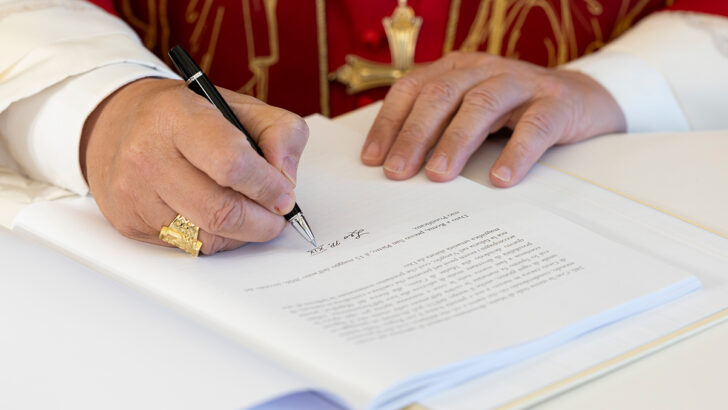
 Pope Leo XIV signs Magnifica Humanitas at the Vatican’s Synod Hall on May 15, 2026, the first encyclical of his papacy, which focuses on the rise of artificial intelligence. Photo: OSV News / Simone Risoluti, Vatican Media.
 Magnifica Humanitas poses the question: What does it mean to be a flourishing human being in a time of AI? This letter is not a neutral consideration of that question, any more than the technologies of today embody neutral worldviews. This encyclical brings the vision of the Gospel to bear on the cultures of AI. In doing so, it warns of a growing culture of power that is reshaping work, family, education, and political life. It calls us to transform dominating modes of power into forms of shared power, and to measure technological developments by their contribution to true social and ethical progress.

Eleven years ago, Laudato Si’ called us to an urgent care for the earth and the poor, warning of a technocratic paradigm that measures human worth by utility. Today, Pope Leo makes clear that to overcome this paradigm and exercise this care for the earth and the poor requires us to urgently safeguard the human. An integral ecology requires an integral humanism centred in Jesus Christ.
Platitude
This appeal is no mere platitude. No idea is more central to modern society, law or politics than that of the free human being. Yet this ideal is now at breaking point, and our “relationship with life is in crisis”. This leads some to grief or despair. In others, it induces a desire to overcome our humanity, striving to become our own gods.
Instead, Magnifica Humanitas presents human freedom as a gift anchored in a truth that is personal, embodied, and relational. Our freedom and intelligence express themselves through a knowing and loving that is irreplaceably embodied – through care, work, contemplation, suffering, and friendship. The encyclical names free human beings as a loved creation, equal in dignity, created for relationship, rational shapers of the world, and a neighbour to fellow humans, without exception. Power is the capacity to cultivate this world together. Without such guiding truths, our freedom becomes little more than an instrument in the hands of arbitrary powers.
Discerning our path in history is a communal task, belonging to the whole Church in dialogue with cultures, the sciences, people of all faiths and beliefs”
Distilling these truths for a time of AI, Magnifica Humanitas offers a new synthesis of the Church’s Social DoctrineAs recent times have shown, when the Church speaks on social matters, some complain of unwelcome interference. Yet the Church rightly speaks because its mission is to reveal the face of God in history, to accompany humanity as it struggles towards its true good and to foster unity.
Discerning our path in history is a communal task, belonging to the whole Church in dialogue with cultures, the sciences, people of all faiths and beliefs, and the Church gladly celebrates the many social vocations that bear responsibility for this task.
Siloes
However, to undertake this common discernment, we must be free of the idea that we live in siloes. We are invited to see ourselves as more than individuals, cogs of the state, market agents, or user-tools of an algorithmic order. The Church’s social doctrine invites us into a wide communal space of encounter and mutual accompaniment, sharing in a collective search for truth, justice and flourishing. For it to be such a space, the most vulnerable and victims must have faces and names and be heard first.
Christ reveals that every human is my neighbour and that we are bound in a solidarity structural and personal; that power must be transparent”
Magnifica Humanitas outlines the social principles that can guide this communal social dialogue. Over 135 years the popes have taught that the foundation of the social order is the human person bearing an inalienable dignity; that we seek a common good which is impossible to reach without the recognition and participation of all; that the resources of the earth are intended to meet the needs of all including future generations; that Christ reveals that every human is my neighbour and that we are bound in a solidarity structural and personal; that power must be transparent and accountable and that communities must exercise such power at multiple levels. This encyclical notes that these principles apply inside the Church if they are to be credible proclamations to the wider world.
False idols
The encyclicals also expose the false idols present in the ideologies of each era. Over 135 years, they have taught: we will not be saved by the market, nor historical forces, nor by the nation-state. Today, Pope Leo cautions that we will not be ‘saved’ by AI or by its post- or transhumanisms. Such ideologies present total autonomy, radical automation, the ambitions of machine consciousness and the overcoming of human limits as ‘saving’ goals. In doing so, they “give rise to new dependencies, exclusions, manipulations and inequalities”, and change the way we think about human limits. Magnifica Humanitas reaffirms that limits are part of how we learn compassion, generosity, and healthy interdependence; part of how the heart is pierced and how it expands towards communion; and part of how the soul grows in a wisdom that is more than mere knowledge.
The tradition’s question is constructive: how do we cultivate technologies that are good news for all, that serve people and truth?”
Yet, we should be clear: the encyclical tradition tells a positive story about technologies, too. Since our origins, humans have created technologies that augment their freedom, alleviate suffering and meet real needs. When technologies remain tools serving a clear good, they can be viewed as an extension of the freedom God gives us in Genesis, to till and keep the land. This view places technologies within the terms of the covenant between God and humanity, honouring the human vocation to decent work, to raise families, to seek truth as a common good, to build community, and to foster unity and peace. The tradition’s question is constructive: how do we cultivate technologies that are good news for all, that serve people and truth?
Tools
Today’s sophisticated technologies are not mere tools, but tools that, like the languages they harvest, carry cultures and bear moral architectures. The encyclical calls for vigilance. The powers of innovation that have traditionally resided with States are today concentrated in the hands of a few wealthy private actors, whose cultures are concealed from common good scrutiny and risk appearing as a new imperium. Pope Leo prompts us to ask: In the interests of the common good, how can we resist such distorting concentrations of power in the hands of the few? How can we re-engage technologies as a matter of the common good, accountable to the good of every human and all humanity?
Magnifica Humanitas acknowledges that many do not feel confident to explore these questions. This letter empowers us. It says: play your part! Ask: what kind of vision of human excellence do I encounter here, what image of human worth, and who determines this worth? For our freedom to be augmented, not habituated, coerced or eroded, we must be free, in work, education, and families, to use these technologies or not, to support them or not.
Pope Leo quotes Romano Guardini’s observation made nearly a century ago: “contemporary man has not been trained to use power well”. This spiritual diagnosis runs like a connecting thread through the encyclical. Addressing how technology is reshaping multilateral politics, Pope Leo diagnoses a deep connection between poverties of relationship and a culture of power characterised by polarisation and violence. He describes deep connections between the “false realisms” that normalise war and social domination, that automate reality and reduce the person to data, and that lock us into friend-foe collective identities. ‘Might is right’ masquerades as strength but is simply force that reveals impoverished relationships behind its mask.
The encyclical helps us discern when a culture risks misrecognising and disordering virtue and vice, strength and weakness, courage and cowardice”
Those rich in relationships know how to dialogue, negotiate, and speak across languages without domination. The encyclical helps us discern when a culture risks misrecognising and disordering virtue and vice, strength and weakness, courage and cowardice. Magnifica Humanitas helps us see that the desire for domination – what Augustine calls the libido dominandi – might be lauded by the world as strength, but is contempt for God and neighbour and never a Christian virtue.
Love
Instead, we are called to a civilisation of love. Pope Leo says this means: de-escalating conflict by disarming our words, focusing on justice as a basis for peace, adopting the perspective of the victims, cultivating a healthy realism, reviving dialogue and multilateralism, and praying.
Mary’s Magnificat concludes this encyclical– alongside Christ’s cry of dereliction on the cross, Mary’s hymn is the most viscerally embodied cry in the New Testament, echoing today in our disembodied age. It is the hymn of a woman abundant with new life, who proclaims the terms of the common good: hearing the suffering first, she points to a human history where God reigns, where the hungry are fed, the mighty overthrown, and the lowly raised up. Her Magnificat gives flesh to the insistent question asked throughout this encyclical: how can we form communities that, in an age of accelerating technological change, place the human first, cultivating spiritual and ethical growth, justice and human unity, and celebrate that humanity’s author, architect and sole saviour is the Trinitarian God in whom we place our hope.
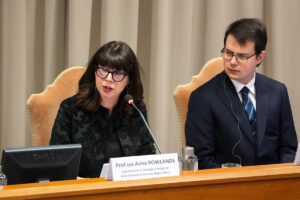
Since 2017, Anna Rowlands has been St Hilda Professor of Catholic Social Thought and Practice at the University of Durham. From 2023 to 2025, she was on secondment at the Vatican for the Synod on Synodality, working with the General Secretariat of the Synod and the Dicastery for Promoting Integral Human Development.
This is the speech Prof. Rowlands gave at the launch of Pope Leo’s Magnifica Humanitas. The document, signed by Pope Leo on May 15 — the 135th anniversary of Pope Leo XIII’s landmark encyclical Rerum Novarum — was unveiled in the Vatican’s New Synod Hall in the presence of the Pope himself on May 25. Prof. Rowlands was among the speakers at the presentation, alongside Cardinal Víctor Manuel Fernández, Prefect of the Dicastery for the Doctrine of the Faith; Cardinal Michael Czerny, S.J., Prefect of the Dicastery for Promoting Integral Human Development; Christopher Olah, co-founder of Anthropic and head of research on AI interpretability; and Prof. Leocadie Lushombo, professor of political theology and Catholic social thought at the Jesuit School of Theology of Santa Clara University in California.