

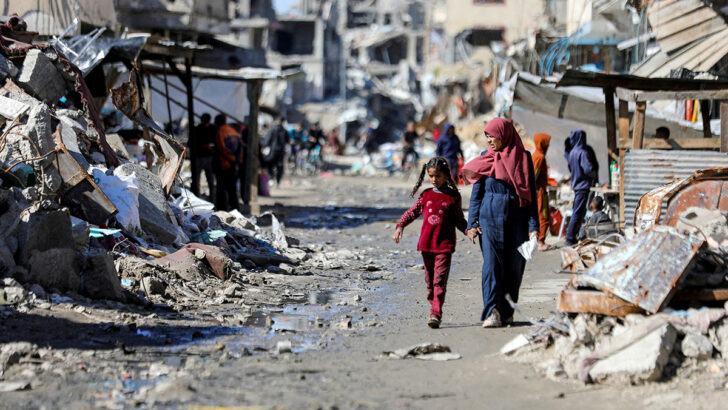
 Palestinians walk past the ruins of houses in Gaza City, March 20, 2024, that were destroyed during Israel’s military offensive amid the ongoing conflict between Israel and Hamas. Photo: OSV News / Dawoud Abu Alkas, Reuters.
 I began writing this on Friday, May 15 – Nakba a Day, the day where we remember the mass displacement and dispossession of Palestinians during the early creation of the State of Israel. In 1948, more than 750,000 Palestinians (some 75-85% of the population) were forced from their homes. Towns and villages were depopulated or destroyed, and families were scattered across borders resulting in a refugee crisis that continues to impact the region today – not to mention the millions of lives.

That was 78 years ago.
Since then, some three generations of Palestinians have existed in refugee camps in surrounding countries, and those who remained in Palestine have experienced eight decades of violence, torture, imprisonment, displacement and a denial of their rights across social, economic, political and religious spheres. And here we are today, reliving the reality of that first Nakba, as Fintan Drury describes in his book Catastrophe: Nakba II where, since October 7, 2023, over 75,000 Palestinians have been killed. Despite the ‘ceasefire’ killings are continuing and have expanded into the West Bank and east Jerusalem – and Southern Lebanon.
Genocide
The genocide and ethnic violence continue to rage in Gaza and the West Bank and there appears no immediate prospect for peace. Unless you access news channels such as Al Jazeera or TRT World news or the Instagram pages of individual Palestinians living in Gaza, or follow the Freedom Flotilla Coalition, you may not even realise that daily atrocities continue, and essential basic and lifesaving supplies remain under blockade. This was recently highlighted by the Catholic Bishop and General Patriarchate of Jerusalem William Shomali in a recent RTÉ interview, where he states that “Gaza is now forgotten” yet the people continue to suffer and go hungry.
The continuing, unchallenged kidnapping by Israeli forces of international citizens in international waters that are protected under international law, is terrifying”
Alongside the killings, in March this year the Special Rapporteur on the situation of human rights in the Palestinian territories occupied since 1967, Francesca Albanese, issued a sobering report on the “systematic use by Israel of torture against Palestinians from the occupied Palestinian territory since October 7, 2023”. In the report she outlines how the torture of Palestinian children, women and men “is not incidental violence. It is the architecture of settler-colonialism, built on a foundation of dehumanisation and maintained by a policy of cruelty and collective torture.” And if this isn’t evidence enough of the brutal reality, the recent chanting by pro-Israel activists outside the New York Times building in New York in support of Israeli soldiers’ “right to rape,” is likewise deplorable. Added to this recklessness is the recent approval on March 30 of this year of a bill by the Knesset to expand the use of the death penalty for Palestinians, imposing capital punishment within 90 days of a final ruling, with limited options for appeal or commutation. This includes Palestinian children.
The continuing, unchallenged kidnapping by Israeli forces of international citizens in international waters that are protected under international law, is terrifying. Equally disturbing is the conscious amnesia to such protections and the responsibility of states to protect their own citizens. This collective disregard for the institutions built over decades to protect people and planet facilitates piracy, demonstrates a mockery of democracy and the rule of law and enables genocide, ethnic cleansing and illegal expansion. This erosion of humanity, contempt for empathy and disregard for human rights and dignity is a chilling and dystopian existence.
So where does this leave us?
A couple of weeks ago, I was attending a conference in the UK. During the plenary at the end of the event, one participant asked – where is the justice for the perpetrator? I have to say I was stunned. And perhaps a little angered by this question. I was uncomfortable and couldn’t see a way in which I could ever feel sorry for the perpetrator who commits such vile acts of inhumanity and causes so much suffering to another human being.
Haunted
I was haunted and challenged by her perspective.
Whilst walking to work one morning, I was reminded of Jesus’ words in Luke 23:34: “Father forgive them, for the know not what they do”. This also felt uneasy for me.
Yet, the more I read about the depths of the depravity of the violence being perpetrated against the Palestinians and the widespread global tolerance and support for such violence, I began to reflect on what it may be like for the individual soul who has and is perpetrating such atrocities, and what living hell they will experience when they become awakened to their crimes. The rising incidences of suicide among Israeli soldiers and reports of the prescription of opioids for those suffering PTSD is one warning.
I lived in South Africa for 4 years, a country where non-white populations were subjected to many years of violence and suffering under a brutal system of apartheid, and many more years under colonialism before that. If we consider the process towards peace after the ending of apartheid in South Africa and also the genocide in Rwanda, we understand that a path to peace must be a journey that establishes and publicly acknowledges ‘truth’, which can lead towards acknowledging the pain and the injustices of the past. Only then can healing and reconciliation begin in divided societies. With reference to the genocide in Gaza, for Peter Beinart, author of Being Jewish after the Destruction of Gaza, what is also needed is a new Jewish narrative that is based on equality in Israel rather than supremacy, finding that the current narrative “…doesn’t endanger only Palestinians. It endangers us [Jews].”
Struggle
While I continue to struggle with the concept of even considering the situation of the oppressor, let alone reconciling, it is a position that I am willing to reflect on and perhaps work through in seeking justice for the people of Palestine, and all those oppressed throughout the world.
Dr Toni Pyke is the Justice, Peace and Ecology co-ordinator with the Association of Leaders of Missionary and Religious of Ireland (AMRI). She has worked in international development and social justice in the US, Nigeria, South Africa, Uganda and Zambia, as well as Ireland and has lectured at Maynooth University and supervised at the University of South Africa.
Check out the short film by the Britain Palestine Project: From the Nakba to Camp David which outlines the displacement, war, diplomacy, occupation, failed political processes, the decisions made during that time, and the consequences which continue to resonate today.