

 Peter Costello
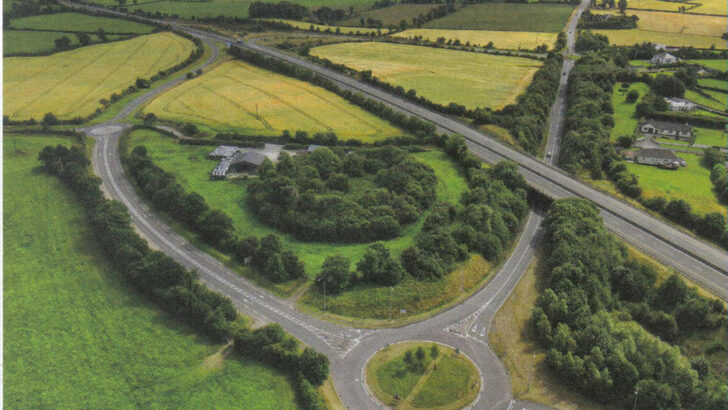 Modern highways bow to the priority of a ‘Fairy Fort’, near Nenagh, Co. Tipperary. Photo:
Richard Mills.
Modern highways bow to the priority of a ‘Fairy Fort’, near Nenagh, Co. Tipperary. Photo:
Richard Mills. Ireland’s Curious Places: 100 fascinating, lesser-known treasures to discover,
by Michael Fewer
(Gill Books, €16.99 / £14.99)
Irish Fairy Forts: Portals to the Past,
by Jo Kerrigan and Richard Mills
(O’Brien Books, €19.99 / £17.99)
What with the effects of climate change and the rising objections to mass tourism around the world, it is likely that in the future Irish people will be spending more time getting to know their own country, rather than enjoying the torrid delights of southern sea and sand. These two books open up interesting vistas of what they might just think of going to see.
Michael Fewer’s book is an eclectic selection of places of curious, historical or natural interest. I have to begin with it simply because I was delighted to see that he includes, at number 84, the Costello Memorial Chapel in Carrick-on-Shannon, consecrated in 1879, which contains the remains of a local merchant’s wife.
We revisit it when in the town, though these Costellos must be the remotest of cousins. However, his photo of the exterior gives no idea of how curious the inside is, with a sheet of armoured glass giving a view of Mrs Costello coffin interred in the floor. This little chapel long claimed to be the smallest in the world.
Sites
Fewer writes that the Cross Island Chapel on Mason’s Pond, Oneida, in New York State, is actually the world’s smallest chapel. There is another rival in the Union Church, Wiscasset, Maine; one Episcopalian and other Baptist.
But there is a distinction, for Mass can be said in the Costello Chapel, and has been from time to time; but marriages and baptisms are all that can be carried out in the American rivals. So, I would say that the Costello Chapel, to adopt the old penal term, can still claim to be the world’s smallest ‘Mass House’.
Fewer ranges from the Seals Strand on the Great Blasket Island, a natural wonder with a thriving seal colony, to the “leaning tower”, a rival to Pisa, to be found in Kilmacduagh in Galway.
Experts claim that 80% of the native people of Ireland are of stock that has been here for 8000 years”
In his books Fewer has always had an architect’s skill in spotting striking little details. Take Poulnabrone Dolmen, in the Burren. In the 1980s an effort was made to repair the dolmen’s capstone which had cracked.
An excavation was undertaken by archaeologists at the same time. In the soil under the monument, they found the remains of 22 people from the Neolithic age. They were able to extract DNA from some of the bones and were surprised to find that it matched three children in the local primary school. This suggested that the ancestors of these children “had probably lived in the same area for five millennia”.
But I understand other experts claim that 80% of the native people of Ireland are of stock that has been here for 8000 years. These people are, of course, not “Celtic”. They are the “real Irish” if you like, a race whose original language and culture was obliterated by the invading “Gaels” about 300 BC.
It is for this kind of detail, and for other follies, fancies and fantasies of the past that make this a charming and entertaining read. And a ready source of places to go on those weekend outings.
Explore
Nor should one miss the account of the “tin church” dedicated to Our Lady of the Visitation at Rearcross in Tipperary, a remarkable and well restored edifice, due to the enterprise of a parish priest in 1887.
(It is by no means as unique as is claimed for there was a similar, though smaller, church in Ranelagh, once a chapel of ease for the C of I parish which ended as a Greek Orthodox Cathedral.)
Both books are well illustrated and make excellent use of drone-mounted cameras to record aspects of the Irish landscape that in a previous generation would have depended on the co-operation of the Flying Corps. The new technology opens up, quite literally, new vistas in Irish archaeology.
Only in this way readers truly explore what academics have discovered”
The researches of Kerrigan and Mills also strike deep into the past. Their main themes are the forts which were early homesteads and the mounds, often with trees on top, that were often burial chambers, though medieval ones might have been Norman baileys.
They evoke the traditions of the “good folk” – but that off hand manner is too common now. Earlier beliefs had survived Irish tales and folklore – a heartfelt tribute to Folklore Commission’s “Schools Collection” as a special very special resource.
I am a great believer that any book, even of the most popular nature, that aims to provide acceptable information or real insights of scholarship or surmise should not be an end itself. All books dependent on research should, if only out of courtesy to the reader, contain, if not a full bibliography, at least a suggestion for further reading. Only in this way readers truly explore what academics have discovered.
As regarding what one Scottish divine called “the Secret Commonwealth”, we have in our family people of rural birth who were firm believers in the good folk, the hungry grass and many other things. Urban readers of today might at least be directed towards The Fairy Faith in Celtic Countries by W. T. Evans-Wentz or The Middle Kingdom by D. A. MacManus.
These beliefs played such an important role in Irish culture and literature over the previous centuries that the unbelieving nature of so much commentary on them today is a pity. Folklorists, though dealing with the inner beliefs of people, often seem to be strangely materialist.
(I was struck by the similar physical appearance of these two books, with the rigid flat backs, and tight openings. I see that both, though typeset in Ireland, were manufactured, though different companies, in Poland: surely a sign of the times in Irish publishing.)