

I spent two very happy weeks in Canada in June — my longest holiday since COVID. One of my great holiday treats is to sit into the pews for Sunday Mass, while another priest does the work — and I watch, critically.
On Trinity Sunday I found myself in Lindsay, Ontario, right in the middle of the state. I went to Mass in the Church of the Purification of the Blessed Virgin Mary, under the care of the Institute of the Incarnate Word. Father tried valiantly to explain the Trinity, where many before him have tried and failed. And he did likewise. But it being Fathers’ Day, he included all our fathers in the Mass, living and dead. Even when praying the Roman Canon, he managed to include special prayers for all the dads. I liked that.
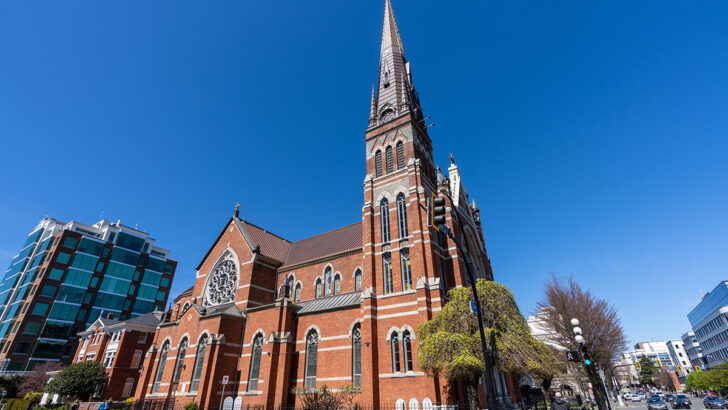
On the following Sunday I was at Mass in St Andrew’s Cathedral in Victoria, British Columbia, which was truly impressive. For one thing, the church was packed. Latecomers were led to the seats behind the altar used by clergy at cathedral concelebrations.

Common
A full church for Sunday Mass used to be common in Ireland; it felt good.
Mass began with a procession of thurible, cross and candles and ten altar servers, another sight rare in Ireland. In that parish, servers have to be confirmed before being accepted for service on the altar, so most were teenagers (and a bit steadier as a result). The thurible was well used, to incense the altar and cross at the start, the Gospel book at the ambo, and the gifts of bread and wine, priest and us all later on. In Ireland the thurible seems only to get an outing at funerals, it was nice to see it enhance the Sunday liturgy.
One thing really struck me was how many children were at Mass. After the Gospel, Father sat on the altar steps and drew 70 or 80 of them around him, to speak to them about the readings in words they could understand. Afterwards he sent them back to their seats with worksheets, while he gave a full homily to the adults.
Communion that Corpus Christi Sunday was under both species, with all invited to receive the host and chalice; in that diocese, the bishop has banned Communion by intinction (or dipping, common during COVID) so on this Sunday, everyone again got to receive as they used to before COVID.
After Communion, two of the parish’s ministry group leaders addressed the congregation.
Support
The immigrant support ministry reported on refugees from Ethiopia the parish was sponsoring; these were introduced to the congregation and welcomed with applause. A report was also given on the progress of the adults baptised at Easter. Mass finished 90 minutes after it started, but it was so absorbing that time flew. I made myself known to the priest at the end. His reply: “Did you ever think of coming here on sabbatical?” Now there’s an idea; there’s so much to learn from a vibrant parish…..
Garden flowers only
Because of the nature of my profession, I see many coffins — often almost covered with enormous flower arrangements. God only knows what these enormities cost. Some families try for simplicity by adding to their death notice: ‘Family flowers only’ or even ‘Fresh flowers, please’. My late mother had a better idea. For the few funerals she organised, a simple phrase ended the obituary notice: ‘Garden flowers only’. A handful of roses, or daffodils, or anything that could be snipped and bound in a rubber band; they looked as good as any fancy wreath. “Keep it simple” was her motto always.
He loved us
You would not expect papal encyclicals to feature on my reading list, and neither would I. But Pope Francis’ last one has captivated me. It’s a reflection on the love of God, as tender a memoir as you can find: ‘On the human and divine love of the heart of Jesus Christ’, it’s subtitled. You can read it yourself, free of charge, on the Vatican website, simply click on the image of Pope Francis and find his encyclicals, especially Dilexit Nos which means, ‘He [God] loved us’. What could be more beautiful than that! And so true, too.