

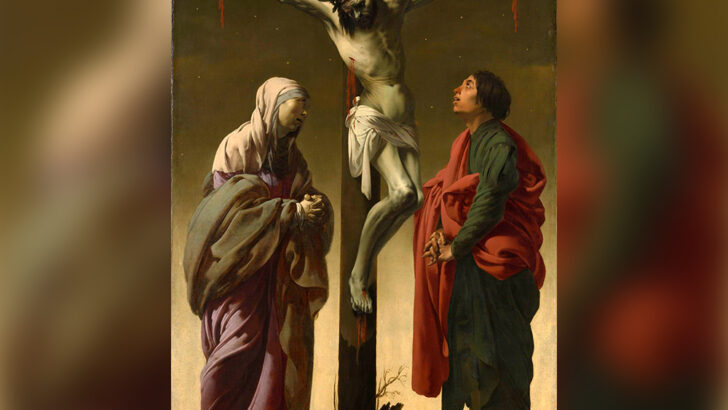
 Hendrick ter Brugghen’s painting ‘The Crucifixion with the Virgin and St John’. Photo: OSV News photo/courtesy The Metropolitan Museum of Art, Pubic Domain.
 “I thirst” is the shortest phrase of the Lord’s last words (Jn 19:28). Short though it may be, it contains unsearchable depths.
The Lord was telling of his physical thirst on a first and properly literal level. The physical thirst of the Lord was no trivial detail in the Passion story but was foretold in the Old Testament. Psalm 22 tells us his “tongue cleaves to” his palate (Ps 22:16). Psalm 69 is even more explicit: “I am weary with crying out; my throat is parched” (Ps 69:4).
When the soldiers at the foot of the cross heard Jesus say “I thirst,” they interpreted his words only on the literal level and offered him vinegar to drink, thus fulfilling Psalm 69: “For my thirst they gave me vinegar” (v. 22).
On a second and more figurative level, the thirst of the Lord revealed something deeper taking place in his soul. Ancient Jews often expressed inward spiritual realities through physical language. Thus the language of thirst became the language of longing and love: “O God, you are my God — for you my soul thirsts” (Ps 63:2).
Yet to whom was the Lord declaring his love when he said “I thirst”? Surely he expressed his desire for the Father, but he also declared his love for you and for me. Scripture tells us that Jesus “loved his own who were in the world and loved them to the end” (Jn 13:1). Why did Jesus die on the cross? He died out of love for us. “God proves his love for us in that while we were still sinners Christ died for us” (Rom 5:8).
“I thirst” expresses the depth of Christ’s love — a love that surpasses understanding (cf. Eph 3:19). Though we cannot fully comprehend it, God grants the saints a share in experiencing something of its breadth and height and depth.
One outstanding witness to this mystery is St Teresa of Kolkata. In 1946, during a train journey, she received a profound grace in which Christ revealed to her personally the meaning of his words, “I thirst.”
She came to understand that when Jesus spoke these words from the cross, he was revealing his burning love and desire for every person. Amid his passion, Christ thirsted for each of us personally. What was granted to Mother Teresa was a share in experiencing that thirst and a call to respond to it.
Her response was simple: to slake the thirst of Jesus through acts of love. Inspired by the spirituality of doing small things with great love, she recognised Christ’s thirst in the poorest of the poor around her and devoted her life to serving them.
To this day, in every house of the Missionaries of Charity throughout the world, next to the crucifix in their chapel, one finds written on the wall: “I thirst.” The words remind us that we are called to love the One who loved us first.
Our calling is to slake the thirst of the One who thirsted for us on the cross by noticing those around us who thirst for love and responding in whatever small ways we can. Sometimes all we can offer is a smile. Yet even a small act of love means the world to Jesus when done for his sake.
Near the end of her life, Mother Teresa wrote to her sisters about the mystery of Jesus’ thirst:
“For me, Jesus’ thirst is something so intimate… the words are not from the past only, but alive here and now, spoken to you. Hear your name. Not just once. Every day. If you listen with your heart, you will hear, you will understand.”
Dominican Fr James Dominic Brent is the author of The Father’s House: Discovering Our Home in the Trinity.