

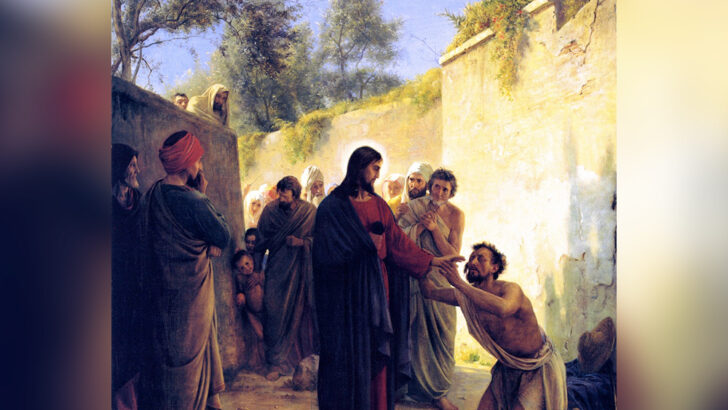
 Healing of the Blind Man’ by Carl Bloch, 1871. Photo: Public Domain.
 All I know is I once was blind but now I see!
As the gospel is very long, it is more practical to read it from your own Bible.

Initial observations
This story is found only in the Fourth Gospel, although the other Gospels do tell of blind men (never women!) recovering their sight. Our story, very much longer than in the other Gospels, is the sixth of the seven signs: the Wedding Feast at Cana, Jacob’s well, the royal official’s son, the Loaves, the walking on the water, the Blind Man and Lazarus.
Kind of writing
(i) We have here a short drama, unfolding in a sequence full of suspense:
Dramatically, Jesus is present only in Scenes 1 and 6, but is really present in all the other scenes as well, because his identity is the subject of the investigation. The final scene brings all the chief protagonists together for the first (and last) time. Scene 2 is the confirmation of the cure.
(ii) The “enquiry” in Scenes 3-5 (structured CB*C*) feels both official and threatening, concluding, as it does, with an expulsion. Both these features reflect two issues at the time of writing (about 95 ad). The first issue is the obvious one: relations between Jews and “Christians” had broken down and eventually (perhaps at the “synod” of Jamnia, c. ad 80) the followers of the Nazarene were expelled from the synagogue (this Gospel alone has the expression “thrown out of the synagogue” [John 9:22; 12:42; 16:2]). It may well be that family members were under pressure (at the time of writing) when one of them became a Christian. The second issue is that the community of the Beloved Disciple, under a kind of persecution, was obliged to account for its faith ever more clearly and deeply. In hard dialogue with fellow Jews, a profound understanding of the identity of Jesus emerged. We see this in the journey of faith made by the Blind Man: the man, “I do not know”, a prophet, from God, the Son of Man, worshipped him.
Old Testament background
(i) [a] In the Old Testament, sickness is a result of sin, sometimes parents’ sins (e.g. Exodus 20:5); [b] the blind, as handicapped people, may not enter the sanctuary (e.g. Leviticus 21:18); [c] It was forbidden to perform “works” of any kind on the Sabbath. [d] there is a mild absurdity in the text: when could the blind man have sinned so that he would have been born blind?!?
(ii) The Book of Tobit tells a tale of sight restored and there also it is symbolic.
(iii) Restoration of sight is part of the promise of the Messiah. Compare a text widely alluded to across the New Testament: “The spirit of the Lord God is upon me, because the Lord has anointed me; he has sent me to bring good news to the oppressed, recovery of sight to the blind [Greek Old Testament addition], to bind up the broken-hearted, to proclaim liberty to the captives, and release to the prisoners” (Isaiah 61:1).
New Testament foreground
(i) Recovery of sight is widely used in the New Testament to speak of coming to faith: e.g. Bartimaeus (Matthew, Mark and Luke) and, most strikingly, Paul himself.
(ii) There are strong links between this story and that of Woman at the Well (water, pool, the staged journey of faith).
(iii) In this Gospel, Jesus as light frames chapters 1-12 (1:4-5, 7-9; 12:35, 46). He has just proclaimed himself Light of the World in 8:12 and repeats it here in 9:5.
(iv) “Seeing”, in this Gospel as often in the New Testament, has two meanings: to see physically and to see (believe) spiritually. The final example in the Gospel is ironic: Blessed are those who have not seen, and yet believe.
(v) The man’s journey of faith is facilitated by his lack of certainty:
9:12 They said to him, “Where is he?” He said, “I do not know.” 25 He answered, “I do not know whether he (= Jesus) is a sinner.” 36 He answered, “And who is he, sir? Tell me, so that I may believe in him.”
This enabling uncertainty is in contrast to the dead certainties of the man’s opponents.
(vi) Jesus finds the man twice, once in : As he walked along, he saw a man blind from birth (John 9:1) and then later in Jesus heard that they had driven him out, and when he found him, he said, “Do you believe in the Son of Man?” (9:35)
It is Jesus’ recognition of the man’s need that leads to a recovery of sight both physical and spiritual. Both are important in the story, because it is the man’s first experience of healing, an experience he cannot deny, which opens him to the second healing of faith. He stands by his experience, no matter what the pressure.
St Paul
For it is the God who said, “Let light shine out of darkness,” who has shone in our hearts to give the light of the knowledge of the glory of God in the face of Jesus Christ. (2 Corinthians 4:6)
Besides this, you know what time it is, how it is now the moment for you to wake from sleep. For salvation is nearer to us now than when we became believers; the night is far gone, the day is near. (Romans 13:11–12)
Brief commentary
Verses 1-7a This is the symbolic world of light and darkness familiar from John 1:1-18. There is an echo of Genesis 2, where God uses mud to create human beings. Unusually, the man does not seek a cure – Jesus identifies the blindness and offers a cure.
Verses 7b-12 This seeming repetition of the miracle is very important: it establishes that people other than the blind man were aware of the cure. It also establishes the man’s personal conviction that something wonderful has happened and no matter what the doctrine it may challenge or contradict, the experience cannot be denied. “I do not know” is very powerful. Knowing is both positive and negative: the negative knowledge of doctrine, the positive knowledge of experience.
Verses 13-17 The first interview raises a real objection: God cannot both command the Sabbath and be the author of its breaking!? This was a real issue between Jews and the first followers of Jesus.
Verses 18-23 Here a doubt about the authenticity of the cure is raised—hence the parents are interviewed. This may reflect the experience of the community at the time of writing.
Verses 24-34 The grounds of the argument shift to a weaker basis: argument from authority and status. The conflict has had, paradoxically, the opposite effect of making the Blind Man more convinced of his experience and inclined to detach himself from “the Jews”.
Verses 35-41 All the protagonists are present and a hard judgement given against those whose certainties are dead.
Pointers for prayer
- The blind man makes a journey of faith, rooted in an experience of healing from the hand of Jesus. This experience has potential to grow and deepen. What has been my experience of the healing presence of Jesus in my life? Prayer of thanksgiving.
- Under pressure, the blind man and the community he stands for are obliged to reflect again and again on what they really believe. What has happened to my faith in times of pressure against believing? Prayer of faith.
- Amazing Grace has the words: I once was lost, and now I’m found. Jesus goes out of his way to find the blind man and bring him through the next stage of faith. What has my experience of finding my “self” been? When have I been touched by Jesus? Is he reaching out to me now? Prayer of conversion.
- The blind man witnesses to his experience, in spite of conventional, even orthodox opposition. Perhaps this has been part of my experience too? Prayer of witnessing
When taking a gospel story for prayer, it is often helpful to break the story up into its individual sections. Each section represents a movement, an interaction between the characters. This is particularly true of a long story such as the one we have today. There are six different scenes in this story. Any one of them could be the focal point for your prayer. Try to identify the movement in the section you take for prayer. The objective is to discover the Good News in the story. The Good News is that the story of grace is deeper than the story of sin, both in the gospels and in our lives. One should also note the different characters in the story, for each of them could be a character with whom you can identify. In this story we have Jesus, the blind beggar, the disciples, the neighbours, the blind man’s parents and the Pharisees.
Prayer
God our Creator, show forth your mighty works in the midst of your people. Enlighten your church, that we may know your Son as the true light of the World and through our worship confess him as Christ and Lord, who lives and reigns with you in the unity of the Holy Spirit, holy and mighty God for ever and ever. Amen.
=====
Christ will shine upon you!
First Reading
Eph 5:7 Therefore do not be associated with them.
Eph 5:8 For once you were darkness, but now in the Lord you are light. Live as children of light—
Eph 5:9 for the fruit of the light is found in all that is good and right and true.
Eph 5:10 Try to find out what is pleasing to the Lord.
Eph 5:11 Take no part in the unfruitful works of darkness, but instead expose them.
Eph 5:12 For it is shameful even to mention what such people do secretly;
Eph 5:13 but everything exposed by the light becomes visible,
Eph 5:14 for everything that becomes visible is light. Therefore it says,
“Sleeper, awake!
Rise from the dead,
and Christ will shine on you.”
Initial observations
The imagery of light makes this reading especially inviting and appropriate for the fourth Sunday of Lent. It functions as a kind of encouragement not to lose heart but to keep on going in view of the great hope we have in the risen Christ, to be celebrated soon at Easter.
Kind of writing
Ephesians has a simple letter layout:
1:1-2 Greeting
1:3-14 Blessing
1:15-23 Thanksgiving
2:1-6:20 Body of the Letter
7:21-24 Letter conclusion
Overall, Ephesians reflects a common type of writing at the time, the Two Ways form of instruction. Our reading comes from a portion of the body of the letter devoted to living as children of the light (5:1-14).
It is really unlikely that the letter is from Paul. The practice is writing in the name of another was well known at the time. It allowed one to acknowledge the main source of one’s ideas, while bringing the tradition up to date in a new context.
Origin of the reading
Ephesians is a document of second generation Paulinism. Like Colossians in many ways (perhaps a second, expanded edition?), it nonetheless has its own deeper teaching about Christ, as we can see in Ephesians 5:21-6:2. The context is a later one and the challenge is how to sustain the message of Paul and bring it to expression for a later generation. Not really unlike our own time, when you think about it.
Related passages
Now this I affirm and insist on in the Lord: you must no longer live as the Gentiles live, in the futility of their minds. They are darkened in their understanding, alienated from the life of God because of their ignorance and hardness of heart. They have lost all sensitivity and have abandoned themselves to licentiousness, greedy to practice every kind of impurity. (Ephesians 4:17–19)
For our struggle is not against enemies of blood and flesh, but against the rulers, against the authorities, against the cosmic powers of this present darkness, against the spiritual forces of evil in the heavenly places. (Ephesians 6:12)
But you, beloved, are not in darkness, for that day to surprise you like a thief; for you are all children of light and children of the day; we are not of the night or of darkness. So then let us not fall asleep as others do, but let us keep awake and be sober. (1 Thessalonians 5:4–6)
Brief commentary
Verse 7 Following on a list of vices in vv. 3-6, v. 7 looks on and looks forward, opening up the positive reflection of living in the light. The teaching is not unlike that found in 2 Corinthians 6:14–7:1.
Verse 8 The train of thought is quite Pauline—the indicative of what you are followed by the imperative of what you should become. As in the Dead Sea Scrolls, use is made of a moderate dualism to delineate conduct sharply.
Verse 9 Using a slightly mixed metaphor, the author encourages good behaviour. There is a discussion about the intended audience at this point — pagans or believers. On balance, it is more likely the advice is to Christ-believers.
Verse 10 The verb used could also be translated as to discern what is pleasing to the Lord. In the cultural context, determining what is suitable behaviour is an activity of reason. For the believer, in contrast, the “locus” of such discernment is our relationship with the risen Christ.
Verse 11 The “unfruitful works of darkness” is a general reference to the ways of unbelievers. Who is addressed here? It might be fellow believers who have slipped back into former practices (Matthew 18:15–17; Galatians 6:1). Or, are we to think of believers, at this point, rebuking outsiders for their behaviour? This latter is preferable in light of vv. 12-13. The church must not retreat from the world but confront it.
Verses 12-13 Given the list of vices early in chapter 5, it is likely that the writer has in mind sexual immorality and indecency. It may even be that Christians—by standing apart from society—are already being accused of some kind of secret activity. The affirmations here are rather general, but, perhaps were clearer to the first hearers than to later readers. There is an echo of the teaching of Jesus: For there is nothing hidden, except to be disclosed; nor is anything secret, except to come to light. (Mark 4:22)
Verse 14 The three lines in poetic form are most likely an excerpt from a baptismal hymn, presumably familiar to the audience. The references are to baptism and to the Lord’s Day, marking the resurrection. Cf. Arise, shine; for your light has come, and the glory of the Lord has risen upon you. (Isaiah 60:1)
Pointers for prayer
- As we approach Easter, this is a good time to reflect on being baptised — how have I appropriated the gift as a grown-up?
- Challenging the surrounding culture is, well, challenging. What has my experience been? What have I learned?
Prayer
Father of light, you have called us into being and called us again to new life in Christ. As we received the light of Christ in faith and baptism, help us to be what we have received and to live a children of the light. Through Christ our Lord.
=====
The Lord looks on the heart
Second reading
1 Sam 16:1 The Lord said to Samuel, “How long will you grieve over Saul? I have rejected him from being king over Israel. Fill your horn with oil and set out; I will send you to Jesse the Bethlehemite, for I have provided for myself a king among his sons.”
1 Sam 16:2 Samuel said, “How can I go? If Saul hears of it, he will kill me.” And the Lord said, “Take a heifer with you, and say, ‘I have come to sacrifice to the Lord.’
1 Sam 16:3 Invite Jesse to the sacrifice, and I will show you what you shall do; and you shall anoint for me the one whom I name to you.”
1 Sam 16:4 Samuel did what the Lord commanded, and came to Bethlehem. The elders of the city came to meet him trembling, and said, “Do you come peaceably?”
1 Sam 16:5 He said, “Peaceably; I have come to sacrifice to the Lord; sanctify yourselves and come with me to the sacrifice.” And he sanctified Jesse and his sons and invited them to the sacrifice.
1 Sam 16:6 When they came, he looked on Eliab and thought, “Surely the Lord’s anointed is now before the Lord.”
1 Sam 16:7 But the Lord said to Samuel, “Do not look on his appearance or on the height of his stature, because I have rejected him; for the Lord does not see as mortals see; they look on the outward appearance, but the Lord looks on the heart.”
1 Sam 16:8 Then Jesse called Abinadab, and made him pass before Samuel. He said, “Neither has the Lord chosen this one.”
1 Sam 16:9 Then Jesse made Shammah pass by. And he said, “Neither has the Lord chosen this one.”
1 Sam 16:10 Jesse made seven of his sons pass before Samuel, and Samuel said to Jesse, “The Lord has not chosen any of these.”
1 Sam 16:11 Samuel said to Jesse, “Are all your sons here?” And he said, “There remains yet the youngest, but he is keeping the sheep.” And Samuel said to Jesse, “Send and bring him; for we will not sit down until he comes here.”
1 Sam 16:12 He sent and brought him in. Now he was ruddy, and had beautiful eyes, and was handsome. The Lord said, “Rise and anoint him; for this is the one.”
1 Sam 16:13 Then Samuel took the horn of oil, and anointed him in the presence of his brothers; and the spirit of the Lord came mightily upon David from that day forward. Samuel then set out and went to Ramah.
Initial observations
Our reading takes us to another great character in the Biblical tradition: David. Many scenes could have been chosen but this is selected on account of the emphasis on the seeing of God.
Kind of writing
This delightful vignette is a quest story.
Exposition: 1-4a Context; actors.
Complication: 4b-11 Suspense
Climax: 12 David identified
DÈnouement: 13 Anointing as king
Style: A key word guides the narrative: the verb to see (1 Samuel 16:1, 6–7). It is not always clear in translation.
Tension: The prophet’s first discernment is mistaken and God has to intervene directly (v.7). The parade of sons creates tension, even though we are spared the tedium of plodding repetition with the use of the et cetera principle (v. 10).
Reading stance: the first-time hearer/reader will be on the same level of information as the characters in the story. At that level of even-handed telling, the focus will be on the person selected.
Finally: It is rare in the Bible for character to be described physically. For the regular Bible reader v. 12a is unusual.
David is also the youngest, an echo of a powerful theme is Genesis known as the reversal of primogeniture.
Origin of the reading
The books of Samuel constitute a meditation on kingship in Israel. Apart from the monarchs, Samuel is the most important character. Within the two books of Samuel, the prophet himself is a complex and ambiguous figure. To catch a sense of that, it would be good to read 1 Samuel 8.
Related passages
Jesse became the father of Eliab his firstborn, Abinadab the second, Shimea the third, Nethanel the fourth, Raddai the fifth, Ozem the sixth, David the seventh. (1 Chronicles 2:13–15)
Brief commentary
Verse 1 The grieving links this story with the previous one in 1 Sam 15. Saul was indeed eventually rejected: see 1 Samuel 15:23 as well as 8:7; 10:19; 15:26.
Verse 2a Samuel fears Saul’s reaction to his subversion.
Verse 2b-3 God proposes a subterfuge to gain entry to Jesse’s family so that the next monarch may be discerned.
Verse 4-5 The arrival of Samuel causes alarm, which the prophet deals with. In this way, access is gained.
Verse 6-7 Suspense begins with the prophet’s false discernment, quickly set aside by God. Looking at appearances was the mistake before because Saul was also tall (1 Samuel 9:22; 10:23). V. 7b is a key to the point of the whole story.
Verse 8-10 The parade is quickly told and even abbreviated. It seems the story at this point is blocked: none of the sons of Jesse is suitable.
Verse 11 To be sure, Samuel asks a question. David is identified as the youngest and as a shepherd. Kings were often compared to pastors in the ancient Near East. David’s youth is a reference to the elevation of the youngest in Genesis, itself a symbol of God’s selection of insignificant Israel as his chosen people. The postponement of hospitality creates a final tension, quickly told.
Verse 12 The unusual description gives David great “presence” in the telling because the reader/hearer is invited to imagine him. We notice in v. 12b that is not Samuel who speaks but the Lord himself. Samuel was in error before—just now with the sons of Jesse and, more alarmingly, with Saul as king.
Verse 13 The traditional anointing takes place in the restricted circle of the family to keep it secret. The spirit of the Lord is given here for the grace of leadership. See 1 Samuel 10:6; 16:13–14; 2 Samuel 23:2; 1 Kings 18:12; 22:24; 2 Kings 2:16. f
Pointers for prayer
- We all tend to look at appearances. What has helped me in my life to look deeper?
- Sometimes the unexpected choice really is the right one. Can I see that in my own life experience?
Prayer
You yourself, O God, are our light and you have “shone in our hearts to give the light of the knowledge of the glory of God in the face of Jesus Christ.” Help us to receive this gift with faith and become people who live not by appearances but by the inner light of truth and faith.