

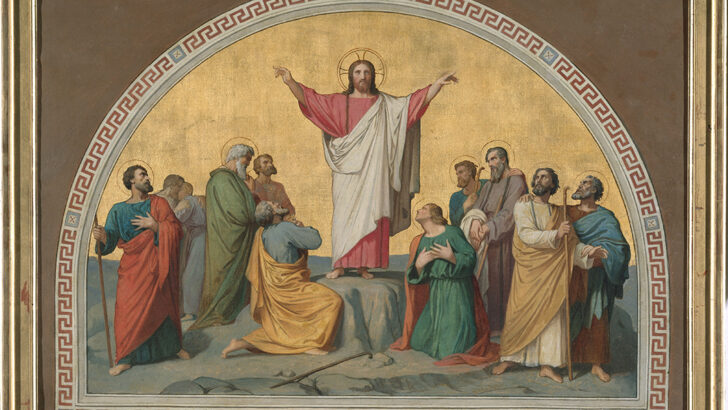
 Romain Cazes’ Sketch for the Church of Saint-François-Xavier - ‘The Mission of the Apostles’ (c. 1868). Photo: Wikimedia Commons / Public Domain.
 Acts 1:1-11; Psalm 47 (46); Ephesians 1:17-23; Matthew 28:16-20

And remember, I am with you always, to the end of the age
The Gospel
Matt. 28:16 Now the eleven disciples went to Galilee, to the mountain to which Jesus had directed them.
Matt. 28:17 When they saw him, they worshiped him; but some doubted.
Matt. 28:18 And Jesus came and said to them, “All authority in heaven and on earth has been given to me.
Matt. 28:19 Go therefore and make disciples of all nations, baptising them in the name of the Father and of the Son and of the Holy Spirit,
Matt. 28:20 and teaching them to obey everything that I have commanded you. And remember, I am with you always, to the end of the age.”
Initial observations
All four Gospels have different ways of bringing the story to a close. The most stark is Mark, which originally ended with the enigmatic and impossible 16:8. Luke shows the disciples continuing to worship in the Temple in Jerusalem, where the Gospel began and where the Acts will begin. The final blessing takes place in Bethany in this Gospel. John’s Gospel, has in effect, two endings, both highly significant: 20:30-31 and all of chapter 21. Today’s passage is Matthew’s closure of the Gospel story, a closure which is really an opening. The location, words and gestures are all unique to Matthew. The timing (Easter Sunday?) seems unclear.
Kind of writing
Properly speaking, this final scene of the Gospel is a peroration, that is, a final summing up or résumé. It synthesises the identity of Jesus in this Gospel, in the light of the resurrection. It portrays the mission of the Church, especially baptism. It promises the continued presence-in-absence of the Risen Lord.
Old Testament background
(i) In Matthew’s Gospel, Jesus is portrayed as a new Moses-type figure. This is very clear from Matt 1-2. Within the Gospel itself, Jesus’ central teaching is given from a mountain (Matt 5-7), just as Moses gave his teaching on Mount Sinai. Finally, just as Moses went up a mountain (Mount Nebo, within sight of the Holy Land) before his final departure (Deut 34:1-2), likewise Jesus from a mountain, this time within the Holy Land, makes his final appearance.
(ii) The phrase “I am with you” or “I will be with you” has a tremendous echo in the Old Testament: Noah, Abraham, Jacob, Moses, Joshua, David, Solomon, Isaiah and so on are all given this promise. It is especially rich in the book of Jeremiah (Jer 1:8, 19; 15:20; 30:11; 42:11; 46:28):
Do not be afraid of them, for I am with you to deliver you, says the Lord.” (Jer 1:8)
(iii) Behind this lies the name of God as revealed to Moses.
But Moses said to God, “If I come to the Israelites and say to them, ‘The God of your ancestors has sent me to you,’ and they ask me, ‘What is his name?’ what shall I say to them?” God said to Moses, “I Am Who I Am.” He said further, “Thus you shall say to the Israelites, ‘I Am has sent me to you.’” (Ex 3:13–14) That in turn is taken up is a special way by the prophet Isaiah (cited in Matt 1:22-23), because Immanuel means literally God (El) with us (immanu).
Therefore the Lord himself will give you a sign. Look, the young woman is with child and shall bear a son, and shall name him Immanuel. (Is 7:14).
(iv) The extraordinary claim to authority echoes a significant OT text:
As I watched in the night visions, I saw one like a human being coming with the clouds of heaven. And he came to the Ancient One and was presented before him. To him was given dominion and glory and kingship, that all peoples, nations, and languages should serve him. His dominion is an everlasting dominion that shall not pass away, and his kingship is one that shall never be destroyed. (Dan 7:13–14)
New Testament foreground
(i) Authority: in this Gospel the teaching and actions of Jesus enjoy a special authority which causes a reaction (Matt 7:29; 8:9; 9:6, 8; 10:1; 21:23-24, 27; 28:18). This authority, in turn, is given is a special way to Peter (16:18).
(ii) Mountains have a symbolic function in this gospel, as their frequency in comparison with the other Gospels shows (12-7-6-4).
(iii) Worship:“Where is the child who has been born king of the Jews? For we observed his star at its rising, and have come to pay him homage.” (Matt. 2:2) Then he sent them to Bethlehem, saying, “Go and search diligently for the child; and when you have found him, bring me word so that I may also go and pay him homage.” (Matt. 2:8) On entering the house, they saw the child with Mary his mother; and they knelt down and paid him homage. Then, opening their treasure chests, they offered him gifts of gold, frankincense, and myrrh. (Matt. 2:11) And those in the boat worshiped him, saying, “Truly you are the Son of God.” (Matt. 14:33) Suddenly Jesus met them and said, “Greetings!” And they came to him, took hold of his feet, and worshiped him. (Matt. 28:9)
(iv) End of the age: this expression is found only in this Gospel, reflecting the continued commitment to end-time hope: …and the enemy who sowed them is the devil; the harvest is the end of the age, and the reapers are angels. Just as the weeds are collected and burned up with fire, so will it be at the end of the age. (Matt. 13:39-40) So it will be at the end of the age. The angels will come out and separate the evil from the righteous. (Matt. 13:49) When he was sitting on the Mount of Olives, the disciples came to him privately, saying, “Tell us, when will this be, and what will be the sign of your coming and of the end of the age?” (Matt. 24:3) “…and teaching them to obey everything that I have commanded you. And remember, I am with you always, to the end of the age.” (Matt. 28:20)
St Paul
May the God of peace himself sanctify you entirely; and may your spirit and soul and body be kept sound and blameless at the coming of our Lord Jesus Christ. The one who calls you is faithful, and he will do this. (1 Th 5:23–24)
Brief commentary
Verse 16 That is, the Twelve minus Judas. Galilee—Mark’s Gospel promised they would see the Risen Lord in Galilee. This probably means that on the Gentile mission, they would experience the Second Coming. However, by the time Matthew’s Gospel was written, already it was clear that there would be a “time of the Church”, with some rudimentary structures. So, in this Gospel, the function of the Galilee appearance changes to a commission to continue the mission.
Verse 17 A reassuring feature of the resurrection appearance narratives is the initial doubt of the recipients. Worship of Jesus began early and is noted in the Gospel of Matthew from the start.
Verse 18 Heaven and earth, as a combined expression, occur in this Gospel more frequently than in the others (24-4-10-4). This is the universal, even cosmic authority of the Risen Lord as shown in Matthew 25 especially.
Verse 19 This is the first mention of baptism since Jesus’ own baptism (Matt 3:6, 11, 13-14, 16). As we see from Romans 6, Christian baptism is essentially different from the baptism of John. The Trinity, as a doctrine, is present in nuce in the NT, although rare. It took several centuries before the Church proposed what we would recognise as the Trinity. However, the seeds are present in texts such as this one. Disciples are mentioned very frequently in this Gospel (74-48-40-79).
Verse 20 There is a great deal of Jesus’ teaching in Matthew’s Gospel, collected into five great speeches (5-7, 10, 13, 18, 23-25). The “being with” echoes the name given to Jesus uniquely in this Gospel: “All this took place to fulfil what had been spoken by the Lord through the prophet: ‘Look, the virgin shall conceive and bear a son, and they shall name him Emmanuel,’” (Matt 1:22-23)
Pointers for prayer
- It is time for Jesus to return to his Father. He meets his disciples for the last time. His final words give them direction for their future. Perhaps you can recall such parting moments in your own life – leaving home, school, college, training, the death of a loved one. What was that like for you? Was there an occasion when words spoken then gave you direction for your future?
- Perhaps you can identify with Jesus in the story, when as a parent, teacher, or in some other way you sent someone on his/her way in life knowing you would not be with him or her as in the past. When did the way you parted help the other to make his or her own way in life?
- Jesus told his disciples that although he would not be with them as in the past he would be with them in a new way right through their lives. Have there been times when you were reassured by the love and support of another even though s/he was not physically present with you?
- In parting with his disciples Jesus gave them a mission for the future. Where, when and how did you get a sense of the meaning and purpose of your own life? How does that sustain you now? Is there any way in which that purpose ties in with the mission given to the eleven to make disciples of all the nations?
- Matthew’s Gospel begins by introducing Jesus as “Emmanuel – God with us” and ends with the promise of Jesus to be with his disciples until the end of time. That promise is also to us. What are the things which help you to be aware of the presence of Jesus with you on life’s journey?
Prayer
God of majesty, yours is the power that raised Christ from death, yours the glory that exalted him to your right hand. By the mystery of the Ascension, sustain our hope as we bear witness to our baptism.
By the perpetual outpouring of your Spirit confirm your Church in its mission of salvation. Grant this through Jesus Christ, the first-born from the dead, who lives and reigns with you in the unity of the Holy Spirit, God for ever and ever. Amen.
Thought for the day
We could ask how is the Risen Lord with us? The New Testament and the church tradition offer a rich array of “presences.” Christ is present in the neighbour in need, in created reality beautiful and awe-inspiring, whenever the disciples gather, in the word proclaimed, in the sacrament celebrated and through the Holy Spirit. Perhaps we do not always feel this presence, but the words of Jesus are a guarantee that no matter what is going on in my life or my community or my church, he is with us, our Emmanuel.
Prayer
Emmanuel—God with us—we thank you that you are indeed always with us. Help us to find you and recognise where you truly are and not just where we want you to be.
***
God put this power to work in Christ when he raised him from the dead
The first reading
Eph 1:15 I have heard of your faith in the Lord Jesus and your love toward all the saints, and for this reason
Eph 1:16 I do not cease to give thanks for you as I remember you in my prayers.
Eph 1:17 I pray that the God of our Lord Jesus Christ, the Father of glory, may give you a spirit of wisdom and revelation as you come to know him,
Eph 1:18 so that, with the eyes of your heart enlightened, you may know what is the hope to which he has called you, what are the riches of his glorious inheritance among the saints,
Eph 1:19 and what is the immeasurable greatness of his power for us who believe, according to the working of his great power.
Eph 1:20 God put this power to work in Christ when he raised him from the dead and seated him at his right hand in the heavenly places,
Eph 1:21 far above all rule and authority and power and dominion, and above every name that is named, not only in this age but also in the age to come.
Eph 1:22 And he has put all things under his feet and has made him the head over all things for the church,
Eph 1:23 which is his body, the fullness of him who fills all in all.
Initial observations
The readers of every generation feature in this marvellous reflection and prayer. The sense of awe before the transcendent is palpable.
Kind of writing
In the genuine letters from Paul, the letter format has been adjusted to include a longer thanksgiving for the faith of the recipients. In 2 Corinthians this takes the form of a “blessing” prayer. In Ephesians, both styles are present.
- 3-14 Blessing prayer
- 15-23 Thanksgiving report
The introductory verses are included as usual in these notes. In contrast to the genuine letters, there is no “embedded” account of what is happening in the community. The other great prayer from Ephesians is offered in the next section.
Origin of the reading
It is not quite sure if this letter should be addressed to the Ephesians, because some important manuscripts lack the expression “in Ephesus.” It has also proved difficult to establish the context in community which occasioned the writing. (i) Is it to do with the famous and flourishing Artemis cult? (ii) It is to do with proto-gnostic mythologies? (iii) Or perhaps, some combination involving Jewish speculation on the heavenly journey? A clue is provided by the Dead Sea Scrolls, suggesting a Jew with a background in Jewish sectarianism. At the same time, the writing is very polished, so a Jew who enjoyed a good Hellenistic education (not unlike the apostle himself). Perhaps in a context of flourishing Judaism, the writer tries to bolster Christian identity. In any case, the vision is breath-taking, taking us well beyond the limits of the Roman empire to a global expansion of the Gospel.
Related passages
For this reason I bow my knees before the Father, from whom every family in heaven and on earth takes its name. I pray that, according to the riches of his glory, he may grant that you may be strengthened in your inner being with power through his Spirit, and that Christ may dwell in your hearts through faith, as you are being rooted and grounded in love. I pray that you may have the power to comprehend, with all the saints, what is the breadth and length and height and depth, and to know the love of Christ that surpasses knowledge, so that you may be filled with all the fullness of God. Now to him who by the power at work within us is able to accomplish abundantly far more than all we can ask or imagine, to him be glory in the church and in Christ Jesus to all generations, forever and ever. Amen. (Ephesians 3:14–21)
Brief commentary
Verse 17 The writer moves from thanksgiving report to intercession. God’s wisdom was already mentioned: In him we have redemption through his blood, the forgiveness of our trespasses, according to the riches of his grace that he lavished on us. With all wisdom and insight he has made known to us the mystery of his will, according to his good pleasure that he set forth in Christ, as a plan for the fullness of time, to gather up all things in him, things in heaven and things on earth. (Ephesians 1:7–10) The Spirit of wisdom probably ought to have a capital letter, pointing to a more than human wisdom.
Verse 18 The language here is very close to that of the Essenes: May He enlighten your mind with wisdom for living, be gracious to you with the knowledge of eternal things, and lift up His gracious countenance upon you for everlasting peace. (1Qs 2:3–4) The eyes of your heart is unparalleled elsewhere but seems to suggest moral conduct. The content of that enlightenment is expanded in terms of Christian hope. Saints means simply fellow Christians, as opposed to angels or heavenly beings.
Verse 19 The prayer turns to God at work in believers, the shift signalled by switching from “you” to “us.” What is this power?
Verse 20 God’s great deed is the resurrection of Jesus. Cf. Dan 12:2–3; Acts 2:32–33; Phil 2:9–11. Cf. also: In him also you were circumcised with a spiritual circumcision, by putting off the body of the flesh in the circumcision of Christ; when you were buried with him in baptism, you were also raised with him through faith in the power of God, who raised him from the dead. (Colossians 2:11–12)
Verse 21 Being greater than heavenly powers comes up in Phil 2:9-11 again and also in Heb 1:4-5.
Verse 22 The expansion of the teaching in 1 Corinthians is evident: When all things are subjected to him, then the Son himself will also be subjected to the one who put all things in subjection under him, so that God may be all in all. (1 Corinthians 15:28)
Verse 23 The mention of the church as body reminds us of Paul again in 1 Corinthians 12 and Romans 12. “Fullness” does occur in the genuine Paul, usually in reference to the inclusion of the Gentiles. Here it is rather more cosmic: With all wisdom and insight he has made known to us the mystery of his will, according to his good pleasure that he set forth in Christ, as a plan for the fullness of time, to gather up all things in him, things in heaven and things on earth. (Ephesians 1:8–10)
Pointers for prayer
- My own moments of awe before God and the resurrection…
- My own sense of belonging and inheritance…
Prayer
Mysterious God, nearer to us than we are to ourselves, we stand in silent awe before you and your deeds of power in the risen Christ. Amen.
***
You will be my witnesses in Jerusalem, and to the ends of the earth
The second reading
Acts 1:1 In the first book, Theophilus, I wrote about all that Jesus did and taught from the beginning
Acts 1:2until the day when he was taken up to heaven, after giving instructions through the Holy Spirit to the apostles whom he had chosen.
Acts 1:3 After his suffering he presented himself alive to them by many convincing proofs, appearing to them during forty days and speaking about the kingdom of God.
Acts 1:4 While staying with them, he ordered them not to leave Jerusalem, but to wait there for the promise of the Father. “This,” he said, “is what you have heard from me;
Acts 1:5 for John baptised with water, but you will be baptised with the Holy Spirit not many days from now.”
Acts 1:6 So when they had come together, they asked him, “Lord, is this the time when you will restore the kingdom to Israel?”
Acts 1:7 He replied, “It is not for you to know the times or periods that the Father has set by his own authority.
Acts 1:8 But you will receive power when the Holy Spirit has come upon you; and you will be my witnesses in Jerusalem, in all Judea and Samaria, and to the ends of the earth.”
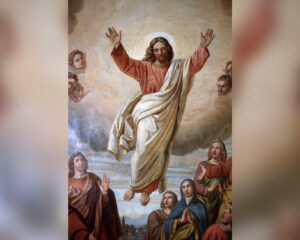
Acts 1:9 When he had said this, as they were watching, he was lifted up, and a cloud took him out of their sight.
Acts 1:10 While he was going and they were gazing up toward heaven, suddenly two men in white robes stood by them.
Acts 1:11 They said, “Men of Galilee, why do you stand looking up toward heaven? This Jesus, who has been taken up from you into heaven, will come in the same way as you saw him go into heaven.”
Initial observations
The Prologue to Luke’s second volume is Acts 1:1-14 (the remaining three verses are added here to complete the genre). This elaborate introduction unfolds in four distinct moments. (1) A summary of the Gospel story (vv.1-3); (2) two representative scenes from the forty days of Easter fellowship between Jesus and the disciples (vv. 4-8); (3) the ascension proper (vv.9-11); (4) a summary statement to lead us into the narrative of Acts (12-14). In effect, we have here a complex transition to the Acts, with many hints of what is to come.
Kind of writing
This is both a prologue and a transition. A prologue should intrigue the reader / hearer by presenting the context (Jesus’ definitive departure), the protagonists (the apostles, Mary), and the “inciting moment”, that is, suspense of the narrative (What will happen now that he is gone? The anticipated descent of the Holy Spirit). As a transition, the links with the Gospel are clear (Theophilus), the new situation is named (the time after the forty days), the potential error of looking the wrong way is acknowledged, and a summary prepares us to the real beginning of the story-telling in Acts 1:15.
Origin of the reading
The ascension account both closes the first volume of Luke and opens his second volume. It address a later need: what about subsequent generations of believers?
Related passages
Luke 1:1-4; 24:50-53.
Brief commentary
Verse 1 The second volume begins with a summary of the Gospel, “all that Jesus did and taught.” See Luke 4:16-30, for an anticipatory synthesis.
Verse 2 The ascension was already recounted in Lk 28:50-53. The promise of the Holy Spirit is made in 24:49. A tremendous role is accorded to the Spirit in Acts, starting with the Pentecost scene. Cf. “beginning” in Lk 1:2.
Verse 3 Luke has in mind his own story of Jesus eating after the resurrection in Lk 24:36-43.
Verse 4 The centrality of Jerusalem for the evangelist is clear. It is the historic city towards which Jesus turns his face (9:51), in which the events of salvation take place, and from which the “word” will be brought to the whole world (symbolised by Rome). Cf. Being therefore exalted at the right hand of God, and having received from the Father the promise of the Holy Spirit, he has poured out this that you both see and hear. (Acts 2:33)
Verse 5 The promised Spirit is given different names: clothed with power from on high (24:49); baptised with the Holy Spirit (Acts 2:1-12). Cf. Luke 3:16.
Verse 6 The restoration of Israel was a key to Jesus’ own ministry, as indicated by the choice of the Twelve, to symbolise the tribes, and by the apostles’ desire to restore the number with the election of Matthias. The restoration of Israel was associated with the coming of the Spirit (cf. Ezekiel 37; Joel 2:28-32). The very same question of “when” comes up elsewhere in the New Testament. Cf. Luke 1:35.
Verse 7 Cf. a text omitted by Luke from Mark: Mark 13:32.
Verse 8 After Pentecost, Jerusalem will lose its central role in God’s purpose. Cf. universalist texts in Isaiah, such as: 8:9; 45:22; 48:20; 49:6; 62:10-11.
Verse 9 The ascension metaphor echoes both exaltation and enthronement in power (see Psalm 110, used widely in the NT). There is a clear evocation of the departure of Elijah and the passing of the mantle to Elisha (here to the disciples).
Verse 10 The two men specifically call to mind Luke’s account of the empty tomb proclamation.
Verse 11 In vv.9-11, the emphasis on “sight” (watching, sight, gazing, looking up, saw) prepares the apostles for their role as witnesses. Cf. Luke 21:27and 24:5-6.
Pointers for prayer
- Significant transitions involved endings and beginnings. It may help to remember your own experience of this in ordinary life. Perhaps too, there have been significant moments of “before and after” in your discipleship?
- In our culture, witnessing to the faith can invite dismissal, even ridicule. We can also meet welcome and encouragement. What has your experience been?
- There is a palpable sense of anticipation in Acts 1:1-14. When you have waited on God, in prayer and in discernment? What did you learn? Prayer of openness to the Spirit.
Prayer
O God, giver of the Holy Spirit, we open our eyes to your vision, we open our hearts to your gift, we open our lives to your direction. We await your promise to be clothed in power from on high, so that we too may truly bring your good news in Christ to everyone in our time and to the ends of the earth. Amen.
***
The Liturgy
Themes across the readings
The first reading and the Gospel match each other closely. Respecting lectionary tradition, the Lucan chronological order (Gospel-Acts) is inverted.
The responsorial Psalm
Psalm 47 (46) fits perfectly the feast and the readings: God goes up with shouts of joy; the Lord goes up with trumpet blast. The context of writing is mostly likely post-Exilic, when people had given up on earthly monarchs.
Sunday introductions
First Reading
Acts 1:1-11
Luke and the Acts of the Apostles are a two-volume work as the introduction makes plain. First we hear a kind of summary of the story thus far. Then the writer, in symbolic fashion, marks the end of the time of Jesus’ appearances.
Second Reading
Ephesians 1:17-23
The whole reading is a beautiful, inspiring prayer. We too are mentioned and we may allow ourselves to be moved!
Gospel
Matthew 28:16-20
What is expected of disciples after Jesus’ death and resurrection? How will Jesus be with us? Perhaps the last sentence is the most important.
Weekday introductions
Monday 18 May
St John I, bishop of Rome, martyr
Acts 19:1-8
Followers of John the Baptist who did not believe in Jesus as Messiah continued to exist for a long time.
John 16:29-33
Although Jesus speaks plainly throughout this Gospel (unlike in Mark), nevertheless the slow journey of the disciples is registered. The overall tone is one of encouragement.
Tuesday 19 May
Acts 20:17-27
Today’s reading is a very touching scene: the final farewell of Paul to the faithful of Ephesus. It offers a kind of apologia for the Pauline mission.
John 17:1-11
Today we hear the start of the final prayer from the Farewell Discourse. It is, of course, a prayer; but it is also a kind of summing of the teaching so far and a looking forward to the time after the resurrection. You may notice the typical “definition” of eternal life: And eternal life is this: to know you, the only true God, and Jesus Christ whom you have sent.
Wednesday 20 May
St Bernadine of Siena, priest
Acts 20:28-38
Paul’s last speech to the elders in Ephesus is full of still valid and good advice and the very last moment is very moving.
John 17:11-19
“Glorify” may sound strange to us, as if Jesus were looking for some kind of vain recognition. In this Gospel, however, to glorify point to the cross; specifically, it means that the heart of God, God’s inner identity, is disclosed in Jesus’ death and resurrection.
Thursday 21 May
St Christopher Magallanes and his Companions, martyrs
Acts 22:30, 23:6-11
“Divide and conquer” is an old rule and Paul uses it cannily in today’s vignette. Paradoxically, Paul is “rescued” by the very officials who hold him prisoner.
John 17:20-26
This heartfelt prayer will touch us all. Although conflict is normal, at every level, it cannot be normative. Therefore, we strive for forgiveness, reconciliation and true fellowing or oneness. May this great prayer be ours today!
Friday 22 May
St Rita of Casica OSA, religious
Acts 25:13-21
A key event in the life of Paul is recounted. He was under arrest in Caesarea. As a Roman citizen, he makes appeal to the emperor.
John 21:15-19
Because our reading of John is coming to a close as the Easter Season ends, the lectionary takes us forward to chapter 21. In the background, there is an oblique reminder of his betrayal (charcoal 1). But in the foreground stands the high call to love and the fundamental call to follow.
Saturday 23 May
Acts 28:16-20,30-31
The closing of the Acts is a marvellous scene. Paul is in Rome and still preaching. It is notable that the very last sentence of the Acts reads as follows (in Greek): proclaiming the kingdom of God and teaching the truth about the Lord Jesus Christ with complete freedom and unhindered. A great ending — and a great beginning, because it is up to us the readers to continue the task.
John 21:20-25
Our Gospel is also a closing scene. It was important for the community, dealing with the death of their beloved leader. At the same time, it provide the writer with a second chance to close the whole book, with mixed feelings of exasperation and wonder!