

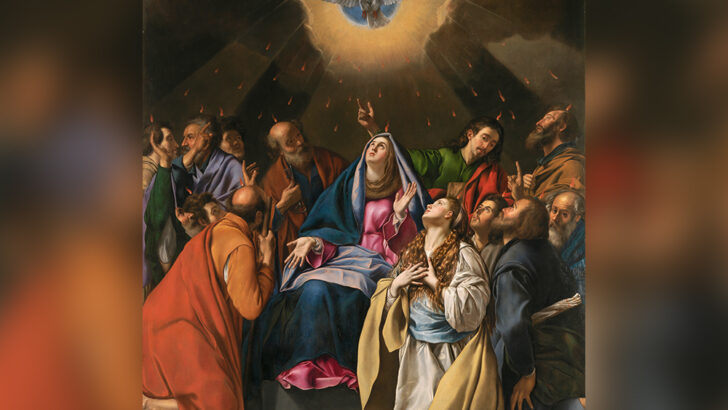
 ‘Pentecost’, by Juan Bautista Maíno (c. 1615–1620), depicting the coming of the Advocate, the Spirit of truth promised by Jesus. Photo: Wikimedia Commons / Public Domain.
 Acts 8:5-8,14-17; Psalm 66 (65); 1 Peter 3:15-18; John 14:15-21

You know him, because he abides with you, and he will be in you
The Gospel
John 14:15 Jesus said: “If you love me, you will keep my commandments.
John 14:16 And I will ask the Father, and he will give you another Advocate, to be with you forever.
John 14:17 This is the Spirit of truth, whom the world cannot receive, because it neither sees him nor knows him. You know him, because he abides with you, and he will be in you.
John 14:18 “I will not leave you orphaned; I am coming to you.
John 14:19 In a little while the world will no longer see me, but you will see me; because I live, you also will live.
John 14:20 On that day you will know that I am in my Father, and you in me, and I in you.
John 14:21 They who have my commandments and keep them are those who love me; and those who love me will be loved by my Father, and I will love them and reveal myself to them.”
Initial observations
This mysteriously inviting passage is the fruit of prayer, contemplation and discernment. As such, it eludes analysis; rather it invites a comparison with our own experience and stirs our own desire.
Kind of writing
(i) This is identifiable as belonging to the genre of Last Will and Testament. As often noted, in the OT and sometimes in the NT, the last speech of the main protagonist can be very important. A number of the typical themes can be found here: how will the followers manage after the master has left? Will he be present in another way? How should the followers behave in a practical way? In some ways, the answer to all three problems is the same: the Spirit will keep the spirit of Jesus alive and they will know this by their love; such love will keep them in the communion with the Father and with Jesus himself.
(ii) This particular realisation of the theme belongs in the much longer Final Testament of John 14-17. These reflections, placed by the author on the lips of the risen Jesus, are the fruit of deep prayer and experience of the spiritual gifts. In the profound discernment of the author, the word of the Lord to this community is a recognition of feeling orphaned, an affirmation of the Holy Spirit and an invitation to continue to love (horizontally and vertically, so to speak). The continued “seeing” of Jesus, is a matter of faith seeing in this Gospel.
(iii) In terms of the place of this excerpt, the following plan of the second half of the Gospel of John may help:
THE BOOK OF GLORY (13:1-20:31)
The Last Discourse (13:1-17:26)
- Making God known: the foot washing and the morsel (13:1-38)
- Departure (14:1-31)
iii. To abide, to love, and to be hated (15:1-16:3)
- Departure (16:4-33)
- Making God known: Jesus’ final prayer (17:1-26)
Old Testament background
(i) The language of “orphan” is found widely in the Old Testament, with a particular awareness of the vulnerability of the orphan. An experience of vulnerability, in the time “after” Jesus, lies behind this text.
(ii) There is a Wisdom background to the reflection here, taking up the sapiential tone of the Prologue: The beginning of wisdom is the most sincere desire for instruction, and concern for instruction is love of her, and love of her is the keeping of her laws, and giving heed to her laws is assurance of immortality. (Wis 6:17–18)
New Testament foreground
As is the way of John’s Gospel, key words here echo the use of key words elsewhere in the same Gospel text. In fact, the burden of the commentary below is made up of these cross references, a kind of echo reading to hear the resonances.
St Paul
Therefore, since we are justified by faith, we have peace with God through our Lord Jesus Christ, through whom we have obtained access to this grace in which we stand; and we boast in our hope of sharing the glory of God. And not only that, but we also boast in our sufferings, knowing that suffering produces endurance, and endurance produces character, and character produces hope, and hope does not disappoint us, because God’s love has been poured into our hearts through the Holy Spirit that has been given to us. (Rom 5:1–5)
Brief commentary
The “commentary” today is made up of other verses in the Gospel.
Verse 15 There is only one commandment, to love.
They who have my commandments and keep them are those who love me; and those who love me will be loved by my Father, and I will love them and reveal myself to them. (Jn 14:21)
Jesus answered him, “Those who love me will keep my word, and my Father will love them, and we will come to them and make our home with them. (Jn 14:23)
If you keep my commandments, you will abide in my love, just as I have kept my Father’s commandments and abide in his love. (Jn 15:21)
But whoever obeys his word, truly in this person the love of God has reached perfection. (1Jn 2:5)
For the love of God is this, that we obey his commandments. And his commandments are not burdensome… (1 Jn 5:3)
Verse 16 The Advocate in the Gospel is the Spirit; in the first letter of John, it is Jesus himself.
Now he said this about the Spirit, which believers in him were to receive; for as yet there was no Spirit, because Jesus was not yet glorified. (Jn 7:39)
My little children, I am writing these things to you so that you may not sin. But if anyone does sin, we have an advocate with the Father, Jesus Christ the righteous. (1 Jn 2:1)
Verse 17 The Spirit of truth means the Spirit of Jesus (the way, the truth and life) who brings the life of Risen Lord, into our hearts.
When the Advocate comes, whom I will send to you from the Father, the Spirit of truth who comes from the Father, he will testify on my behalf. (Jn 15:26)
When the Spirit of truth comes, he will guide you into all the truth; for he will not speak on his own, but will speak whatever he hears, and he will declare to you the things that are to come. (Jn 16:13)
We are from God. Whoever knows God listens to us, and whoever is not from God does not listen to us. From this we know the spirit of truth and the spirit of error. (1 Jn 4:6)
This is the one who came by water and blood, Jesus Christ, not with the water only but with the water and the blood. And the Spirit is the one that testifies, for the Spirit is the truth. (1 Jn 5:6)
Verse 18 The pattern here is presence—absence—presence in a wholly new mode.
And if I go and prepare a place for you, I will come again and will take you to myself, so that where I am, there you may be also. (Jn 14:3)
When it was evening on that day, the first day of the week, and the doors of the house where the disciples had met were locked for fear of the Jews, Jesus came and stood among them and said, “Peace be with you.” (Jn 20:19)
A week later his disciples were again in the house, and Thomas was with them. Although the doors were shut, Jesus came and stood among them and said, “Peace be with you.” (Jn 20:26)
Jesus then said, “I will be with you a little while longer, and then I am going to him who sent me. (Jn 7:33)
Verse 19 The second part of this tremendous verse call for deep faith.
Just as the living Father sent me, and I live because of the Father, so whoever eats me will live because of me. (Jn 6:57)
Verse 20 The mutual indwelling of the Father and the Son is extended to the believer. The “day” in this Gospel would seem to be the “now” of salvation.
On that day you will ask nothing of me. Very truly, I tell you, if you ask anything of the Father in my name, he will give it to you. (Jn 16:23)
On that day you will ask in my name. I do not say to you that I will ask the Father on your behalf. (Jn 16:26)
Verse 21 Very challenging for contemporary faith: the practice of love opens the believer to the love of God and the revelation of the Son.
Jesus answered him, “Those who love me will keep my word, and my Father will love them, and we will come to them and make our home with them. (Jn 14:23)
For the Father himself loves you, because you have loved me and have believed that I came from God. (Jn 16:27)
I in them and you in me, that they may become completely one, so that the world may know that you have sent me and have loved them even as you have loved me. (Jn 17:23)
Pointers for prayer
- The identity of Jesus is revealed as the Messiah and the Son of God, not with a display of human power, but as one who was prepared to suffer unto death to show us how our God loves us. How does the Passion story speak to you as a revelation of how God loves you?
- “If you love me you will keep my commandments”, and specifically the commandment to love one another (cf. 13.34). How have you experienced the love of God and love of those around you?
- Jesus is preparing his disciples for his imminent departure and for a future in which he would be with them in a different way. He would not ‘leave them orphans’ but send an ‘Advocate’ to ‘be with (them) for ever’. How have you experienced the presence of God with you in your life?
- Perhaps you have also experienced the challenge of preparing another (a child, a friend) for a time when you would no longer be physically together. Recall how you gave the message of your ongoing support.
- How have you experienced the presence and support of a loved one (parent, spouse, friend) when circumstances have separated you from them?
- The proof of the ongoing presence of Jesus with his disciples is that “I live and you will live”. Discipleship is about much more than rules and regulations. It is about being alive. How has discipleship helped you to be more fully alive?
Prayer
Faithful God who loves us in Christ Jesus, send your Spirit of truth to dwell within us, that we may always reject what is false, live by the commands of Christ, and be true to the love you have shown us.
Grant this through Jesus Christ, the resurrection and the life, who lives and reigns with you in the unity of the Holy Spirit, God for ever and ever. Amen.
Thought of the day
The greatest things you’ll ever learn is to love and be loved in return.” The following words, attributed to Pedro Arrupe SJ, may up lift and inspire. “Nothing is more practical than finding God, that is, than falling in love, in a quite absolute, final way. What you are in love with, what seizes your imagination, will affect everything. It will decide what will get you out of bed in the morning, what you will do with your evening, how you will spend your weekends, what you read, who you know, what breaks your heart, and what amazes you with joy and gratitude. Fall in love, stay in love and it will decide everything.”
Prayer
Jesus, you love the human race: let your love of us strike so deep a chord within us that our lives may resound to the music of that grace, drawing others to the leap of faith and the dance of joy.
Always be ready to give an account of the hope that is in you!
The first reading
Pet 3:13 Now who will harm you if you are eager to do what is good?
1 Pet 3:14 But even if you do suffer for doing what is right, you are blessed. Do not fear what they fear, and do not be intimidated,
1 Pet 3:15 but in your hearts sanctify Christ as Lord. Always be ready to make your defence to anyone who demands from you an accounting for the hope that is in you;
1 Pet 3:16 yet do it with gentleness and reverence. Keep your conscience clear, so that, when you are maligned, those who abuse you for your good conduct in Christ may be put to shame.
1 Pet 3:17 For it is better to suffer for doing good, if suffering should be God’s will, than to suffer for doing evil.
1 Pet 3:18 For Christ also suffered for sins once for all, the righteous for the unrighteous, in order to bring you to God. He was put to death in the flesh, but made alive in the spirit.
Initial observations
Our reading contains what is probably the most remembered line in 1 Peter: “Always be ready to make your defence to anyone who demands from you an accounting for the hope that is in you.” It has lost none of its relevance, of course. On the contrary, today it means even more! Given the times, it may be well to start not with some enquirer or opponent but rather with ourselves: how do I account to myself for the hope that is in me. The challenge before us all is to integrate faith and life. A not insignificant part of that integration is how I bring together my Christian convictions and my understanding of the world at large (science, history, psychology and so forth).
Kind of writing
Letter opening: 1:1-2
Thanksgiving: 1:3-12
Three main sections
Opening 1:13-2:10
Middle 2:11-4:11
Closing 4:12-5:11
Letter conclusion: 5:12-14
Our reading comes from the middle section, which is laid out as follows:
2:11-4:11 Living among the gentiles
2:11-12 Introduction
2:13-3:7 The Household Code
3:8-12 Mutual love
3:13-22 Following Christ’s example
4:1-6 Living in the Spirit
4:7-11 Responsibility towards all
Our reading come for the long motivational section on Christ’s example. The first section runs form v. 13 to v. 17. A new train of thought starts in v. 18.
Context in the community
The context for this writing was given in the notes for the Second Sunday of Easter.
Related passages
By his great mercy he has given us a new birth into a living hope through the resurrection of Jesus Christ from the dead, and into an inheritance that is imperishable, undefiled, and unfading, kept in heaven for you, who are being protected by the power of God through faith for a salvation ready to be revealed in the last time. (1 Pet 1:3–5)
Slaves, accept the authority of your masters with all deference, not only those who are kind and gentle but also those who are harsh. For it is a credit to you if, being aware of God, you endure pain while suffering unjustly. If you endure when you are beaten for doing wrong, what credit is that? But if you endure when you do right and suffer for it, you have God’s approval. (1 Pet 2:18–20)
Never say “Hard,” for whatever this people says is hard, but do not fear what it fears, neither be troubled. Sanctify the Lord himself, and he himself will be your fear. (Isa 8:12–13 LXX)
…from the pain of his soul, to show him light and fill him with understanding, to justify a righteous one who is well subject to many, and he himself shall bear their sins. (Isa 53:11)
Brief commentary
Verse 13 This rhetorical question sets the tone for the topic opened up. The word of eager is zelotes, used in the culture to refer the pursuit of virtues such as honour, virtue, truth, piety, righteousness, and justice. Of course, harm may come from fellow human beings but the relationship with God is secure.
Verse 14 This verse takes us back to an earlier section, 1 Pet 2:18-20 (see above). The writer seems to have in mind the eighth beatitude from Matthew 5: Blessed are those who are persecuted for righteousness’ sake, for theirs is the kingdom of heaven. (Matt 5:10) Suffering precisely for being righteousness seems to be part of the reality addressed by this letter. See 1:6–7; 2:12, 18–25; 4:12–19; 5:8–10.
Verse 14b-15a The writer makes use of Isaiah 8:12-13, from the Greek OT, the Septuagint (LXX), given above. It provides a longer version of a very common biblical command: Do not be afraid. To reverence or sanctify Christ in your hearts is not a matter of piety; rather, it means to keep the perspective of Jesus himself, who also suffered.
Verse 15b-16a Defence or apologia could point to antagonistic disputes or genuine enquiry. Hope here points directly to the resurrection, the great principle of all Christian faith and optimism. Gentleness (prautes) and reverence (phobos) could also be rendered humility and fear. These are first of all attitudes towards God, but also towards our fellow human beings.
Verse 16b This verse could not be more relevant: never give the opposition ammunition!
Verse 17 Suffering of some sort is inevitable and must be borne. But there is a special grace in suffering for doing and being good. Cf. 2:20; 4:15–16.
Verse 18 This verse is really the opening of a further reflection, taking us to v. 22. The one line included here hints again at the example and inspiration of Jesus himself (2:21–25; 4:13–16; 5:1, 9–10). Sacrifice is an important category in 1 Peter, underlining both the cost to Jesus as well as fulfilment of Scripture (Suffering Servant Songs from Second Isaiah; see Is 53:11 above). There is no notion, however, of penal substitution or punishment, so we don’t have to read the medieval doctrine of redemption into an early Christian text.
Pointers for prayer
- What is your experience of giving an account of the hope that is in you?
- What is your experience of suffering for your faith?
Prayer
God of our new life in Christ, help us to embrace and so live the gospel that others may be drawn to Jesus. When we must use words, let your Spirit guide us to speak with such gentleness and reverence that none may be turned away.
Peter and John laid their hands on them, so they received the Holy Spirit
The second reading
Acts 8:5 Philip went down to the city of Samaria and proclaimed the Messiah to them.
Acts 8:6 The crowds with one accord listened eagerly to what was said by Philip, hearing and seeing the signs that he did,
Acts 8:7 for unclean spirits, crying with loud shrieks, came out of many who were possessed; and many others who were paralysed or lame were cured.
Acts 8:8 So there was great joy in that city.
Acts 8:14 Now when the apostles at Jerusalem heard that Samaria had accepted the word of God, they sent Peter and John to them.
Acts 8:15 The two went down and prayed for them that they might receive the Holy Spirit
Acts 8:16 (for as yet the Spirit had not come upon any of them; they had only been baptised in the name of the Lord Jesus).
Acts 8:17 Then Peter and John laid their hands on them, and they received the Holy Spirit.
Initial observations
A two-stage evangelisation is pictured in today’s first reading. The first proclamation of the Good News is very powerful and this is followed by a more formal sending of Peter and John. At their hands, the Samaritans complete their becoming disciples by receiving the Holy Spirit.
Kind of writing
Philip and Simon Magus (Act 8:4-25). The author presents two stories combined: the Samaritans and Simon. In the full text, it unfolds in this way:
Introduction: v. 4
Philip, Simon, the Samaritans: vv. 8-13
- Philip and the Samaritans: vv. 5-8
- Simonís earlier activity: vv. 9-13
Peter, Simon, the Samaritans: vv. 9-24
- Peter and the Samaritans vv. 14-17
- Peter and Simon: vv. 18-24
Conclusion: v. 25
- 4 and v. 25 form an inclusio or frame. For the sake of clarity, this complex scenario is simplified in the Lectionary: vv. 5-8, that is, section 1 above and vv. 14-17, that is, section 3 above.
The reading concentrates on the Samaritans and omits the curious but distracting story of Simon Magus.
Context in the community
The layout of the Acts:
From Jerusalem (1-7)
Throughout Judea and Samaria (8-12)
To the ends of the earth (Rome) (13-28)
Once more, the reading comes from the middle section of the Acts, beginning with a somewhat complex presentation combining a proclamation to the Samaritans with a showdown with Simon Magus. This latter is omitted in our excerpt.
Related passages
In contrast to the other Synoptic Gospels, Luke has a special place for Samaritans: the parable of the Good Samaritan (Luke 10) and the story of the ten lepers (Luke 17). In keeping with that wider interest, chapter 8 of Acts is devoted to the preaching to the Samaritans. Elsewhere, Samaria is mentioned (Acts 1:8; 8:1, 5, 9, 14; 9:31; 15:3). The present story is the fulfilment of a promise earlier in Acts, which reads:
So when they had come together, they asked him, “Lord, is this the time when you will restore the kingdom to Israel?” He replied, “It is not for you to know the times or periods that the Father has set by his own authority. But you will receive power when the Holy Spirit has come upon you; and you will be my witnesses in Jerusalem, in all Judea and Samaria, and to the ends of the earth.” (Acts 1:6–8)
Brief commentary
Verse 5 The mission of Philip to the Samaritans contrasts with information elsewhere in the Gospel tradition:
These twelve Jesus sent out with the following instructions: “Go nowhere among the Gentiles, and enter no town of the Samaritans, but go rather to the lost sheep of the house of Israel. (Matt 10:5–6) And he sent messengers ahead of him. On their way they entered a village of the Samaritans to make ready for him; but they did not receive him, because his face was set toward Jerusalem. (Luke 9:52–53)
It is a little ironic that Philip, one of the seven and not one of the twelve, is the first to bring the Good News beyond Judaea to Samaria.
Verse 6 Samaritans expected their own “messiah” called the taheb. As “cousins” of the Jews, they are portrayed as also rejecting Jesus (see above). In this incident a break-through occurs and so they too are worthy to hear the Gospel.
Verse 7 The effectiveness of Philip’s preaching is illustrated dramatically and typically (cf. Luke 4:33-35; 8:28-33; 9:39-42). Signs are usually seen but now they are also heard because of the shrieking (JB translation). The healing stories are important and Luke’s purpose in the omitted section was to counter the claim or impression that Christian miracles were somehow indistinguishable from pagan magical practices. The similarities are on the surface, as Luke makes clear.
Verse 8 At a first reading, the power of this conclusion may not be clear. Behind it stands the story of Simon who cured “the least to the greatest”, that is, challenging established economic, gender and purity codes. The note that they listened “with one accord” had profound social implications and, therefore, “there was great joy in that city.”
Verse 14 This sending constitutes an official recognition of the mission outwards and also serves to consolidate the unity achieved between the Hebrews and the Hellenists (represented by Philip). The “word of God” is another word for the Good News in Acts: Acts 4:31; 6:2, 7; 8:14; 11:1; 12:24; 13:5, 7, 46; 17:13; 18:11.
Verses 15-16 In this way, Peter “verifies” the mission initiated by Philip. The “equality” of Philip and Peter helps to sustain the contrast between Simon Magus and both Philip and Peter, in the wider story.
Verse 17 This is often called the Samaritan Pentecost.
Pointers for prayer
- What to me are the signs and wonders which confirm the Good News in my own life and in the life of my community?
- There are stages in coming to faith—awakening and then confirmation. Can I name my own moments of awakening to faith? Who were the agents of its confirmation?
Prayer
Let your holy Word, O God, awaken in us a hunger for you. Let your Holy Spirit, loving God, come upon us that we may be witnesses to your power in all that we are and say and do. Amen.
31_01 – ‘Pentecost’, by Juan Bautista Maíno (c. 1615–1620), depicting the coming of the Advocate, the Spirit of truth promised by Jesus. Photo: Wikimedia Commons / Public Domain.
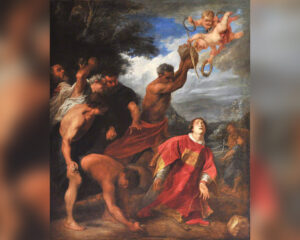
31_02 – ‘The Stoning of St Stephen’ by Anthony van Dyck (c. 1623- 1625) depicting the first martyr bearing witness with gentleness and faith. Photo: Wikimedia Commons / Public Domain.
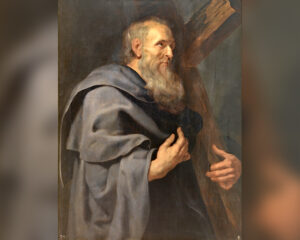
31_03 – ‘St Philip’ by Peter Paul Reubens (c.1611) from his Apostles Series. Photo: Wikimedia Commons/ Public Domain.
Hearers of the Word: The liturgy
Acts 8:5-8,14-17; Psalm 66 (65); 1 Peter 3:15-18; John 14:15-21
Themes across the readings
It is good that these readings are matched because the excerpt from John—very inspiring—risks sounding a little abstract or remote from experience.
The responsorial Psalm
Psalm 66 (65) is a splendid response to the reading. In particular, the note of joy is explicitly triggered the experience of God’s help, as in the reading from Acts: Come and hear, all who fear God. I will tell what he did for my soul.
Sunday introductions
First reading
Acts 8:5-8, 14-17
How do people come to faith and Christian community? This reading portrays two stages, which might challenge the way we do things. The starting point is awakening and only later comes the confirmation.
Second reading
1 Peter 3:15-18
This passage is often quoted because of the line “always have your answer ready for people who ask you the reason for the hope that you all have.” This is surely important, but the phrase before it is just as much a key: “Reverence the Lord Christ in your hearts.
Gospel
John 14:15-21
John’s Gospel uses a few times an expression for the Holy Spirit, which is “advocate”. We probably think “lawyer” and that’s not wrong. More richly, it means someone who stands along side you. Not a bad way to think of the Holy Spirit.
Weekday introductions
Monday 11 May
Acts 16:11-15
Today we hear of the founding of Paul’s first community in Europe. Philippians shows just how warm relationship became after these simple beginnings.
John 15:26-16:4
The word “paraclete,” strange to us, means literally the one who stands alongside someone, to plead for them. This is very like the Pauline vision of the Spirit helping us in our weakness. John’s Gospel, however, adds two extra dimensions, noticed in today’s Gospel: witnessing and remembering.
Tuesday 12 May
Acts 16:22-34
In biblical language, an earthquake symbolises the presence and action of God. In this extraordinary story, a truly astonishing reversal takes place.
John 16:5-11
Our Gospel reflects on the meaning of Jesus’ departure (death): it signals and enables the gift of the Spirit in a completely new way.
Wednesday 13 May
Our Lady of Fátima
Acts 17:15, 22-18:1
One expression from this reading is often quoted: it is in him that we live, and move, and have our being. The context for this marvellous affirmation is set-piece confrontation between Paul and the philosophers of Athens.
John 16:12-15
We are more aware, perhaps, than other generations of the importance of memory for our well-being and stability as individuals. It is important for us as believers as well and, fortunately, we are not alone. The Holy Spirit guides us not simply to retain the past but to live the future of our faith.
Thursday 14 May
St Matthias, apostle
Acts 1:15-17, 20-26
The writer of the Acts has great esteem for the Twelve and, as part of the continuity between the two Testaments, the “college” of the apostles is restored after the betrayal and death of Judas. The prayer of discernment shows confidence in God’s presence and inspiration.
John 15:9-17
What would you choose to represent the heart of the Christian proclamation? Following Jesus’ own example, our Gospel places at the heart of the Christian project the command to love. We may put “command” in inverted commas: really we are dealing with loving and being loved.
Friday 15 May
St Carthage, bishop
Acts 18:9-18
Enemies try to get the governor of Corinth to act against Paul, but Gallio sees through the ploy and dismisses the case. Gallio was governor from winter AD 51 to spring 52, so this scene helps us to put a date on Paul’s first visit to Corinth. Gallio’s brother was the better known philosopher Seneca.
John 16:20-23
In the Gospel of John there is very little “tension” towards the future, unlike other New Testament documents. Today’s reading, however, is an exception. We even find a standing metaphor from apocalyptic: labour pains. The insistent use of “joy” tells us what the Gospel writing has in mind.
Saturday 16 May
St Brendan, abbot
Acts 18:23-28
An important person is introduced in today’s reading: Apollos, a Jew from Alexandria. As a baptised Christian, he was a most eloquent proponent of the Gospel. Some Corinthians much preferred him to Paul, less able as an orator, it would seem.
John 16:23-28
In line with the literary genre of the Farewell Discourse, Jesus makes provision for his future role as intercessor and mediator. We may note, however, that unlike much traditional intercession, the Father already loves us and there is no need to persuade him to give what he already desires to give us.