

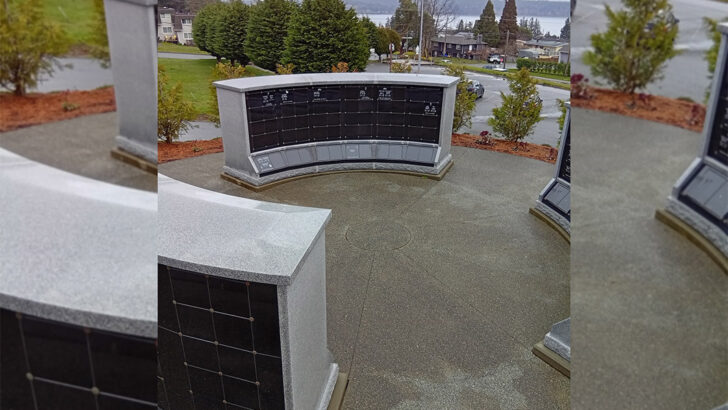
 A standalone columbarium in the grounds of St Patrick’s Church, Campbell River, Vancouver Island. Popular with people, who can visit with deceased family members when they come to the church. Columbariums are always open too (unlike the ones located in old mortuaries etc. in Ireland). Photo: Fr Bernard Cotter.
 Did you see the video showing a priest in Ireland bring a funeral eulogy to a premature close? Even in Canada I was able to view this. I felt sorry for the priest in question, as I have often felt like doing likewise. As a presider at funerals in Ireland for over 40 years, there have been times when the eulogy before Mass seemed to drag on and on, seemed to include details that were far too personal – and I could see people’s eyes glaze over as they struggled to listen. Yet I have never intervened; a priest just can’t do that. The funeral is too significant a moment, particularly in Ireland. As a priest presiding, I have learned to sit and listen (and sometimes fume too).

The only time for a priest to influence the eulogy is ahead of time, when he meets the family to plan the funeral Mass. In my home Diocese of Cork and Ross, only one eulogy is allowed, it precedes the Mass and is no more than five minutes long. Explaining this to a family, I suggest that if they need more time to speak, that’s fine; they might do so at the wake or at the graveside, after the prayers: there is plenty scope for lengthy eulogies there. But in the church, time is limited; a balance has to be struck between remembering the life that has ended and rejoicing in the God who calls us to eternal life.
Sentiments
This latter aspect is of course entirely lacking in secular funerals. All that is honoured is the life now extinguished; without the hope in eternal life that Christians hold dear, it’s all people have to cherish. For secular Canadians, a so-called ‘Celebration of Life’ is held to mark a death. Family and friends gather to record the loss and grieve together, but without the hope of ever seeing the person again.
I heard of one of these ‘Celebrations’ at an island near Victoria recently. A young mother had died in tragic circumstances, leaving two young children behind. A month later, up to 300 people gathered in the island’s community hall, for a ‘pot luck’ lunch. Some speeches were given, but the community dispersed in as much sadness as it had gathered, with the woman’s children remaining inconsolable; without Christian hope, a ‘Celebration of Life’ can only go so far to ease the pain of loss.
I did not find out how the ashes were eventually disposed of, or whether the family just took them home with them”
Catholic funerals at least provide that hope. I have attended three during my stay in Canada, all similar in structure to an Irish funeral Mass. In two cases though, the body had been cremated and the Mass centred on the ashes of the deceased, which felt quite odd.
I was particularly amused at the funeral of a priest who died in retirement, presided over by the bishop. A very brief eulogy was given by a relative of the priest before Mass started. Then the priest’s ashes were brought in with the Entrance Procession, and incensed and sprinkled with holy water once Mass was over. A reception followed in the adjoining church hall, and the priest’s ashes joined us for this also (!), placed in a shrine by the door. I did not find out how the ashes were eventually disposed of, or whether the family just took them home with them, as often seems to be the case.
Columbarium walls, where ashes are reverently placed so that people can feel close to their deceased relative’s remains, will eventually become widespread in Canada as well as Ireland. These also provide a necessary point of closure to the funeral rites.