

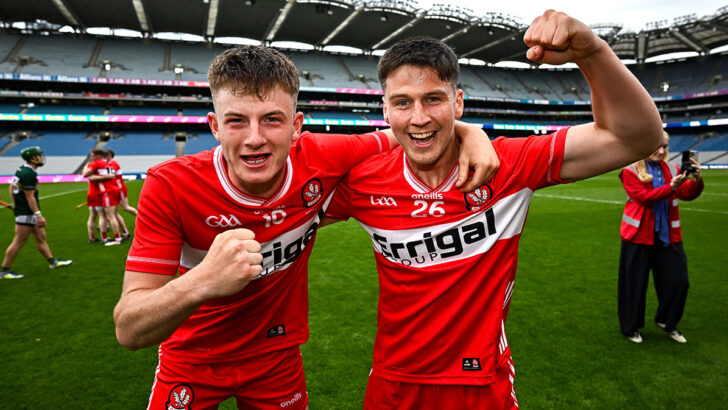
 Derry players Connor Melaugh, left, and Ryan McGarvey celebrate after their side’s victory in the Christy Ring Cup final match between Kerry and Derry at Croke Park in Dublin, May 30, 2026. Photo: Seb Daly / Sportsfile.
 For all but six of Ireland’s thirty-four hurling counties, the intercounty season is already over. Before the meteorological summer had even properly begun, the vast majority of counties had played their final championship match of the year.

For some their seasons ended not on packed terraces amid the glamour of a sold-out stadium, but in front of modest crowds at Croke Park, with limited television coverage and little national attention afforded to some of the biggest days in their hurling calendars.
For Derry, Longford and New York, however, those occasions represented the pinnacle. Promotion, silverware and a place in the history books awaited the winners of the Christy Ring, Nicky Rackard and Lory Meagher Cups.
Yet once those trophies were lifted and celebrations concluded beneath the Hogan Stand, only the Joe McDonagh finalists and the six remaining Liam McCarthy counties of Cork, Limerick, Clare, Galway, Dublin and Offaly remained standing as the summer reaches its climax, almost before it has even begun. For everyone else, the year is over.
That reality continues to jar. When compared to football, the imbalance is striking. While hurling’s championship is already approaching its conclusion, football’s All-Ireland series is only beginning to gather momentum. Even after the opening round of the Sam Maguire series, there remain almost twenty championship fixtures before the destination of the cup is decided in late July. For hurling, there are just five.
It is a contrast that poses difficult questions for a sport that, from the highest levels of the GAA, is supposedly seeking growth and expansion. Over the course of finals weekend, The Sunday Game devoted little more than four minutes of coverage to the Christy Ring, Nicky Rackard and Lory Meagher finals combined. Were it not for TG4, those occasions would have received virtually no television exposure at all.
Reality
The reality is that much of hurling’s lower-tier championship now survives on the efforts of broadcasters operating outside the mainstream. Were it not for platforms such as Clubber and StreamSport, many of these competitions would exist in something of a digital wilderness. Even the Joe McDonagh Cup, arguably the most important development competition in the game, struggles to command consistent coverage from either RTÉ or GAA+ with only the final being shown by the main broadcasters.
GAA Uachtaran Jarlath Burns has repeatedly spoken of his desire to strengthen hurling and leave a lasting legacy in that regard during his tenure. To his credit, significant steps have already been taken.
The establishment of the Hurling Development Committee under William Maher last year saw the creation of dozens of new underage hurling units in traditionally football-dominated areas, demonstrating a genuine commitment to broadening the game’s reach.
Recent years have shown just how transformative winning the Christy Ring Cup can be for developing counties”
Yet those initiatives can only go so far if the championship structure itself continues to limit hurling’s visibility. The lower-tier finals received only a fraction of the attention afforded to other major GAA occasions, despite representing the equivalent of All-Ireland finals for the counties involved. To the players, coaches and supporters of Derry, Longford and New York, as well as beaten finalists Kerry, Tyrone and Leitrim, these were the defining days of their season.

Significant
Derry’s triumph was particularly significant. After suffering defeat in three successive Christy Ring Cup finals, the Oakleaf men finally climbed the steps of the Hogan Stand as champions and secured promotion to next year’s Joe McDonagh Cup. Yet as that achievement unfolded in Croke Park, many of the county’s GAA supporters were travelling to watch the footballers face Armagh in the All-Ireland series.
Recent years have shown just how transformative winning the Christy Ring Cup can be for developing counties. Just ask Offaly, who defeated Derry in the 2021 final and now find themselves preparing for an All-Ireland quarter-final against one of Munster’s heavyweights. Or consider Kildare, who inflicted similar heartbreak on the Oakleaf County in 2024 before going on to secure consecutive promotions and trade blows with Leinster’s elite this summer in one of the most encouraging examples of hurling’s growth in recent years.
Derry now find themselves at a similar crossroads. A growing wave of momentum has swept through hurling on Foyleside. At the forefront of that resurgence has been Slaughtneil, whose remarkable success over the past decade has helped establish the club as the standard-bearers of Ulster hurling. Their dominance, built on thirteen consecutive county titles and consistent provincial success, has provided a blueprint for what can be achieved.
That emerging generation was central to Derry’s Christy Ring triumph, with young stars such as Rian Collins and Conor Melaugh playing pivotal roles”
Crucially, they are no longer carrying the county alone. The likes of Kevin Lynch’s and Lavey have begun producing serious talent at underage level, creating a pipeline that is now feeding into the senior setup.
That emerging generation was central to Derry’s Christy Ring triumph, with young stars such as Rian Collins and Conor Melaugh playing pivotal roles in overcoming a Kerry side that entered the competition as overwhelming favourites for an immediate return to the Joe McDonagh Cup following relegation last season.
Thriving
The possibility of football and hurling thriving side by side was also evident in this year’s Paddy Buggy Cup final between St Patrick’s Maghera and CBS Tralee The Green. The contest showcased the bright future of both codes within both Kerry and Derry and demonstrated that success in one does not have to come at the expense of the other.
Collins, the victorious St Patrick’s Maghera captain on that occasion, has already emerged as one of the standout young performers in Johnny McGarvey’s senior panel, having already secured himself an All-Ireland minor football medal with the county in 2024. For Derry, the Christy Ring victory represents far more than a trophy and promotion. It is another sign that hurling in the county is moving firmly in the right direction.
However, during his presentation speech to Derry captain Cormac O’Doherty, GAA President Jarlath Burns touched upon a challenge rarely discussed openly within the Association, yet one that lies at the heart of hurling’s developmental struggle outside of its traditional strongholds.
“You’ve been in three of the last hurling finals and lost all three, and many of your best hurlers will be lining out against Armagh today. Hopefully next year in the Joe McDonagh Cup they will play with the hurlers, which is the true native game,” Burns remarked.
The comment highlighted a reality familiar to many developing hurling counties. In football-dominated areas, hurling is often competing not only against other counties but against its own code for players, attention and resources.
If hurling is to continue growing beyond its traditional heartlands, it must not only be developed; it must also be given the space, visibility and prominence to thrive”
Derry’s Christy Ring triumph should have been one of the defining sporting moments of the county’s year. Instead, it took place on the same afternoon as a major football championship fixture, with many supporters understandably drawn elsewhere. Meanwhile for Kerry, their hurlers’ biggest day of all served as a warm-up to the county’s under-20 football triumph that followed soon after.
That, perhaps, illustrates the scale of the challenge facing hurling in dual-code counties. What amounted to an All-Ireland final for Derry hurling was forced to compete for attention with a first-round football championship game. No development committee, funding package or strategic plan can fully address that issue on its own.
If hurling is to continue growing beyond its traditional heartlands, it must not only be developed; it must also be given the space, visibility and prominence to thrive. At present, the structure of the season often creates the impression that hurling is something to be accommodated rather than actively promoted.
Meanwhile, the Nicky Rackard Cup final brought a very different issue into focus. It is one that has attracted relatively little attention since its introduction under Jarlath Burns’ presidency, but if current trends continue it is unlikely to remain under the radar for much longer.
New York secured a second successive promotion by edging past Tyrone in the decider, earning a place in next year’s Christy Ring Cup. On the face of it, that is an impressive achievement. Tyrone are among a number of counties investing enormous effort into climbing the hurling ladder and deserve serious recognition and credit for their work, yet it was the Exiles who ultimately prevailed.

Structure
However, New York’s success inevitably raises questions about the structure under which they compete. Unlike every other county in the competition, New York entered the Nicky Rackard Cup after the round-robin stage had concluded. While the other six counties endured a gruelling group campaign to earn their place in the knockout stages, the Exiles were handed direct passage to the semi-finals.
Under the current regulations, if New York win promotion from a tier, no county is relegated from that grade”
Mayo, for example, had to navigate five championship matches before facing New York in the last four. It was a similar story in the Lory Meagher Cup last season, where the Exiles entered at the semi-final stage before going on to defeat Cavan in the final. Given that Cavan have just three hurling clubs and did not field an intercounty side until 2017, their rise to the decider was precisely the type of development success story these competitions are designed to encourage.
Under the current regulations, if New York win promotion from a tier, no county is relegated from that grade. Furthermore, once promoted, they are granted a three-year period in which to establish themselves. Only if they fail to win a championship semi-final during that time are they automatically relegated.
The rationale is understandable. Asking counties to repeatedly undertake transatlantic travel would place a significant financial burden on already stretched county boards, while New York instead commit to spending a short period in Ireland each summer. Yet while the reasoning is clear, the optics and indeed the practicality are more problematic.
Traditionally, the top two teams emerging from the round-robin series contest the divisional final after earning their place through a demanding championship schedule. Since New York’s inclusion, however, the Exiles have been parachuted into a semi-final against the second-placed side.
Debate
At present, because the issue is confined to the third and fourth tiers, it has generated little public debate. But should New York continue their upward trajectory and eventually reach the Joe McDonagh and even the Liam McCarthy Cup, questions around competitive balance and fairness will become increasingly difficult to ignore.
More importantly, it raises a broader question. If the objective of these competitions is to develop emerging hurling counties, is a structure that affords one participant significant competitive advantages really serving that purpose?
The lower-tier competitions were established to develop hurling in the weaker counties, providing a pathway for teams to improve, compete and gradually climb the ladder. That was evident in the scenes of celebration as Longford secured promotion to next year’s Nicky Rackard Cup by overcoming neighbours Leitrim and claiming a third Lory Meagher title.
The issue is not New York themselves. It is the structure surrounding them”
It is within that context that New York’s current route into the championship sits uneasily with the very purpose of those competitions. The Exiles’ success should not come as a surprise. Their pedigree is impressive, and the quality within their ranks would be the envy of many counties operating at this level.
Former Galway All-Ireland winner Johnny Glynn is perhaps the most recognisable name, while former Waterford player Thomas Douglas adds further experience. They are also underpinned by a strong contingent of senior club hurlers from Tipperary, giving them a depth of talent that many developing counties simply cannot match.
There is nothing wrong with that. The Irish diaspora should be encouraged to play and promote the native games wherever they reside, and New York’s hurling community is one of the GAA’s great success stories. The issue is not New York themselves. It is the structure surrounding them.
Realities
There must surely be a fairer way to accommodate the logistical realities of transatlantic competition without granting advantages that other counties do not enjoy. After all, these tournaments are supposed to reward development, progression and achievement on the field.
Imagine if the same principle were applied at Liam McCarthy Cup level. After surviving the ferocious demands of the Munster and Leinster Championships, how would supporters react if New York were suddenly parachuted into a preliminary quarter-final? Or worse still, if their inclusion came at the expense of a county that had battled through the provincial championship to earn its place?
The reaction would be swift and uncompromising. Yet the principle is no different simply because the counties affected operate outside hurling’s traditional spotlight. If these competitions are truly about developing the game, then every county should be asked to travel the same road to success.