

 Peter Costello
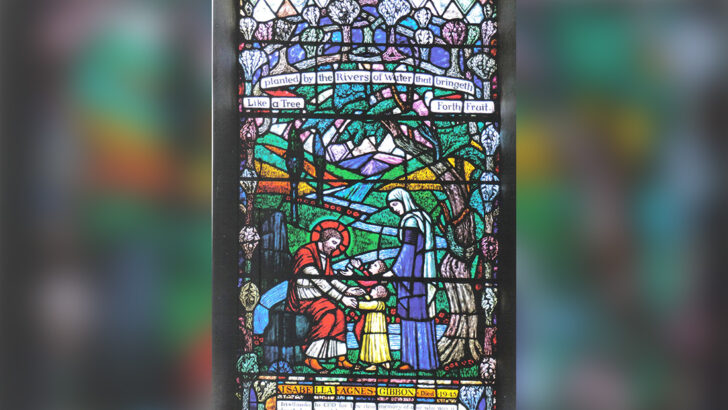 Christ Blessing the Children, window by Catherine O’Brien in St Nathi’s Church (CofI),
Dundrum
Christ Blessing the Children, window by Catherine O’Brien in St Nathi’s Church (CofI),
Dundrum Dublin’s Stained Glass: A guide to the finest twentieth-century windows,
by David Caron
(Four Fours Press, €29.95 / £24.95)
This is a book which will give delight as well as insight to those who enjoy nothing more than exploring our great tradition of stained glass, largely created since the beginning of the 20th century.
David Caron has devoted his career to the diverse trends of Irish stained glass. He is especially noted for his superb account of the career of Michael Healy at An Túr Gloine. He created, along with others, the Gazetteer of Irish Stained Glass, an enlarged version of which appeared in 2021.
That was a monumental work of co-operative scholarship. This book is very different. It aims to provide the ordinary “church crawler” with a guide to the best examples of stained-glass work to be seen in the greater Dublin region. Its production has been aided by Dublin City Council and South Dublin County Council.
Research
Though the research is all David Caron’s, the overall effect of this depends on the technical brilliance of Jozef Vrtiel, who is a master of the difficult art of photographing stained glass windows, which are in places intended to be lit by sunlight.
But amateur photographers in churches are often photographing contre jour, and the results are often disappointing. It is clear that Vrtiel places his lights outside: in his photographs the light streaming through from outside makes the glass glow with a warmth that cannot always be seen on site. The photographer is a real master of his technique.
The text is divided into accounts of what can be easily seen in Dublin City, in Dublin North, and Dublin South, covering both suburbs and county. The information about the individual artists is provided in detail in a final section, which includes data difficult to include in a mini gazetteer.
On glass work in churches, he denounced the easy reliance of Irish clergy on importing ready-made stained glass from Munich, in the Catholic kingdom of Bavaria, then an industrial centre”
Of course, this means a great deal is not included. In my own district nothing is said about the windows in Haddington Road, for instance, about which one of the parish clergy, Fr Patrick Claffey, wrote about recently. However, the equally fine windows in the Sacred Heart, Donnybrook, are included.
The Irish stained glass tradition dates back almost exactly to 1900. The Irish art critic Robert Elliot, in his historically important book Art and Ireland (Dublin, 1906), discussed art in the church, ecclesiastical architecture, sculpture and stained glass. On glass work in churches, he denounced the easy reliance of Irish clergy on importing ready-made stained glass from Munich, in the Catholic kingdom of Bavaria, then an industrial centre. His pages and illustrations strongly featured Michael Healy.
This book could be said to represent a Catholic contribution to the Irish Revival, one which is all too often overlooked by many critics of both art and literature.
Conscious of the already existing gazetteer of stained glass, this book concentrates on which might rightly be called the high lights. Of course, not all of the pieces are to be seen in churches or indeed in museums, for the itinerary begins with Bewley’s Oriental Café in Grafton Street, a set of windows that was the object of a recent civil action in the courts, which ensured that the windows would stay where they were intended to be.
Familiar
Most of the places will be familiar at least by name; though the interior of the Unitarian Church on St Stephen’s Green will not I think be familiar to many people.
For the rest the windows are all in Churches or religious edifices of various denominations. A reviewer would not care to pick among these, as all are worth seeing. However, I noted some unmentioned places, though not all these come within the 20-century era.
There is no reference for instance to the magnificent window, ‘My Four Green Fields’ (1939) by Evie Hone at the head of the main stairway in Government Buildings, Merrion Street (easily visited at weekends).
And they were astonished at his doctrines”
Then there is in the National Library of Ireland, albeit mostly from the 1890s, windows in the foyer and staircase with vignettes of literary figures from the past such as Dante, which Joyce and other literary folk would have so often passed.
Then there is the chapel in Trinity College, if only for one window, the memorial to Bishop Berkeley (the subject of much recent and badly founded abuse). The window shows Jesus preaching at Capharnaum, captioned: “… and they were astonished at his doctrines” (Luke 4:32) – as indeed people had been at the immaterialism of Bishop Berkeley himself.
But all in all, this is a book for those weekend excursions that some families (not devoted to sport) still make to interesting and inspiring places.