

 Peter Costello
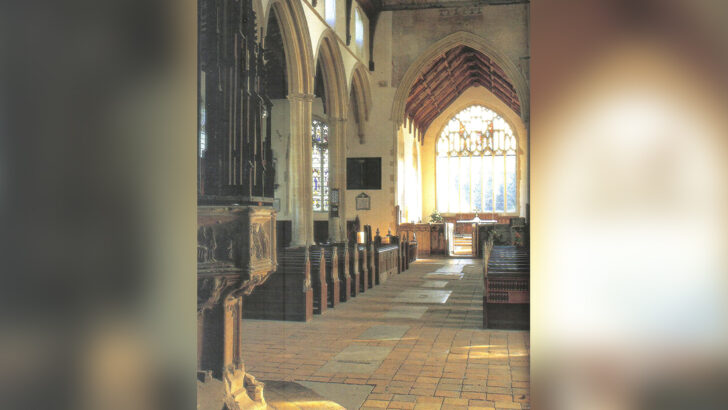 St Peter and St Paul, Salle, Norfolk’s ‘rural Cathedral’,
dating from the 14th century
St Peter and St Paul, Salle, Norfolk’s ‘rural Cathedral’,
dating from the 14th century England’s Thousand Best Churches,
by Simon Jenkins, with photographs from the Country Life archive
(Allen Lane, £50.00; also available in paperback)
This is not strictly a new book, but it is one which is very relevant to an important discussion for today: what is the future of our churches here in Ireland?
Some readers will like to know, too, that it was highly commended to its members by the Latin Mass Society in England on publication. This is not to say that Jenkins himself, a controversial writer in some respects with historic doubts about the very idea of Celtic culture, is a believer: he favours these churches, not as places to pray or worship, but as witnesses and figures of national history and culture.
Unlike, say, Sir John Betjeman or the painter John Piper, who were active Anglicans, who saw in churches and chapels something more than witnesses to the past, but rather living entities in their own right.
It is a model of the sort of book that has never been attempted in Ireland, but which ought to be before we have any more closures.
It is divided into some 47 sections, so that the districts of the large counties and cities can be covered in detail. It is certainly an epitome of what were once upon time Catholic churches, hence the interest of the Latin Mass Society.
Curious
However, without begrudging Jenkins’s enthusiasm, his own views are curious at times. He remarks in one place that Eamon Duffy “gives a partisan but fascinating account of the Reformation” in his important book The Stripping of the Altars, which suggests Jenkins has not fully absorbed the great losses of that period that the Cambridge historian described.
But more than that, the book is suffused with a sense of “Little England”: the churches and chapels of Wales and Scotland are simply ignored; though Betjeman and Piper were concerned with both. Jenkins himself comes from Welsh Congregational stock, so one might have thought that would make him attentive to the adherents of “the chapel in the Valley”.
Perhaps we should more seriously survey (in the style of Simon Jenkins) what we do have, including installed church art”
We were told the other week by an authoritative figure here in Ireland that we have “too many churches”. This is certainly a premise that needs some examination. There are, of course, those who think churches are “a good thing”, of which we cannot have enough.
But this critique is to see a church as merely a piece of real estate. Before deciding to close down any more of them, perhaps we should more seriously survey (in the style of Simon Jenkins) what we do have, including installed church art.
But pause a moment and consider further. All over the country, even within the Dublin conurbation, people are protesting about the withdrawal of services of other kinds. Banks are closing down branches wholesale, and reducing the number of ATMs as well. Everything should be online, the say.
Post offices
After the banks, come the post offices: five have closed in my area alone – though in fact the post offices should become hubs for the government information system providing what so many long for now, personal service (which is after all a vocation in itself).
After the banks and post offices came the pubs, the local store, and even the coffee shops. Among the clergy there is often airy talk about “community”, but this seems to be built often enough on a very narrow view of what that community is.
Yet is closure the future? Recent surveys in the United States have shown a distinct return to religion among the millennial generation, both among Catholics and evangelicals. The surveys suggest that vocations should soon follow. Here we might close the churches, and find them needed after all.
The other week there was a report from rural Tipperary of the return of a filling station cum “corner shop”, which with its provision of a coffee dock has become a small thriving social centre, reversing the feeling so many have of a slow decline of rural social life.
Closing a church would be even more damaging to ‘the community spirit’ than the loss of the bank, post office and public house”
Could it be that the same applies to the churches? Certainly, some Anglican parishes in the Dublin region seem to thrive in a way Catholic parishes do not.
Have some lost faith too soon then? Certainly, giving up too soon never got anyone to the top of the mountain. The Catholic church at a local level may well need a new model, and maybe that can be found in the communal organisation of the Reformed churches.
Certainly, closing a church would be even more damaging to “the community spirit” than the loss of the bank, post office and public house.
In the meantime, something more active might be done at a local level of writing and creating histories of the parishes as whole as communities and social groups within those communities. All those local historians so well trained at Maynooth should turn to this.
And they should remember that history is the history of the ordinary people, not the parish clergy, not the patriots, not the famous, but those with “day to day” lives. The sort of people indeed that Jesus preached to in the gospels.