

 David Quinn
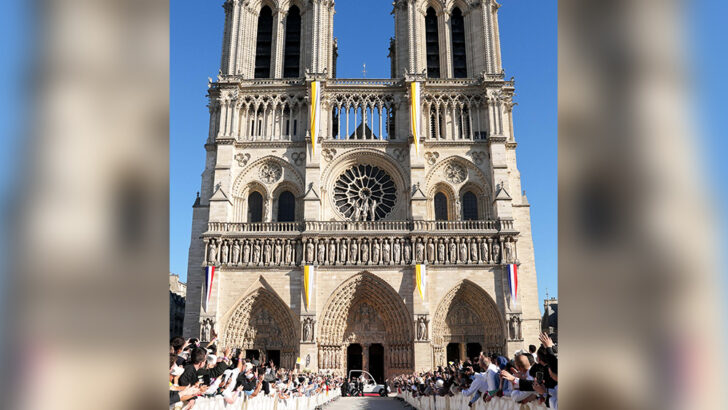 Pope Leo XIV greets the faithful from the popemobile outside Notre-Dame Cathedral in Paris, September 25, 2026, following the celebration of vespers. Photo: CNS / Lola Gomez.
 Pope steals the hearts of the French
Jacques Hébert was one of the most anti-clerical figures of the French Revolution. Hébert and his faction led the anti-Christianisation campaign that reached its peak in Paris in 1793. The campaign closed churches, persecuted priests who would not swear loyalty to the Revolution and converted some churches into ‘temples of reason’—including, to rub revolutionary salt into the wounds, the world-famous cathedral of Notre Dame.
Watching the massive crowds who turned out in Paris to greet Pope Leo on his visit to France last weekend, the historian Tom Holland commented, “Not a good day for the ghost of Jacques Hébert…”
Notre Dame Cathedral, despite the French Revolution, still symbolises French history and France itself more than any other building”
Pope Francis did not attend the reopening of Notre Dame last year following the terrible fire that almost destroyed it in 2020, and which involved massive rebuilding and restoration work. The sight of France’s most famous church being almost burnt to the ground struck French people to their hearts. Notre Dame Cathedral, despite the French Revolution, still symbolises French history and France itself more than any other building. It is a reminder that French history and destiny are still inextricably linked with that of the Catholic Church.
Factor
If the Church disappears completely as a factor in French life, then the major religion that will co-exist with secularism in France will be Islam—something no French revolutionary, never mind Jacques Hébert, would have imagined in their wildest dreams.
Pope Leo visited Notre Dame on Friday evening, the first day of his visit, in a very moving ceremony. The occasion was full of high points, but for many people the most memorable was the sight of him praying outside the cathedral in front of a beautiful statue of the Virgin and Child, the sun shining on its silver and making it glow as the crowd, and the Pope, sang Salve Regina.
The statue had been commissioned by King Louis XVIII around 1817. It was almost destroyed by anti-clerical rioters in 1831. We are lucky this beautiful work of religious art still exists.
But if the sight of Notre Dame Cathedral so superbly restored, with the pope of Rome visiting it, joined by a huge crowd would have both bothered and surprised Jacques Hébert, he would have been even more disturbed by the vast numbers—around 800,000 according to estimates—who lined the Champs-Élysées and filled Place de la Concorde the next day for a papal Mass.
Hébert could not but have been struck by the large number of enthusiastic young people in the crowd, or indeed by the scenes the night before when 80,000 youths filled Stade de France to pray and sing with the pope and watched a magnificently staged pageant involving hundreds of people celebrating the history of the Church in France.
It began with the legendary arrival of Mary Magdalene with Lazarus in France at the very beginning of Christian history. It was called the ‘Army of Saints’ or ‘saints tableaux’, and featured St Thérèse of Lisieux, St Joan of Arc (surrounded by knights), St Blandina facing Roman soldiers, St Bernadette Soubirous, St Vincent de Paul, St Catherine Labouré, among others.
In many ways it was the perfect antidote to the appalling opening ceremony in Paris for the Olympic Games two years ago, one that seemed to almost mock French history and featured a semi-blasphemous depiction of the Last Supper.
Following the Mass in Paris, Pope Leo moved on to Lourdes where he prayed in front of the grotto on the Saturday night and said Mass in front of another huge crowd the next day. While in Lourdes, he met with victims of clerical sex abuse.
He then went on to Metz, on the French-German border. This location is associated with Robert Schuman, a devout Catholic who was one of the founders of what is now the European Union. The city is also a symbol of reconciliation between France and Germany, having swapped hands between the two countries several times in wars over the centuries.
The figure tended to bump along at around 5,000 baptisms per annum, but next year it is expected that around 20,000 adults will be baptised”
Pope Leo’s visit presented certain challenges for the French State which is committed to the doctrine of Laïcité, which strictly separates Church and State. Pope Leo did meet French president Emmanuel Macron upon his arrival in France, but Macron did not attend any of the Masses, although his wife, Brigitte, did attend the one in Paris and so did various French political leaders, mainly from the right and centre-right.
Award
Macron wanted to award Pope Leo the Legion of Honour, but the Pope declined. The official reason was that the Pope was on an apostolic visit, not a State one, but some observers believe the refusal was partly motivated by the fact that France has just passed a law permitting assisted suicide which Macron enthusiastically supported. Macron was also an enthusiastic supporter of a measure that put a ‘right’ to abortion in the French Constitution two years ago.
The Pope’s visit was extremely timely. Although weekly Mass attendance in France is very low at just 5% or so, there is a growing vibrancy all the same which is most obvious in the big increase in adults coming forward for baptism. The figure tended to bump along at around 5,000 baptisms per annum, but next year it is expected that around 20,000 adults will be baptised.
In a country with 70 million people, that is a drop in the ocean in some ways and opinion polls would probably fail to detect it. Nonetheless, almost no one, including Church leaders, would have predicted this happening, and priests in many parts of France are reporting this big increase in the number of young French expressing an interest in the Catholic faith. In fact, the increase is so sudden, they have been caught on the hop.
They think several factors are driving the increase. One is that many young people are encountering faith-related material online. Another is the growing crisis of meaninglessness and alienation present in the lives of many young people, and the faith is an antidote to that. A third factor that some observers cite is the visible presence of the Muslim faith which is making some French wonder about their own historic faith. Currently, the number of Muslims who attend Friday prayer is not massively behind the number of Catholics who attend weekly Mass even though, on paper, there are far more Catholics than Muslims in France.
Pope Leo’s hugely successful visit will hopefully act to spur on the revival of interest in the Catholic faith in France, boost the number of adult baptisms and cause further worry for the ghost of Jacques Hébert.