

 Martina Purdy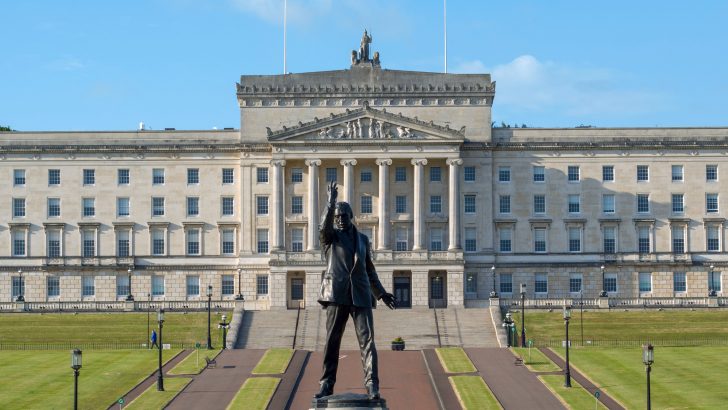
A leading politician – who once claimed he was indoctrinated at his Catholic grammar school – has been spearheading a highly controversial bill in the north of Ireland. Eoin Tennyson, an Alliance Party MLA at Stormont, wants to ban conversion practices related to sexuality or gender.
Some time ago, Mr Tennyson, a gay man, shared his experience of RSE (Relationship and Sex Education) lessons at school. “There was one — one — fleeting reference to same-sex couples,” he said, “which was met with laughter from teachers and pupils in the school.”
It was a wounding moment for the young Catholic teenager, scared to tell his parents, friends and family of his sexuality.
Now as an adult representing Upper Bann, Mr Tennyson is in a position to publicly platform his pain, and to change the law. His bill is aimed at criminalising conversion practices – and ending the “stigmatisation of LGBTQIA+ people.”
The intention, according to the bill’s explanatory notes, is not to criminalise religious beliefs but to target practices which go well beyond the expression of those beliefs.
Complaint
A key complaint is that the bill will criminalise conversation around Christian conversion. Critics say this law will do more harm than good. The DUP has warned that parents, pastors and teachers could face up to two years in jail or a fine if convicted. The bill, critics also say, is vague in defining gender and conversion therapy. Gender identity and sexual orientation seem to be whatever the victim or perpetrator considers it to be.
While there is an exemption in the bill for therapy carried out by medical professionals, the bill cites as problematic “any form of counselling or talking therapy, coaching or instruction”. Consent on the part of the “victim” is not a defence.
Paul Frew, DUP MLA, is among the fiercest critics. He suggested that a parent who advises a teenage girl who thinks she is a boy to “think about that for a couple of years” could be accused of suppressing the child’s gender identity.
Mr Tennyson has dismissed these fears as nonsense – pointing to a high bar for a criminal conviction, as “intent” must be proved. Maybe. But at the very least, the bill creates a chill factor. It certainly might make a parent, teacher or pastor extremely cautious before having a conversation with someone about their gender or sexuality.
Mr Tennyson nearly lost his composure the other day as he quoted from a study on conversion practices and the experience of “survivors”.
We can protect people from mistreatment without creating vague new offences that reach into homes, churches and private conversations”
I don’t think anyone would argue that there has not been harm done in the past to people who have same-sex attraction, sometimes involving cruelty, bullying or being locked up. Of course, this is unacceptable by any standards, Christian or otherwise. But we already have laws to deal with abuse or coercive behaviour.
“We can protect people from mistreatment without creating vague new offences that reach into homes, churches and private conversations,” said the DUP leader Gavin Robinson.
Critics of this bill go beyond Christians, parents and unionist politicians.
Dennis Noel Kavanagh, Director of the Gay Men’s Network, is a criminal barrister and a gay man. While Christians have been at times accused by critics of “praying away the gay”, Kavanagh complains of “real harm” being done to the gay community by the new trans and gender ideology. He even referred to those who “cheer on gay conversion at gender abattoirs” – a reference to sex change operations, the ultimate in conversion therapy.
This barrister described Tennyson’s bill, on his Twitter/X account, as “a dog’s dinner” with “an extraordinary level of ambiguity”. “It has nothing to do with protecting gay people, it’s all about smuggling in gender ideology nonsense and the threat of prosecution.”
He added: “This bill criminalises parents who do anything other than affirm.”
The bill however, has been broadly supported by members of the Alliance Party, Sinn Féin, and the SDLP – indeed the SDLP MLA Mark Durkan spoke of this bill in the most naive terms. What is disturbing is that many MLAs supporting this bill attended Catholic schools. How is it that they have failed so miserably to heed the warning of St Peter about ‘strange doctrines’?
Trans ideology is certainly a bizarre doctrine that denies biological reality, supports surgery and puberty blockers for minors and claims that there can be more than 70 genders.
I didn’t know whether to laugh or cry when Sinn Féin’s Emma Sheerin – who can certainly talk and shout – actually chided the DUP over its opposition to the bill.
“If you are a Christian then you acknowledge we are made in the image of God, so I don’t know why you are so obsessed with other people’s gender identity.”
Who wants to tell her that Genesis makes clear that God made them male and female?
Condemned
All too often those who stand up for the truth of Christ are condemned as “bad Christians”.
One Alliance MLA insisted that the bill should not be framed as “faith versus legislation”. Really? I think religious freedom is certainly threatened by this bill – how can you be free to practice your faith if you can’t talk about it to others?
Ruth Paterson, a solicitor and advocate for women’s rights, complained of repeated attempts to shut down reasonable discussion in the chamber. Deputy Speakers Carál Ní Chuilín of Sinn Féin was quick to shut down debate on the definition of gender. “It is not for MLAs to ask questions about how many genders there are?”
It is the job of MLAs to scrutinise and ask questions. And it seems that the same people who insist that you cannot change your sexuality also claim you can change your sex.
Whatever your views on “praying away the gay”, here’s a suggestion: sensible Christians should pray away this bill – and vote out politicians who embrace strange doctrines that are contrary to common sense nor Christian reason.
====
“Don’t forget to pray for Tom Cree,” my friend whispered as I rose to lead a holy hour on Sunday evening. “Who is Tom Cree?” I asked, perplexed. “Not Tom Cree – Drumcree!!” The next morning the headline could not have been clearer: an image of the little country church surrounded by Orangemen and supporters with the traditional headline: “Stand-off.” Winston Churchill spoke of the dreary steeples of Fermanagh. Yet there is nothing dreary about this steeple. What is depressing is that the stand-off between the Orange Order and the residents of the Garvaghy Road who objective to what they regard as a “coat-trailing” anti-Catholic march does not appear to have changed – the only alteration being the aging of the key players since the 1990s during which an innocent taxi driver was among those murdered by resentful loyalists over the blockade. The Garvaghy Road Residents are not faultless in this. But what really confounds me is how Christians can leave a Church service and then wish to offend their neighbour by insisting on their rights to walk a street where they are not welcome. What happened to shaking the dust from your sandals? I do wonder too what the Gospel passage was at the Sunday service. As I write this, it wasn’t recorded in any newspapers.
====
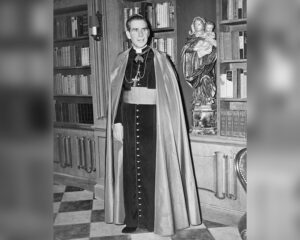
“A CATHOLIC media star” is not a phrase you hear too often these days. But an appropriate description of the newly beatified Blessed Fulton Sheen. I love his books – he writes so well about our Catholic faith and with great insight about Mary, his lady in blue, and of course Jesus, especially in The Eternal Galilean. I like to quote him first thing in the morning: “There’s God – and coffee!” In his last interview he warned the Church cannot be credible by copying the world. Among his last pieces of wisdom, “Modern erotic culture is a failure of purpose not merely a failure of rules!” You don’t have to be Catholic to know that, without purpose, we suffer. Indeed modern psychology states that without a goal we suffer severe distress that impacts our mind, body and soul. And that applies too when our goals are not rooted in life, truth and love. Is there any wonder there is a mental health crisis – which Fulton Sheen often highlighted?