

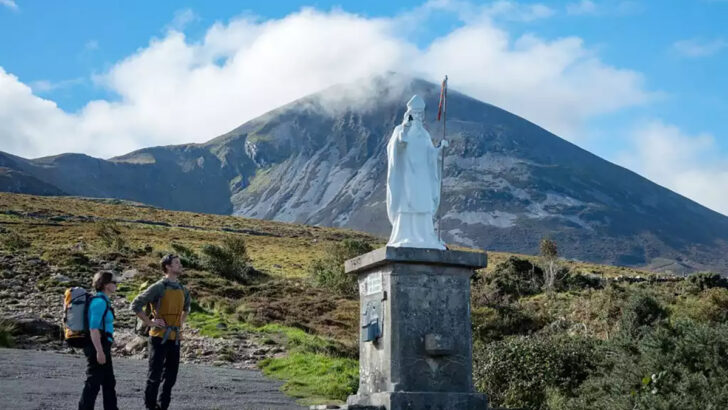
 Pilgrims prepare to start for the summit of Croagh Patrick. Photo: courtesy Ireland.com
 Discovering St Patrick,
by Thomas O’Loughlin
(Darton, Longman & Todd, €15.00 / £10.95)
St Patrick is universally identified with Ireland and the Irish. St Patrick’s Day is one of those few festivals that are celebrated around the world, so much so that it has become more of a carnival than a mere religious feast day.
In Ireland it is perhaps the climbing of Croagh Patrick at the end of July that is the more fervent celebrations, mingling a penitential exercise with a prayerful day out. Churches all over Ireland and in many other countries are dedicated to the saint wherever Irish people penetrated, even into the middle of Wall Street, where St Patrick’s Cathedral is shadowed by the towing skyscrapers.
But who St Patrick really was, and what we can truly know about him are important questions, still much debated. This very readable and scholarly account of St Patrick by a leading authority on the period will provide many readers with answers to their questions.
Patrick saw himself as a freeman of the Roman Empire, a Roman born in Britain and culturally distinct from the barbarians”
It is in two parts. The first part is a discussion of Patrick the man. The second is a study of his writings. And there are informative and useful accounts of two important ancillary subjects, the Christians in Ireland before the arrival of Patrick and the ministry of Palladius, the first bishop of the Irish.
At the outset Patrick states that he was from Bannavem Taburniae, a place yet to be located by scholars. However, there is a wealth of other more useful information to hand from his writings which are brilliantly harvested by O’Loughlin.
For him Patrick belonged to the ‘gentleman farmer class’. This he concludes from the fact that Patrick’s father was a ‘decurion’, a local minor Roman official, and his claim that he was born a freeman. Patrick saw himself as a freeman of the Roman Empire, a Roman born in Britain and culturally distinct from the barbarians. He was raised on an estate which had slaves. The slavers who kidnapped him killed some of them and carried off the rest of them.
The author even speculates that Patrick may have resided in an elaborate Roman villa, such as has been excavated in Kent and Dorset in recent years. Patrick’s family were Christian for at least three generations: his father Calpurnius was a deacon and his grandfather Potitus was a priest: and it may be assumed that he received the education appropriate in such a family. He would have spoken Latin and an earlier form of Welsh. As there were no seminaries, his advance from deacon to priest would have been overseen by the mentoring of other clerics.
Confessio
The author provides excellent English annotated versions of the Confessio and the Epistola militibus Corotici. It seems that the Confessio was Patrick’s response to a complaint by other bishops about his orthodoxy or rather lack of it. Patrick was a millenarian who believed that “the coming of the ‘Son of Man’ on earth’ was at hand. This put him at odds with mainstream Catholic teaching and justified a correction from his fellow bishops.
His response was the Confessio, an extensive account of his life and his mission to the Irish. It records his capture by the slavers and his time as a slave in Ireland, his escape, the return to his home and his subsequent ministry in Ireland. Many passages in it are prayerful soliloquies. Patrick’s letter to the soldiers of Coroticus was a formal condemnation of their murder of some of his young converts.
On discussing the earliest Christians in Ireland O’Loughlin begins with Ptolemy’s map which highlights a number of large harbours in Hibernia. Through these harbours travellers, traders and slavers entered the country, many of them Christians from Britain. Indeed, it seems that the earliest large groups of Christians then in Ireland were slaves who were either brought in, or kidnapped, from Britain.
This is a superb popular history indicative of a lifetime of research and study of the original sources”
Palladius has sometimes been confused with Patrick. It is known that he was the first bishop to minister in Ireland. But otherwise he is virtually forgotten within the traditional memory of Christians in Ireland and has been so forgotten since at least the seventh century.
This is a superb popular history indicative of a lifetime of research and study of the original sources. It undermines many preconceptions about Patrick. The translations of Muirchú’s early life of Patrick, of Patrick’s own writings and other material from the seventh century are particularly valuable. The list of sources and resources for further reading is formidable. Congratulations to Thomas O’Loughlin for this remarkable and readily accessible study of our national saint.