

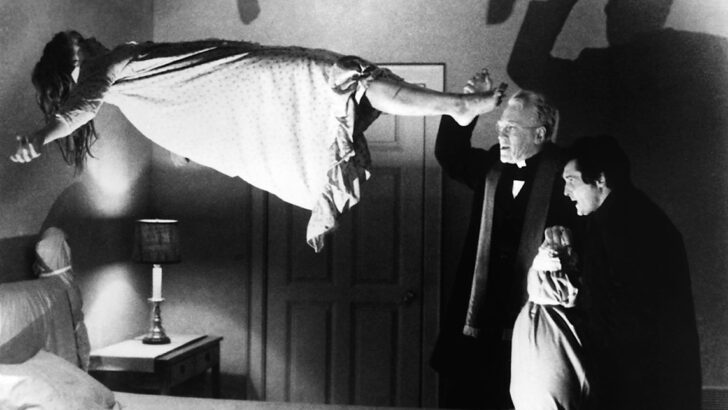
 A still from The Exorcist (1973), starring Linda Blair, Max von Sydow and Jason Miller. Photo: OSV news/Warner Bros.
 “Horror movies can actually help us have the sometimes awkward conversations, but in a safe way,” says Fr Ryan Duns SJ. “That’s my pitch whenever parents get nervous and say, ‘You’re teaching a course on horror at a Catholic school?’

“I tell them, honestly, they’re watching these films anyway. So why not baptise the genre? Why not show students that they can draw out a lot of good theology from the very movies they’ve been told not to watch?”
Fr Duns laughs. “Now, I’m not telling them to do drugs. That’s a terrible idea. But the movies are out there, and for them to work—for horror to really resonate—they draw on and presuppose a deeply theological worldview.”
A Jesuit priest and theologian with Irish roots from Achill Island, Fr Duns serves as Chair of the Theology Department at Marquette University in Milwaukee. “And I play Irish music professionally, so as a kid, I would go back and forth, for the Fleadh.”
Questions
His book Theology of Horror: The Hidden Depths of Popular Films, explores how the horror genre can open people up to deep spiritual and moral questions. An insight which began while he was teaching in an all-boys school in Detroit.
“I hit that sweet spot of what they were interested in,” he recalls. “I found that if I used images and ideas that were part of their culture and their imaginative furniture, it gave me an easier point of entry to talk about the faith.” Following the Jesuit call to find God in all things, Fr Duns describes himself as “a missionary of the imagination.” “I’m not great with languages,” he laughs, “so I decided to speak the language of culture.”
From movies to TV to campfire stories, horror has long held sway over the imagination. But why is that?
“I have two answers,” Fr Duns says. “First, I believe all humans are drawn to horror because we are made for mystery. There’s a not-knowing that gets us out of bed in the morning—a desire to discover, to ask questions. Horror, in an hour and a half, gives us a privileged, albeit bloody, place to raise those questions. Will we find an answer? Often, as in The Blair Witch Project, no answer comes.”
You know what you’ll never find in a horror movie? A moral relativist”
At the same time, he says, horror is a safe space to feel. “We don’t often let our students show emotion. They’re locked behind screens, told to perform, to be perfect. But horror gives them licence to feel fear, anxiety, even grief. You can scream your head off when Leatherface is chasing you and it’s okay.”
At a deeper level, Fr Duns argues that horror, far from being transgressive, is actually “the most conservative of genres.”
“You know what you’ll never find in a horror movie? A moral relativist,” he jokes. “If Leatherface is running after me with a chainsaw, my reaction isn’t, ‘Well, he’s living his truth.’ It’s ‘Oh, hell no!’”
The main conceit of horror is that it deliberately provokes a feeling of a known world being overturned by an unwanted reality. The characters (and by extension the viewer) start with some sense of order, then something breaks in to destroy it leading to a struggle then is to set it right again.
And here, Fr Duns sees a distinctly Christian pattern. “In Jesus’s world, the status quo was a world broken by sin. The poor, the lame, the blind – people accepted that they belonged on the margins. Then Jesus appears and, as Flannery O’Connor said, throws everything off balance. The outsiders become insiders. The blind see, the poor are liberated. Jesus enters the horror story that sin has created and reveals the anti-horror story we’re all called to work for.”
“You know, I like my Freddie Krueger, my Jason Voorhees, the fun stuff,” He says. But I recoil when horror targets the innocent -the elderly, the disabled, children, or pets. And the I look at Jesus, the Lamb of God, the one who takes away the sins of the world, brutally executed in public. That’s the horror story of a sinful and broken world. We see and hear it proclaimed every day at Mass.”
The Crucifixion
The Crucifixion, he says, is the definitive horror story, and the Resurrection its reversal. “As Christians, we should be comfortable with horror. It’s the story of our faith. The innocent victim exposes evil and shows us the way out of the horror story of sin.”
And as the Resurrection is one of both the body and the soul, similarly horror, Fr Duns emphasises, can bring us back to the body in a culture that increasingly disembodies us. “We’re becoming ex-carnate,” he says. “Our lives are lived in the digital cloud. Jesus did not become a JPEG, he became flesh. And we are better for it.”
It is this reality of the Incarnation which runs through culture’s continuing fascination with vampires and zombies. Figures obsessed with flesh and blood to feed their corrupted immortality. “Both have cheated death, but both remain slaves to it. The zombie devours endlessly, death begetting death. The vampire survives only by destroying others.”
You meet the one who conquers death—the one who offers us a share in eternal life—and that offends our sin-sick sensibilities”
By contrast, Christ’s Resurrection is the anti-horror ending: “Eternal life not as a transaction, but as a gift.”
“In a sinful and often cynical world,” he continues, “I think people are sometimes offended by Jesus because he is more monstrous – in the truest sense – in how concretely he embodies the values and vision of God’s kingdom. We’re more comfortable with zombies and vampires because we live in a death-obsessed, death-dealing culture.
“But then you meet the one who conquers death—the one who offers us a share in eternal life—and that offends our sin-sick sensibilities. When Jesus comes to us, we think, ‘That’s too good to be true.’ Or, if we’re complacent, it’s a nightmare because it means we’d have to change everything. And that, we don’t want to do.”
Laboratory
Horror films, for Fr Duns, act as a kind of theological laboratory. “They let us explore big questions in miniature,” he says. “Who can I trust? What do I fear? What do I worship?” While there isn’t space here to delve into the deeper meanings of each film, we can at least touch on a few key examples.
He points to John Carpenter’s The Thing, where paranoia tears a community apart. “How do we live and work together when we can’t trust one another?” he asks. “When lies and deception corrode our communion, the answer is clearly: we can’t.”
In The Exorcist, his reading is more interior. “Most people think ‘The power of Christ compels you’ is aimed at the demon. But maybe it ricochets back. Maybe the ‘you’ is the priest himself. The love of Christ compels him to lay down his life for a friend.”
Even modern films, he says, echo these old questions. In The Black Phone, he sees a meditation on providence and grace: “God writes straight with crooked lines.”
Horror often hides something theologically rich, even deeply Christological, in the most unlikely places”
Fr Duns makes it clear that the Word of God is active in the world. Invoking the Greek Fathers’ phrase logoi spermatikoi (seeds of the Word) to describe how truth is scattered throughout culture.
“If we believe Jesus is who He says He is, then we shouldn’t fear finding Him wherever He’s disclosed,” he says. “You’ll never hear me talk about a theology of pornography or arms trafficking—those are anti-human realities. But horror often hides something theologically rich, even deeply Christological, in the most unlikely places.”
“That’s what I go for,” he says. “I find Christ in the shadows, and then I tell my students: they aren’t as dark as you might think.”