

 Peter Costello
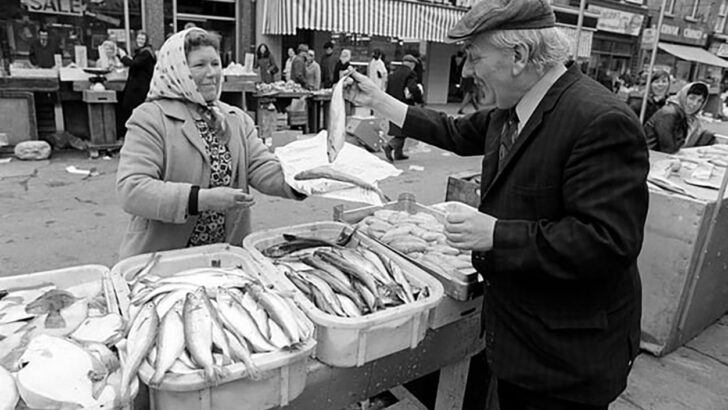 Popular actor Cecil Cheridan buy his fish
dinner from a street trader in 1973 - RTÉ
Archives
Popular actor Cecil Cheridan buy his fish
dinner from a street trader in 1973 - RTÉ
Archives
Dublin’s Women Street Traders, 1882-1932: “Civic Evil” and civil disobedience,
by Susan Marie Martin
(Maynooth Studies in Local History / Four Courts Press, €11.65 / £10.25)
The street traders of inner Dublin were affectionately known as “Shawlies” from their custom of wrapping themselves up against the dank weather in large black woollen shawls. They were often people who could not afford overcoats, whose men folk laboured on the docks or drove drays. These have long vanished, though here and there in the city as in the middle of Dublin’s fashionable Grafton street flower sellers still have a pitch or two.
But the old-style traders sold many other things, fruit, vegetables and fresh fish – never as I remember meats of any kind, for that was a controlled trade reserved for actual butchers, such as the original F. X. Buckley.
In my “small years” I often went with my mother not only to visit the traders in Moore Street, but also those nearer our home, who set out their stalls along Camden Street and Richmond Street. Indeed, many a Friday fast day was served by grilled herrings from Dublin Bay – a real treat now quite forgotten.
These ladies were such a presence that I picked up this new book with great interest. Susan Marie Moore in University College Cork’s Food Studies and Irish Foodways programme, is the author of an earlier book about Cork’s street traders. But this book covers, for me at least, more familiar territory. It is really quite a story.
Basically it is a tale of the old City of Dublin, which remember then controlled only the area within the two canals – those areas outside these were independent Townships, Pembroke, Rathmines and so on.
The city was then in poor shape, a weird mixture of 17th century decay, around St Patrick’s, 18th century splendour around Merrion Square, and 19th century commercial growth, as along Dame Street and O’Connell Street.
The middle-class population, those businessmen who had once “lived over the shop”, had retreated to the new suburbs, where they did not have to pay for the inner city. This lowered the city’s tax base. In the drive to improve the city it was thought that the street traders, say those huddled around the foot of Nelson’s Pillar or the narrow alley of Leinster Market, and other nooks and crannies, would have to go.
Streets
This took some time. Indeed, it was not done under the old regime, but the Street Trading Act introduced by the new regime in 1926, when indeed the city was under the direct control of the central government – the city council and mayor having been stood down, began the change.
So one of the first acts then of the new Irish State was to “tidy up the street traders”. The street traders were pushed into the back streets of the older city, into what the traders saw as “banishment to the slums”.
Of course, it was not a matter of provisions only, though as the author notes the city “lacked the facilities to provision the population” which was on an ever-increasing rise. Old clothes, small goods, pots and pans, secondhand furniture and house fittings, even books, were also sold from stalls.
In a curious way the battle of the women street traders against an alien authority replayed the course of nationalist protest in late Victorian days”
Yet Dublin never had anything quite like the “flea markets” of Paris, or the Portobello or Caledonian Road markets in France and England. But across European cities there were also proper streets markets, well controlled, as there still are. They are now seen as tourist attractions. Here in Ireland the government was not in the hands of “ the people”, but the merchant class.
In a curious way the battle of the women street traders against an alien authority replayed the course of nationalist protest in late Victorian days, except that the Gardai (largely recruited from rural parts) replaced the old DMP and RIC, the judges on the bench were “national-minded”, the city was run by settled politicians who now lived themselves in the comfortable suburbs such as Blackrock (de Valera) or Clontarf (or Gerald Boland).
Into her pamphlet Ms Martin packs a great deal of social and political history of a kind that is little known, often quite unknown to some I expect.
But the lesson of the whole story is one of civil resistance against the over heavy administration. The civil disobedience expounded by Thoreau and Gandhi came to Dublin’s “streets broad and narrow.”
But pause a moment: Molly Malone, who wheeled her wheelbarrow through those streets (supposedly around St Andrews church), “took of a fever and none could relieve her”. Those lines encapsulate the search for a sanitary city of Dublin led by such people as Dr Charles Cameron. There was a good case on both sides then. But I am afraid one’s sympathies go out to the “shawlies”, who were as I recall, ready enough to abuse those they saw “mauling the fruit” with a brisk word or two, or three if needed.