

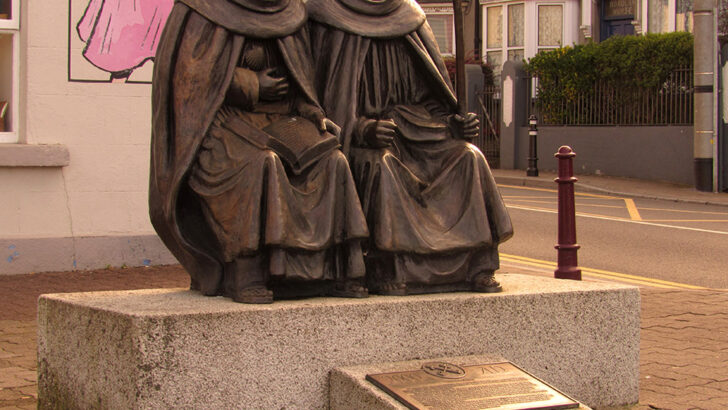
 ‘The Pilgrims’ statue in Mullingar. Photo: Wikimedia Commons / Aerobug, Grace.
 Serving as a priest in Mullingar, I often pass two bronze statues of Augustinian monks known as The Pilgrims in the centre of the town. One carries a pilgrim’s staff and haversack; the other holds the Scriptures and wears the scallop shell, the emblem of the Camino de Santiago de Compostela. Almost 800 years ago, in 1227, St Mary’s Abbey was founded in Mullingar by Bishop Ralph Petit of Meath for the Canons Regular of St Augustine and was later dissolved by King Henry VIII in 1539. In 1996, an archaeological excavation uncovered four skeletons wearing scallop shells, tangible evidence that medieval Mullingar shared in Europe’s great pilgrimage tradition. Today these statues quietly recall that rich heritage and point to one of the deepest experiences of the Christian life: Pilgrimage.

Pilgrimage is never simply about reaching a holy place. Whether crossing the waters to Lough Derg, climbing Croagh Patrick or walking the Camino, the outward journey mirrors an inward one. The journey itself—with its physical effort, the beauty of God’s creation in the surrounding nature, and the companionship of others—becomes part of the pilgrimage’s transforming grace. Through silence, prayer, repentance and grace, God reshapes the heart. The destination matters, but the deeper pilgrimage is the encounter with God along the way.
Journey
The word “pilgrim” comes from the Latin peregrinus, meaning a traveller far from home. Following the example of Abraham, who set out on a journey in faith not knowing where God was leading him, Christians have understood themselves as pilgrims. As Hebrews says, we are “strangers and exiles on the earth” (Heb. 11:13), seeking our heavenly homeland. In a text often prayed at the graveside, St Paul reminds us that “our true homeland is in heaven” (Phil. 3:20).
What should have been a sea journey of only a few weeks becomes a ten-year odyssey”
This longing for home echoes through some of humanity’s greatest stories. Christopher Nolan’s recent film The Odyssey has introduced a new generation to Homer’s ancient epic, whose central theme is the universal desire to come home. Even the word nostalgia comes from the Greek nostos (“homecoming”) and algos (“pain”): literally, “the pain of longing for home”.
After the Trojan War, Odysseus longs to return to his wife Penelope and to his homeland of Ithaca. What should have been a sea journey of only a few weeks becomes a ten-year odyssey, prolonged by pride, temptation and distraction.
One of Odysseus’ first encounters is with the Lotus Eaters. His companions eat the lotus flower and forget their destination. It is an image of “spiritual amnesia”, of how easily we too can become distracted by comfort, entertainment or ambition and lose sight of what truly matters.
His long journey has transformed him; he returns not as a warrior, but as a man”
Later come the Sirens, whose enchanting song promises knowledge and pleasure but leads the sailors towards destruction. Their voices represent the many temptations that ultimately draw us away from our true destination.
Then Calypso tempts Odysseus with the promise of eternal youth and immortality but he longs to return home to Penelope and Ithaca. Even an island paradise cannot replace the place and the people to whom he truly belongs.
Odysseus finally reaches Ithaca and is reunited with his wife Penelope, who remained faithful despite many suitors. Odysseus discovers that home is not merely a place but a relationship of love and belonging. His long journey has transformed him; he returns not as a warrior, but as a man, dressed like a beggar, humbled by suffering.
Pilgrim
The story of Odysseus speaks of something universal: we are all pilgrims on the journey of life. None of us knows exactly what roads lie ahead or what experiences await us. Like Odysseus, we carry within us a deep restlessness — a nostalgia, a longing for home and the love for which we were made.
Yet the Christian pilgrim walks by the light of faith, hope and love through the changing seasons of life. Along the way we experience responsibilities of daily life with the perseverance they demand, commitment and sacrifice, love and heart break, friendship and loneliness, success and disappointment, health and illness. Each joy and sorrow become part of the road by which God patiently leads us home.
Homer portrayed Odysseus as polytropos—a man shaped by many journeys and many turns. In a similar way, God forms each of us through the twists and turns of our own lives. The journey itself prepares us for the homecoming for which every human heart long.
We are all fellow pilgrims seeking the place where our deepest desires are fulfilled”
St Augustine understood this reality: “Our hearts are restless until they rest in [God]”. For St Augustine, the Christian life is a pilgrimage: “Though we labour among the many distractions of this world, we should have but one goal. For we are but travellers on a journey without as yet a fixed abode; we are on our way, not yet in our native land; we are in a state of longing, not yet of enjoyment”.
So, the two bronze pilgrims in the heart of Mullingar are far more than public street art. They remind us that every human life is a pilgrimage. Like the medieval pilgrims who set out from Mullingar for Santiago de Compostela, like Odysseus longing for Ithaca, and like St Augustine with his restless heart, we are all fellow pilgrims seeking the place where our deepest desires are fulfilled. Along the way God shapes us through every chapter of life until, at the journey’s end, we arrive at our true destination: communion with the One in whom our restless hearts find their rest.