

 David Quinn
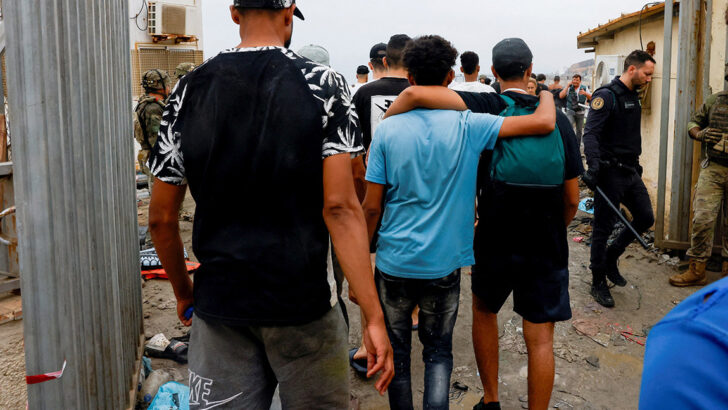 Migrants head back to Morocco from Cueta, Spain, July 31, 2026, after having just crossed the border into the Spanish enclave by sea and land. The Diocese of Cádiz and Ceuta offered emergency resources to civil authorities July 31 as more than 40,000 migrants crossed from Morocco into Ceuta, straining local infrastructure. Photo: OSV News/Jon Nazca, Reuters.
 Last week, something extraordinary happened at a place almost none of us had ever heard of before: 60,000 Moroccans, overwhelmingly young men, made the relatively short swim along the shoreline to somewhere called Ceuta, a small Spanish ‘exclave’ along the North African coastline.

Ceuta is a small town with 84,000 inhabitants. They witnessed tens of thousands of these would-be refugees arriving on their beach in the space of just 24 hours hoping to claim asylum, and then go and live in Spain proper, or maybe some other part of Europe, with Britain often being named. Who knows how many might have ended up in Ireland?
Many of those who made the swim (several dozen drowned on the way over in the crowded waters) were not even pretending to be fleeing persecution. They said they were seeking better economic opportunities, meaning they were all would-be economic migrants, not would-be refugees.
The vast majority swam back home after a couple of days. A small town like Ceuta was never going to be able to feed so many people and the Spanish government was never going to be able to get enough food there on time if it wanted to, which it didn’t. Therefore, they had to go home or starve.
Implications
But it raises the worrying and intriguing question, what would have happened if they could be fed? How many more would have arrived? The answer is certainly tens of thousands more. Then, if the Spanish Government began to move the ones who had already arrived to the mainland, countless numbers more would have arrived in the hope of the same thing happening to them.
Nothing like this could possibly have been permitted. It would have eventually overwhelmed not just Spain, but the whole of Europe. The people traffickers across Africa would have gotten the message and taken full advantage.
These traffickers are the people would-be migrants pay to transport them from one African or Middle Eastern country to another until they finally reach Europe. They make thousands of euros from each migrant. A big reason why it is mainly young men who make this trip is because it is dangerous and arduous and would be far too risky for most women who would be much more vulnerable.
Their families have pooled their resources and sent one person on ahead in the hope that they will gain residency”
You might remember the horrible case that occurred in Belfast a few weeks ago when a Sudanese refugee allegedly brutally assaulted and stabbed a man who was very lucky to survive the attack. A report in one of the British newspapers spoke to another Sudanese man who had made the trip from Sudan with the assailant via people traffickers. This man could only afford to get as far as Libya and is now stranded there. The alleged attacker had the money to make it all the way to Ireland.
The irony is that it takes a considerable sum of money to get to this part of the world via the people traffickers. Those arriving here are rarely the poorest of the poor. They either have money independently, or more likely their families have pooled their resources and sent one person on ahead in the hope that they will gain residency in a part of Europe and then can send for other members of their family via family reunification programmes.
Motivation
If you are a Moroccan man, it was relatively risk-free to make the swim to Ceuta and chance your arm, as it were. No wonder so many tried it.
But why did so many try it all of a sudden? Theories abound. One is that the Americans and Israelis were behind it. Spain’s socialist government is a fierce critic of both Donald Trump and Israel, and therefore both countries (the theory goes) wanted to create a crisis for Spanish Prime Minister, Pedro Sanchez. The idea is that they leaned on the Moroccan government and persuaded them to turn a blind eye as tens of thousands made their way to Ceuta.
Anyone arriving in Spanish territory by sea could not be automatically sent back”
But a Moroccan political writer named Zineb Riboua threw cold water on this. She said it was not in the interests of the Moroccan government to have bad relations with Spain, not to mention the rest of the EU.
She says that Islamists are doing their best to destabilise the Moroccan government by persuading young people they have no hope in Morocco. It suits the Islamists to say that the Moroccan Government is in league with the hated Israelis, and with Trump.
One certain fact is that the Spanish Supreme Court recently ruled that anyone arriving in Spanish territory by sea could not be automatically sent back. The people smugglers then told Moroccans to test the ruling, which they duly did.
Concerns
Another factor is that the Spanish government (which is mired in corruption scandals, by the way) is extremely soft on illegal migration. It recently announced an amnesty for all illegal migrants who have arrived in the country in the last few years. The government expected 500,000 people to apply for the amnesty, but over one million did so in the end.
This has worried other governments across the EU. Will some of those one million eventually arrive in other European countries, including Ireland? And will the Spanish amnesty attract many more migrants to move illegally to Spain? Almost certainly.
Spain has become Europe’s illegal migration underbelly thanks to the policies of the Sanchez government. The Ceuta incident finally snapped the patience of nearly every other EU country. A letter last week criticising the Spanish government’s ultra-liberal immigration policy was signed by the leaders of 22 of the 27 EU member-states. It was sent to European Commission President Ursula von der Leyen, European Council President António Costa and our own Micheál Martin, because Ireland currently holds the EU presidency.
The Ceuta incident also shows the vast numbers who would come here from much of the rest of the world”
The letter directly criticises Spain for creating “pull factors, such as the regularisation of [a] very large number of irregular migrants.” A “pull factor” draws people to a given country.
The Ceuta incident certainly strengthens the case of nationalist parties across the EU that the EU is not doing enough to protect its borders, especially when one member, in this case Spain, has such a lax immigration policy which affects everyone else.
The Ceuta incident also shows the vast numbers who would come here from much of the rest of the world given half a chance and therefore how vital border security is. It shows what open borders would look like. Even the Vatican has borders (and walls), and with good reason. Every country has a duty to protect its own citizens, especially its poorest. Yes, we must help legitimate asylum-seekers as best we can, and permit a certain amount of economic migration, but no, we cannot help all the world. That is simply not possible, or moral, because it would be so self-destructive.