

 Martina Purdy
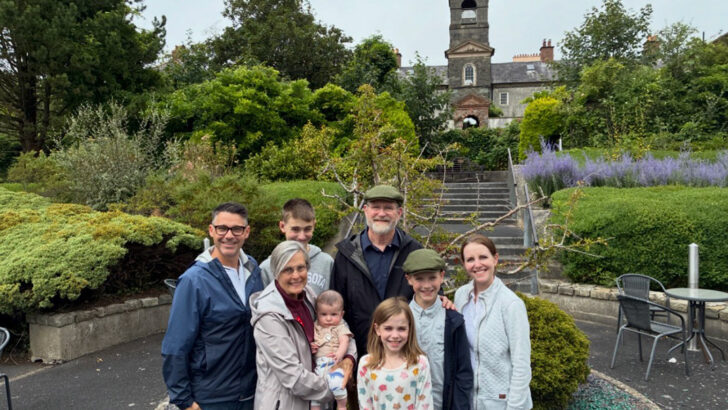 Author & evangelist Jeff Cavins with wife Emily and their family in Downpatrick.
 Jeff Cavins has a gift for communicating the Good News – with wit, insight and a boldness that cuts to the chase and the heart. More than a decade on, I still remember his refreshing talk at a Faith and Life convention in Belfast. The leading American evangelist, and biblical scholar, was addressing an audience of mostly married couples. “Ladies,” Jeff Cavins asked in a mischievous Midwest twang, “does the way your husband breathes ever bother you?”

As the audience tittered, Cavins declared, “I can help you with that.” Everyone – not just the married women – leaned forward in silent anticipation as Cavins announced, rather theatrically, that the answer lay in St Paul’s letter to the Colossians (3:13) “Beeaaarrrrrrrrrr with one another!”
We all slumped back in our seats – amused and resigned to the fact that love, patience, and forgiveness can take effort.
Born and raised Catholic in Minnesota, he quit the Catholic Church as a young man, disillusioned – and influenced by the passion that his new girlfriend Emily and her evangelical friends had for Jesus and for scripture. Their youthful zeal made Catholics at Mass seem like “zombies”. Cavins married Emily and became a Protestant pastor for twelve years before scripture study led him back to the Catholic faith and new life. He regularly hosted EWTN’s Life on the Rock. He has authored several, including ‘Walking with God’, and created the Great Bible Study Programme – an excellent adventure into scripture.
Cavins also teaches at St Paul’s Seminary in Minnesota, leads annual pilgrimages, and is involved in prison ministry.
Cavins returned to Belfast last week, giving a thought-provoking talk on ‘anger’ at St Peter’s Cathedral, as part of a Saints of Ireland pilgrimage that he and Emily are leading.
Journey
Cavin’s third pilgrimage to Ireland is a family affair – among the 80 pilgrims is their daughter Carly, son-in-law Patrick and four grand-children. This pilgrimage has an added poignancy following the death of his parents and revelations about his Irish ancestry.
“Growing up all I really knew was that I was Catholic and I was Irish, and that my ancestors left Cork and came to the United States,” said Cavins who shared details of his heritage in a stunning talk (now online) at St Peters. He began by recalling Patrick Rooney, one of the first victims of the Troubles. Patrick was killed, aged nine, by a stray bullet in his bedroom on August 14, 1969. “He went home,” said Cavins, “to get some rest because the next morning, he was going to serve here at the altar.”
We don’t understand the purpose of anger. And so we usually give in to the least common resistance”
Cavins’ composure faltered as he spoke of this child and his own great great grandmother, Ellen Moran who emigrated with Michael Judge; the couple were married and settled on a farm in Iowa, where they experienced persecution from Protestants in the 1860s. After the celebration of Mass, they were warned: “We don’t do that around here, you know.”
Undeterred, Judge continued to smuggle priests from a local town called Ottumwa until two men rode in on horseback, in long coats and shot him dead; his widow Ellen would eventually marry Cavin’s great great grandfather, Mark Crane. “I always wondered why I ended up the way I ended up – obviously strange,” he smiled. “Why was I on fire for the faith? I didn’t understand my own roots…”
“I began to conclude that I have ancestors who also had trouble, and they could be praying for me.”
His ginger hair now tinged with silver, Cavins admits he also inherited a quick temper. “The easy way out was for me to say, ‘I’m Irish – what do you expect?’ It was when I met Jesus that God began to deal with me about my anger.”
“We don’t understand anger, and we don’t understand the purpose of anger. And so we usually give in to the least common resistance, and we blow up. And we blow up quite quickly.”
Cavins advised slowing down, pausing for prayer or just counting to ten.
And he distinguished between ‘good anger’ over perceived injustice and the hot emotion that arises when we are inconvenienced. “We must get on top of it quickly,” he said.“There’s an old saying – speak when you are angry and you will make the best speech you ever regretted.”
He reminded us that anger can become very destructive if it is not directed towards moral virtues, and harnessed by God’s love. “Ephesians,” Cavins declared, “says be angry but do not sin.”
Cavins spoke of how a bereaved mother turned her rage over her daughter’s road death due to a drunk driver into a crusade to change the law.
I caught up with him in Downpatrick, where he recalled that St Patrick did not give into ‘bad’ anger. “To go back to the people who hurt you – the people who enslaved you – that takes a supernatural charism. That’s not natural. People don’t do that. They stay away from the people that hurt them or take revenge. And he came back with the Good News – with courage and bravery that only the Holy Spirit can provide.”
He shares St Patrick’s passion for evangelisation.
“One of the big problems that we have today is that many people believe that to be a Catholic is simply to believe the right things and go to church. That, if anything, is the beginning. That is not what we are called to do. Nurtured by the Eucharist and the family of God, we are called to literally, with Christ in us, walk among people as Jesus and carry on his ministry.”
Share
How do we take that ‘Good News’ to an increasingly confused and hostile world? “Speak the truth in love, lovingly confront them, and be part of their life and let that light shine, and go beyond just living among them by being equipped to share the Gospel and to carry out the work of Jesus.”
He cites two common excuses Catholics use to avoid evangelisation: “It’s not my gift” or “I don’t know enough”. “This has nothing to do with personal gifts. It has to do with love and relationship. You’re sharing a person, Jesus Christ, who is big and dynamic and colourful, loving, merciful, kind and forgiving. And many of the saints didn’t know a lot of theology. But they knew Jesus and they shared Jesus with people.”
“We make it way too complicated.”
Cavins warned against becoming distracted from our relationship with Jesus”
He said it can be as simple as telling someone: ‘I want to introduce you to Jesus’ – “Jesus can handle himself. Sometimes the simple witness of what Jesus has done in your life is the most powerful witness.”
Cavins warned against becoming distracted from our relationship with Jesus. Years ago, he noticed he was actively “consuming the faith” – learning the catechism and all about the church – while praying only intermittently. “I made a prayer to the Lord – I wrote it down on an index card: ‘Lord I don’t want to lose track of you’. I wanted that from the time I wake up to the time I go to bed, to be conscious of His presence in me, and his mission through me.”
He said he is “sad” about the state of the faith in Ireland. “When you see a place that was so rich in their faith and had such an impact on the world as a result of what Jesus said to do and then you see it affected by, as we are in the United States, cultural trends, modern philosophies, confusion over gender, the very issue of life itself, the unborn. There is nothing happy about that.”
He intends to return to Ireland on mission next year.