

 Peter Costello
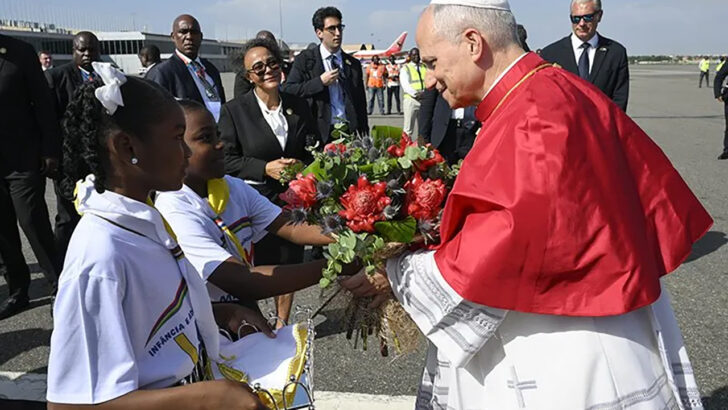 Pope Leo arrives in Angola on his recent trip across Africa. Photo: OSV News / Simone Risoluti, Vatican Media.
 Michael Collins will be a familiar figure to readers. For many years he was an important commentator for international television services on events and personalities in Rome. He brings all that experience to bear in this new biography of Pope Leo XIV. This is the second biography of the Pope to come to hand recently, and I think it can be said that this one is a better read than an earlier one by an American writer.

This, I think, is due to the fact that Michael Collins brings an Irish sensibility to a European view of the new Pontiff and deals from this perspective with the matter of Robert Prevost being “An American Pope”. If you want to read a book that is both au courant and well grounded in the past, this is it – at least as I said before, until those monster biographies so beloved of American writers and journalists begin to arrive in the autumn.
Michael Collins does not make the assumption that his readers will all be Catholics, as so many religious writers do. He starts off with a chapter giving a brief outline of the development of the Papacy and how the office Supreme Pontiff has developed and, more importantly, changed over the centuries.
Collins then turns to Robert Prevost. He outlines his family history – which was it seems more rackety than one might have imagined, his respectable immediate family, and his boyhood and education in Chicago. Very early in his life Prevost, a pious and attentive boy, seems to have been destined for the priesthood.
Qualities
His qualities were quickly recognised by his Augustinian teachers and he was soon on the path to the priesthood as a member of the order, and to an education in Rome itself in Canon Law. This achievement makes him distinctive from other recent popes, and his trained legal mind is seen by Michael Collins as one of his great assets. Every problem he faces is carefully weighed and considered; nothing it seems is off the cuff, or merely superficial.
However, from Chicago, Prevost found himself sent off to Peru. This was an even more formative experience, perhaps the essential one for his outlook. He eventfully rose to become prior of the Augustinians, an office of great responsibility. His talents again marked him out, and he was brought back to Rome by Pope Francis to undertake more universal tasks. Already, there were some who saw him as a possible future pope.
If Pope Francis had been seen as a short-term pontiff, now the feeling was that a younger man with a longer reign was required”
So much for the first half of Michael Collins’ book. The second half, covering some five chapters, deals with the last period of the papacy of Pope Francis, and its attendant difficulties, both scandalous and financial. The pope’s not unexpected, but much-lamented death follows. Then the mind of the Church, or at least of the conclave of Cardinals summoned to Rome, was focused on the choice of a new pope. If Pope Francis had been seen as a short-term pontiff, now the feeling was that a younger man with a longer reign was required. Prevost at 69 fitted that role.
From his long years as a reporter from the Vatican, Michael Collins has a keen eye for the telling detail, and he has collected a great deal of moving moments which he recounts with great skill while carrying his narrative forward at a steady and unhurried rate.
Problems
In his final chapter, significantly entitled ‘Challenges for Leo’, Michael Collins provides a budget of problems that face the new Pontiff. That title means in Latin ‘Bridge Builder’, and it is as a person dedicated to seeking peaceful resolutions and improved relations between all kinds of groups that seems to mark this moment in Robert Prevost’s life.
Those problems include the governance of the Church itself, the role of women and the scandals of abuse. One simple change provides subtle advance from Pope Francis, with a move away from blessings for same sex marriages. An internal Vatican report on the matter of female deacons in the Church deemed the subject to require more theological investigation: the door was not closed.
Inevitably, however complete their text, no author can be fully up to date. Since this book was sent to the printer some months ago, we have seen the extraordinary clash of the President of the United States with Pope Leo.
To smooth that abrasive moment, President Trump sent his Secretary of State Marco Rubio, a cradle Catholic of Cuban origin, to Rome. But last week he also put forward at an event in Florida the idea of Rubio and J. D. Vance, who had attempted to correct the Pope’s theology, as “a dream team” (in the parlance of American baseball). But which of them would be president and which would be assigned the secondary vice presidential role (never a truly influential post), was not made clear.
Difficult
However, it is really difficult to see that the popular base of the Republican Party, lying as it does among evangelicals with very own fixed historical views on the Pope in Rome and Catholicism, would accept an all-Catholic ticket in 2028.
However, it is the upcoming autumnal midterm elections that may prove to be the most telling for the future of the Republicans, the Democrats, the progressives and conservatives, and even for the notion of democracy itself in the USA.
One fears that President Trump’s penchant for loose and over colourful language will lead to yet more standoffs with the Vatican. In these circumstances, the steady, solid, legal-minded Leo XIV may well be just the right person to fill the chair of Peter. Already some may be thinking just how providential the election of Robert Prevost may have been.