

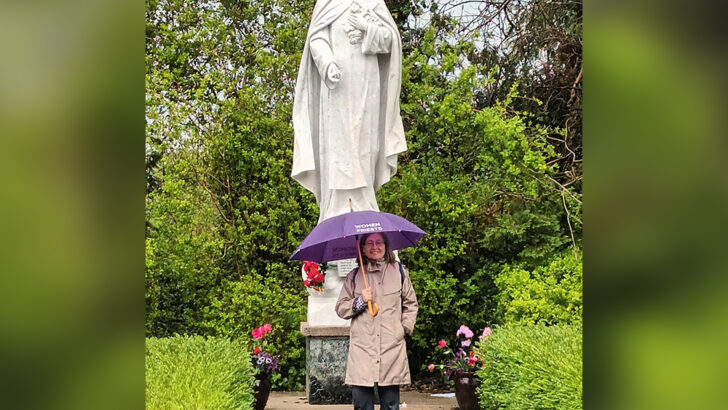
 Soline Humbert at with a statue of St Thérèse of Lisieux, in
Knock. Photo: Colm Holmes.
Soline Humbert at with a statue of St Thérèse of Lisieux, in
Knock. Photo: Colm Holmes.
For decades Soline Humbert’s name has been associated in Ireland with the debate over women’s ordination. Her recently released memoir, A Divine Calling, is as she says, “the story of a call that will not let me go.”

Born in France and later making her home in Ireland, Ms Humbert lost her mother at 12 and first sensed God’s call as a teenager at Trinity College Dublin. At 17 she had what she describes as a decisive encounter with God. “I had known about God’s love,” she says, “but now I experienced it, like falling in love with God.”
Only months later came what she calls the “disturbing part”: a sense that God was calling her to the priesthood. “In 1974, in Ireland, that was unthinkable. I wondered if I was mad. I had no one to talk to. I ended up in a very dark place… I didn’t know what to do with it.”
For years she set aside the experience, marrying Colm Holmes, raising two children, and building a family life. “I thought: that chapter is over,” she says. But in 1990 the old sense of vocation returned “like a volcano that erupts again. I hadn’t asked for it. I was the first one disturbed by it. But I realised I couldn’t keep saying no.”
Ms Humbert often compares a vocation to a pregnancy: “You carry it inside you; it’s alive; you have to bring it to birth. If you don’t, you are half-alive, as if in a tomb. When I finally said yes, I felt free, though I had no idea what lay ahead… I told the bishops, ‘I am not going back into the tomb.’”
Though the affirmation brought Ms Humbert great peace, as she approached the bishops with what she considered was “good news for the Church”, she often met resistance. Rejections often bolstered by the 1994 apostolic letter, Ordinatio Sacerdotalis, which declared “the Church has no authority whatsoever to confer priestly ordination on women and that this judgment is to be definitively held by all the Church’s faithful.”
At the end of the pier I sensed Christ saying to me: I am bound to my Church and I will never leave it, no matter how it treats me”
Ms Humbert’s decision to publicly proclaim came at a personal cost as opportunities for Church work dried up. Similarly, she saw other women who would tell her of a similar call to the priesthood remain silent for fear of losing their ministries or being ostracised.
It was times like this she was tempted to walk away, once writing a bishop saying she was leaving the Church. But she would have an encounter which changed her mind.
It happened during a walk on the pier in Dún Laoghaire.
“At the end of the pier I sensed Christ saying to me: I am bound to my Church and I will never leave it, no matter how it treats me. It was like the story of Peter fleeing Rome and meeting Christ on the way. I turned back. I thought: the servant is not greater than the master. If Christ stays, so will I.”
That moment has been her anchor ever since. “Christ himself has been crucified by his own Church,” she says. “But he does not abandon it. That has kept me.”
Looking back, Ms Humbert emphasises that her story has never been about ambition.
“It was never about wanting a title or position,” she says. “If anything, I would have preferred a quiet life. But to keep saying no was like denying the very breath in me.”
Now a grandmother, she sees her journey above all as a witness to the importance of heeding God’s call. “I hope it encourages anyone, woman or man, who has had an experience of God’s call to trust it and to speak of it. There is still a climate of fear. Many hesitate to share their experience in case they are dismissed as delusional. I want them to know they can trust the prompting of God’s Spirit.”
For her, vocation is at the heart of Christian life. “To be born is to have a calling,” she says. “But you have to say yes. That is where the real freedom lies, not freedom to do whatever you want, but the freedom to live life to the full. If you repress what is most alive in you, you are not truly alive.”
More than five decades after that first encounter with God, Ms Humbert’s sense of calling, of vocation remains the thread running through her life. “I never went looking for this path,” she says.
“The call came and I could not run from it.”