

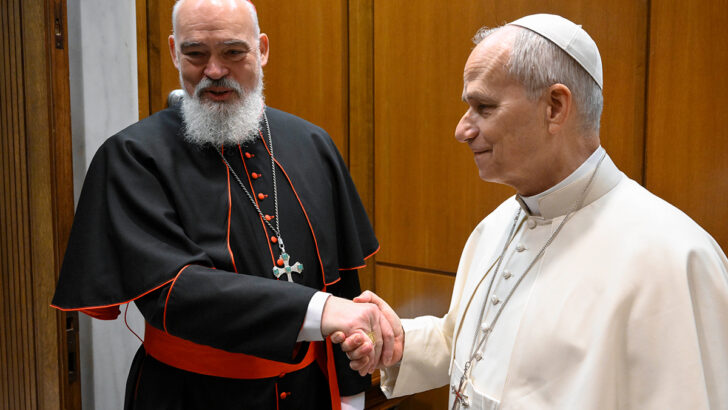
 Pope Leo XIV greets Cardinal Dominique Mathieu of Teheran-Ispahan, Iran, during a private
meeting at the Vatican March 11, 2026. Photo: OSV News/Simone Risoluti, Vatican Media.
Pope Leo XIV greets Cardinal Dominique Mathieu of Teheran-Ispahan, Iran, during a private
meeting at the Vatican March 11, 2026. Photo: OSV News/Simone Risoluti, Vatican Media. On February 28, Israel and the US launched massive air strikes against Iran. The following day, Pope Leo XIV responded during the Angelus prayer with the words: “Stability and peace cannot be achieved through mutual threats or weapons that bring destruction, suffering and death, but only through reasonable, authentic and responsible dialogue.” He appealed to those involved to “take moral responsibility and stop the spiral of violence before it leads to an insurmountable abyss.”
It took a long time for the Vatican to issue a statement. It was not until March 6 that the Vatican newspaper Osservatore Romano published on its front page an aerial photograph of two excavators digging rows of children’s graves for the victims of this collateral damage. Above it was the headline: ‘The face of war’.
It took another three days before the Holy See announced to the media on Monday evening: “Pope Leo XIV expresses his deep sorrow for all the victims of the bombings in the Middle East in recent days, for the many innocent people, including many children.” On Monday morning, the Iranian ambassador to the Vatican complained in a press conference that the Pope had not “at least condemned the attack on the school and the killing of the children.”
The fact that the media organs run by the Secretariat of State show political sensitivity in times of crisis is nothing unusual for Vatican observers. Often, like a seismograph, movements can be detected here earlier than in large-scale papal speeches on the open stage.
At this level, Leo XIV has so far fallen short of what John Paul II said and did in 2003 to prevent the then large-scale attack by Western forces on Iraq – and later to condemn it publicly. Admittedly, the Pope from the US never tires of promoting peace and diplomacy. However, he has not yet wielded the sharpest sword at his disposal – public condemnation of crimes against humanity or moral condemnation of the war of aggression.
The Pope’s restraint is apparently related to a new division of roles in the Vatican. In the first six months of his pontificate, Leo XIV – especially at his second residence in Castel Gandolfo – spoke quite frequently with the media and also made political statements. According to the Secretariat of State, this set off alarm bells among those responsible for foreign policy.
They feared a return to the political turmoil of the Francis pontificate: At that time, the Pope spoke candidly (and sometimes naively) to the media about current foreign policy issues – and the diplomats had to repair the damage. According to the Secretariat of State, this should not be repeated.