

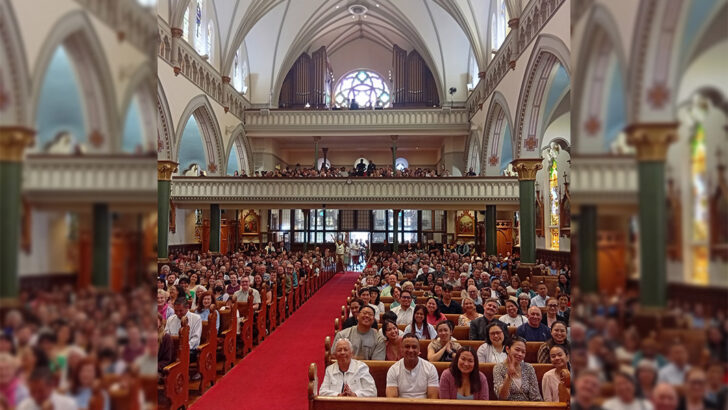
 Fr Dean Henderson celebrates Mass every Sunday at St Andrew’s Cathedral, Victoria, BC, Canada; photo shows some of the capacity congregation attending.
 How did I end up in Canada for my sabbatical? The answer is simple: I went to Mass in Victoria when I was on holidays there, and it was the best parish Mass I had seen in 42 years. What made the Mass so good? For one thing, the church was full for the Mass, and the attendance seemed to include more younger folk. They had not come for a fast Mass (the Mass took an hour and a half), but for a quality liturgy, with a significant homily as part of it, given by the cathedral rector.

Having spent six months based there, I would see five elements in the success of Sunday Masses in Victoria Cathedral:
- About 20 years ago, a rector with a particular interest in the liturgy was appointed here. Not only did he introduce liturgical norms for the cathedral, he took time to form the ministers, so that everyone understood what they were doing. Visiting clergy quickly learn there is a way to lead liturgy that everyone follows. No transient priest can change things — unlike in Ireland, where liturgy is often reduced to the whims of a priest. Formation has made a difference here.
- The cathedral has superb stewards for every Sunday Mass. These make sure the nave is filled before the balcony is opened. When this is filled, a group is led into the altar area during the gospel, till that area is full too. Only then are the roped-off seats at the back made available, and once they are filled, only the porch remains. The stewards also ensure that everyone receives Communion in an orderly manner, that people who become ill are cared for, ambulances called etc. as necessary.
- Music is a feature of every Sunday Mass. To facilitate this, a booklet with words and music of every song and part of the Mass is provided; everyone who attends knows they are expected to join in. And they do. A grand piano backs the cantor who leads the singing in a Mass without a choir, while during the Solemn 11 o’clock Mass, the choir leads the singing from the upper balcony, with the organ.
- The rector, Fr Dean, a convert from Anglicanism, works hard to provide solid teaching in his Sunday homily —always quoting papal teaching and the Church Fathers, to show that the fullness of faith is found in ‘Mother Church’. He celebrates three of the cathedrals’ Masses every Sunday, and also leads a dialogue homily with the children.
- Victoria has a mega-church, called the Coastline Community. People in Victoria who don’t come from a faith background often look for something and find the Coastline Church. The trouble is, it’s not enough, so they move from it to the Cathedral — another ingredient in its success.
They must be doing something right: last Easter 15 adults were baptised at the Cathedral’s Easter Vigil — already 30 have signed up to prepare for baptism next Easter: see standrewscathedral.org for more.
Future
I sometimes wonder if the Irish Church has any future at all? Unlike other countries, we have built an over-reliance on the priest at the centre of the parish. Even when Vatican II spoke of the ministry of the baptised, we were inclined to say that the baptised weren’t needed once we had enough priests. It seems as if the Lord has a different vision of our future. The question is whether we are indeed ready to embrace the changes this will mean. If we can form lay people for leadership, and transform our structures, there is hope. Can we?
I was impressed with Bishop Denis Nulty’s letter on the future of parishes in the September 3 The Irish Catholic. He spoke of the 25 lay pastoral ministry students from Kildare and Leighlin beginning Year II of their diploma. It is wonderful to see an Irish diocese providing solid formation for lay people. I presume at least some of these students will be leading parishes where the resident priest has been withdrawn and receiving the salary that would otherwise go to such a priest. This gives me hope that we can escape the never-ending ‘priest-shortage’ mantra and implement alternative parish options.