

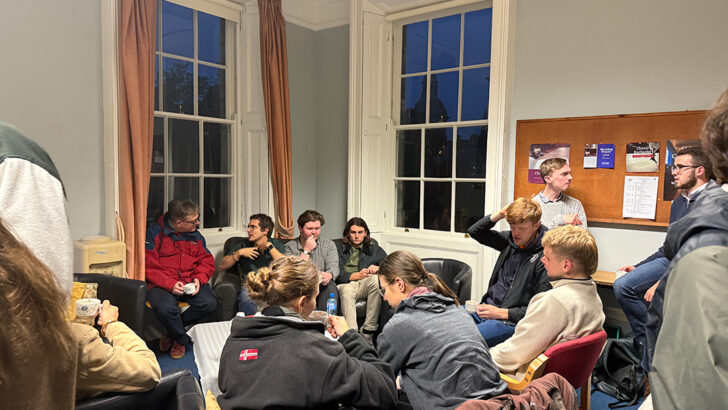
 Members of the Laurentian Society gather for tea and discussion at the Trinity College Dublin chaplaincy. Photo: Frida Hennig
 By Frida Hennig and Pedro Esteva
Young Catholics have responded to Bishop Niall Coll’s recent remarks about youth, who he referred to as “i-Gens”, seeking “clarity, coherence and tradition” rather than adaptability and experimentation, which can often seem fruitless.
The Irish Catholic spoke to two “i-Gen” Catholics to get their perspectives on the Bishop of Raphoe’s comments. Story Pennock, a second year at Trinity College Dublin, a member of the university’s Laurentian Society, and a recent convert said she resonated with Bishop Coll’s assertion.
“The Church has been a certain way throughout its whole history, ” said Ms Pennock. Speaking on what initially drew her to Catholicism, the Trinity student said the “historical veracity” of the faith was something that was important to her when converting. “I wanted to be in the sect that had the most consistency.” Now, the consistency that attracted Ms Pennock is being threatened by conversations around synodality and reform that often focus on the restructuring of Church processes.
Echoing Bishop Coll’s remarks that youth are “less interested in conversation and more in formation that produces conviction and confidence”, Ms Pennock said that to her, “experimentation feels like trying to make the Church more palatable to a secular audience;” a move which she does not agree with.
When asked about what the Catholic Church in Ireland can do to accompany and support i-Gens in their faith journey, she continued to speak about the increase in secularisation in Ireland. “I think that the Church might feel a bit more timid about speaking on social issues,” said Ms Pennock, “but I think it should take a hardline stance on things.” She shared that many young Catholics are looking for the Church to allocate more resources to social issues rather than shying away from discussion.
Louis Jahnigan, a second year at University College Dublin and a Newman Society co-auditor said Bishop Coll’s comments about tradition being the cornerstone for i-Gen Catholics were “spot-on” and shared that a lot of his Catholic friends are “very traditionally-minded”.
He noted that in the UCD chapel, which the Newman Society uses for Mass, women will often wear veils, “which is a funny contrast because the chapel was built in the 70s and is relatively new.”
“I think standards have fallen off greatly,” said Mr Jahnigan, “people used to be a lot more virtuous in terms of practicing their faith.”
Similarly to Ms Pennock, Mr Jahnigan said that the tradition of the Church provides solidity for him, something that is particularly important for busy university students. He said he likes that the tradition and stability of the Catholic Church “doesn’t apologise for itself”.
Laity should be given the chance to understand their beliefs before being asked to adhere to experimental structural changes”
Rather than focusing on the synodality and reform that Bishop Coll made his remarks about, Mr Jahnigan emphasised the importance of catechesis when asked about how he believes the Church should accompany young people. Referencing a history of “deliberate attempts to deprive the laity of catechesis because ‘they don’t need to know about that’”, Mr Jahnigan said his biggest advice to the Church in the current climate is “don’t underestimate people”. In other words, laity should be given the chance to understand their beliefs before being asked to adhere to experimental structural changes.
“I think catechesis is critical,” continued Mr Jahnigan. “It’s critical that people know why they believe what they believe.”
Both university students identified their respective Catholic societies as vital spaces for their faith formation, citing the ability to engage in fruitful discussion even when disagreeing with their peers, or “intellectual charity”, as Mr Jahnigan put it, as something that is lacking in their other university spaces.
“At UCD, everyone is very dogmatically liberal on social issues like abortion, transgenderism,” explained Mr Jahnigan. “It’s refreshing to be in a space where we’re not just silencing each other, even when we disagree sometimes.”
Ms Pennock shared that the Laurentian Society has brought her a sense of community. “It’s pretty amazing…I never had friends that were Christian growing up,” she said. “We [Laurentian Society] all have very good heads on our shoulders in terms of social issues and matters of faith.”
Based on the experiences of Ms Pennock and Mr Jahnigan, it’s clear that spaces that cater specifically to i-Gen Catholic are prioritising formation and catechesis that breed confidence and solidity in faithful youth, just as Bishop Coll suggested.
NET Ministries
While university students describe discovering faith in their campus communities, a similar pattern is emerging nationwide across various ministries.
When given an opportunity to encounter Jesus on a very personal level, that’s usually a new experience”
Thomas Starkie of NET Ministries Ireland said Bishop Coll’s remarks reflect what missionaries encounter regularly in schools, parishes and even among those who volunteer for ministry themselves. “‘Why’ is the predominant question,” he said, explaining that young people increasingly want clear explanations rather than inherited practices. “They want to know why they should care.”
“They understand the mechanics of religious practice,” he said, “but when given an opportunity to encounter Jesus on a very personal level, that’s usually a new experience.”
Formation and community are therefore integral. Young people are often drawn by what they witness in others: “They see something different – joy, togetherness – and they want to understand where that comes from.”
Rather than disengaging from institutional faith, he said many are seeking deeper grounding. “We are definitely seeing an increase in visible love for the Church as well as for God,” he said, adding that young Catholics increasingly want to understand “what the Church teaches” and how faith shapes daily life.
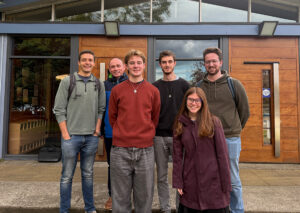
Photo: Frida Hennig.
Holy Family Mission
Similarly, at Holy Family Mission in Co. Waterford, Fr Patrick Cahill said that the desire for clarity appears consistently among participants.
“Many of the young people we work with have such a hunger for formation,” he said. “So often they ask us, ‘What does the Church actually teach?’”
Applicants arrive to the program eager to share their faith but are often unsure of how to do so. “They are eager to be missionaries but do not feel equipped,” Fr Cahill said, but they want to know the “truth about who God is, truth about the mission of His Church and the truth about who He has created them to be.”
Most of the young people I work with have little knowledge of the Church’s recent history”
Fr Cahill also highlighted the fact that digital culture may be intensifying the search for truth rather than replacing it. Surrounded by constant distraction, young people begin looking for something deeper. “This results in a deeper hunger for what they can’t find in the world — the sacred, reverence and ultimately God Himself.”
Unlike previous generations shaped by Ireland’s ecclesial crises, many approach faith without strong preconceptions. “Most of the young people I work with have little knowledge of the Church’s recent history,” he said, instead discovering Christianity as something new.
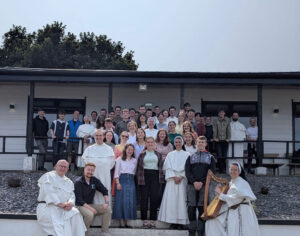
Dominicans
Bro. Philip Neri OP of St Saviour’s Church said young adults are increasingly drawn to spaces where faith is taught clearly and lived seriously.
“They want to know their faith well,” he said, describing strong interest in talks and discussion groups that are “rich in doctrinal content but also clear and compelling.”
That curiosity often develops into a more intentional spiritual life. “Some choose of their own accord to come to daily Mass and to pray the Liturgy of the Hours together,” he said. “They see all that the Catholic faith has to offer as deeply authentic.”
Young adults, he added, are particularly drawn to the Church’s spiritual tradition. “They’re hungry for a deeper spirituality rooted in the tradition of the Church,” he said, noting how encounters with saints such as Teresa of Ávila reveal “the depths of the interior life to which God is inviting them.”
While many first encounter faith online, real growth happens in community. “They are delighted when they encounter people like themselves in the real world, a community to which they can belong,” he said, where “real transformation takes place” as young adults strive together toward Christ.
Evangelium
Beyond campus groups and parish apostolates, gatherings such as Evangelium are bringing young adults together from across the country to explore the faith more deeply.
‘It’s not the same people coming year after year,’ said Mr Bradshaw. ‘We didn’t recognise an awful lot of people last year. You’re tapping into a new population each time’”
Evangelium aims to help participants move from encounter to articulation. “A key focus is to give people not just the answers for themselves, but the ability to communicate those answers and those beliefs to others,” said one of the organisers, James Bradshaw.
The young adult apologetics initiative has seen changing audiences at its conferences in recent years. “It’s not the same people coming year after year,” said Mr Bradshaw. “We didn’t recognise an awful lot of people last year. You’re tapping into a new population each time.”
The growth, he stressed, reflects wider activity across Ireland’s Catholic landscape. “No organisation is an island,” he said, highlighting the importance of chaplaincies, youth ministries and parish initiatives in helping young adults encounter faith before seeking deeper understanding.
“The young adult scene in Ireland is more lively, more healthy now than it was before COVID,” he added.
From university societies and missionary programs to young adult gatherings, these connections, taken as parts of a whole, showcase that a growing number of i-Gen Catholics are not only returning to Church but seeking to understand, live, and share their faith with new confidence.