

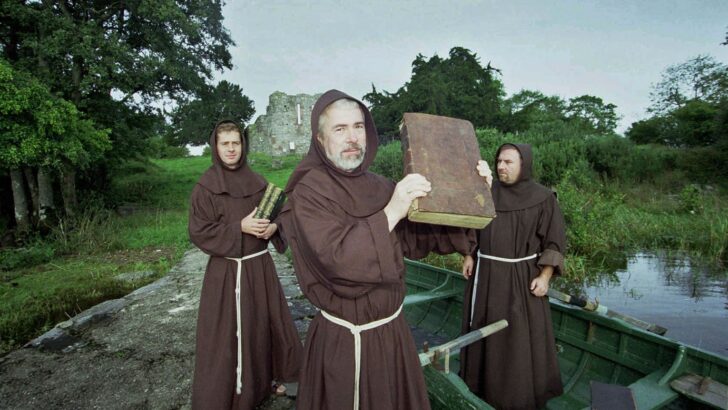
 In County Kerry, Ireland, monks hold up old texts on Innisfallen Island, where ruins of a sixth-century abbey are found. Early Celtic Christian spirituality is engaging modern believers in the United States. (CNS photo by Valerie O'Sullivan) (Aug. 11, 2000)
The Vatican has held up Ireland’s missionary monks as a model for responding to cultural upheaval while calling for an investigation into the “sudden decline in Catholicism” in countries where faith was once deeply rooted.
In Venite ad me, published on October 22, the Dicastery for the Doctrine of the Faith says Irish monasticism helped to safeguard Christian learning following the collapse of Roman institutions in Western Europe, developing “new forms of evangelisation” and helping spread private confession.
Historian Dr Catherine Swift of Mary Immaculate College said monks such as Columba and Columbanus sought places away from cities where they could focus on prayer, but often established their communities near crossroads and routes, allowing them to remain engaged with the wider world.
“They were choosing to live secluded from temporal temptations in order to focus more closely on their relationships with God but they were also still engaged with the world around them,” she told The Irish Catholic.
“The Irish were travelling missionaries, going out to new places,” she said. “Leaving behind their own locality was seen as a prestigious form of martyrdom.”
She also highlighted the tradition of establishing communities of 12 in imitation of the Apostles, and explained that “the Irish developed the practice of older men guiding younger monks in private – a pattern which later became associated with the figure of anam chara or soul friend”.
Speaking about Irish Catholicism more broadly, Dr Jessie Rogers of St Patrick’s Pontifical University, Maynooth, said secularism had exposed an “over-reliance on inherited Catholic identity and sacramental preparation without much attention to ongoing faith formation through all of life’s stages”.
“Faith is not simply something that can be passed on through instruction or preparation for particular religious milestones,” she said. “It grows through shared experiences and participation in communities where the Gospel is lived out in ways that people find meaningful and credible.”
As Church historian Prof. Massimo Faggioli, formerly of Trinity College Dublin, put it: “There’s no preservation without transmission.”
Fr Martin Delaney, co-author of the First Communion programme Do This in Memory, recalled his father “on his knees, quietly saying his prayers every morning and every night, then coming around to our beds to bless us with holy water”.
“We ask parents to nurture their children’s faith and teachers to prepare them for First Communion and Confirmation, often without asking whether those adults have a living faith themselves, or what support they need,” he said.
Any investigation into Ireland’s religious decline, he added, must confront “the abuse scandals and failures of leadership that shattered trust in a country like ours”.
“Faith, it says, passes from candle to candle. We must reckon with what happens when people can no longer trust the hand offering the light.”