

At Dublin Zoo, a passenger plane soared harmlessly overhead. For most visitors, it was a passing curiosity. But for a group of Ukrainian children, the sound was unbearable. They screamed, dropped to the ground, and hid in terror.

“They were seized by unspeakable fear,” recalled Fr Vasyl Kornitsky, a Ukrainian Greek Catholic priest now serving in Dublin. “It was heartbreaking. You can only imagine what they’ve endured.”
That scene of panic revealed the invisible scars carried by Ukrainian families who fled the war. Their lives in Ireland are safer, but the trauma of bombings and air raids remains close to the surface.
For refugees like Alla Taranukha, who fled Chernihiv after weeks of siege, faith has been a lifeline. “Russian tanks passed through our city for three days,” she said. “We ran out of food. Farmers saved us with milk. On my birthday, I baked bread from flour meant for cattle.”
When she arrived in Sligo and discovered a Ukrainian Catholic parish, she wept with relief. “My soul needed it so much,” she said. “I cannot thank the Irish people enough for their shelter and heartfelt kindness.”
Others share similar stories. Petro Chelyadyn, who fled Ukraine with his wife and three children, was deeply moved when he first heard the Divine Liturgy in his own language in Ireland. “We are very grateful to the Irish people,” he said. “They opened their homes and hearts to us.”
The Ukrainian Greek Catholic Church (UGCC) has endured persecution before. Under Soviet rule, priests were executed or exiled, churches shuttered, and the faithful forced underground. Yet the Church survived. Today, it thrives in Ireland.
Since Russia’s full-scale invasion in 2022, Ukrainian Catholic communities have multiplied. Once a small gathering in Dublin, the Church now serves refugees in six centers: Dublin, Cork, Limerick, Waterford, Galway, Belfast, and Sligo. Priests travel to reach scattered families, welcomed into Roman Catholic churches by Irish clergy and laity.
“The Irish truly understand our pain,” said Fr Kornitsky. “They open their doors without hesitation. We never feel like strangers.”
Irish priests, too, have been moved. Fr John Carroll, who often prays with Ukrainians in Sligo, described their liturgy as “a language of the spirit, of the heart, of imagination. It speaks through aesthetics. In your tradition, I find a richness that touches all the senses.”
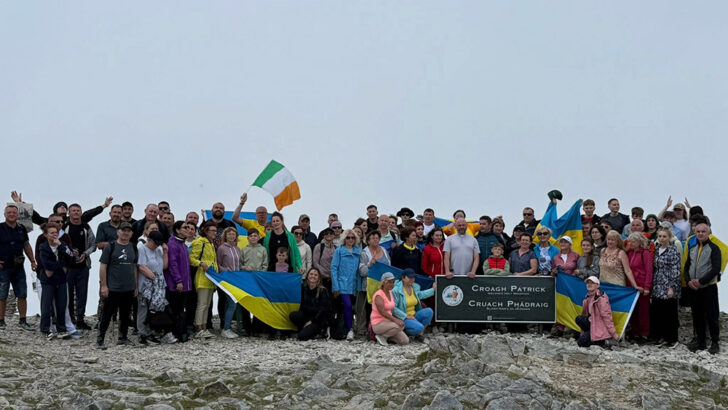
Despite displacement and uncertainty, Ukrainians continue to bear witness to their faith. Children prepare for First Holy Communion, choirs sing ancient hymns, and parishes organize pilgrimages and community gatherings.
“Undoubtedly, those fleeing the war bear deep spiritual wounds,” said Fr Kornitsky. “But through our steadfastness, we show how strong we are in our faith and conviction—that if God is with us, who can be against us?”
The frightened children at Dublin Zoo remind us that the wounds of war linger. Yet the resilience of Ukrainian faith in Ireland tells another story: one of hope, gratitude, and solidarity.
In every Liturgy sung in Sligo, Cork, or Dublin, in every act of kindness offered by Irish families, a quiet miracle unfolds. Together, Irish and Ukrainian Catholics are living proof that faith survives even in exile—and that light continues to shine in the darkness.