

What is Critical Thinking? A useful way to approach that question is to ponder what uncritical thinking looks like. To think uncritically is to swallow things whole; to accept without question the ideas presented to us. Of course, many a barstool atheist will want to say, ‘Aha, so faith is uncritical thinking, because believers accept things they cannot prove.’

But all thinking rests on unproven and unprovable foundations, or axioms. Consider it this way: if I want to prove the validity of the foundations of my thinking, then they can no longer be regarded as foundations, as I’ll have to dig deeper in order to expose the ideas on which my foundations rest. Then I’ll have to dig still deeper, in order to show what those deeper foundations are based on. Sooner or later, I’ll have to admit that either I work from unprovable foundations, or I have no foundations. So whatever else it asks of us, critical thinking does not require that our thinking have no unprovable foundations.
It can happen that people who want their ideas to be swallowed whole, without criticism or question, insist that the very people who question them are failing to engage in critical thinking, or that they are guided by ethos, or belief, or presupposition, rather than by critical engagement with ideas. Now, if I put it to you that your criticism of my ideas simply reflects a lack of critical thinking on your part, then I hope you will give me a very robust rejoinder indeed! The concept of critical thinking should not be used to mask its absence.
So, what is critical thinking and what does it do, that uncritical thinking fails to do? Fundamentally, critical thinking weighs up ideas; it assesses; it evaluates. The significance of this is found in the word ‘evaluates,’ in which, barely hidden, is the word ‘value.’ Critical thinking makes judgments based on values. There is no critical thinking without evaluation, and there is no evaluation without values. There is simply no such thing as neutral, value-free critical thinking. We can make critical assessments only on the basis of what we judge to be good, truthful… of value.
But sometimes, those who wish to present their values as the only possibility for right-thinking people seek a free pass when it comes to critical thinking, while accusing of uncritical thinking the very people who are thinking critically about their values.
Critical thinking is premised on the reality – not the avoidance – of values; it is premised on the conviction that there is truth and there is falsehood, and that we can and should seek to distinguish between them (even it, at times, it can be difficult to make that distinction). If there is no distinction between truth and falsehood, then the only things that matter are politics, power, manipulation. And where these are all that matters, then critical thinking is redundant, and ‘How do I eliminate my opponent?’ becomes just as valid a question as ‘What is his reason for opposing me?’
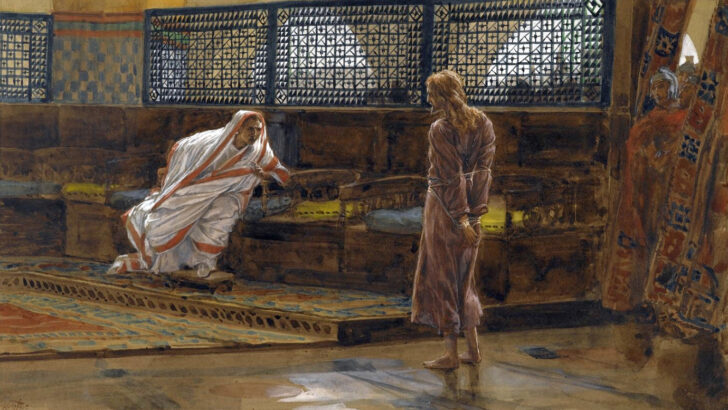
Remember Pontius Pilate? After he asked that fateful question, ‘What is truth?’, he then resorted to the politics of handwashing, by handing Truth itself over to a citizens’ assembly. Once we reject the notion that there is truth and that it makes claims on us, there is only politics (and power, and manipulation). Critical thinking appeals to truth. To engage in it is not to claim a monopoly on truth, but to be a seeker after the truth.
Far from being an obstacle, our Christian faith is an ally of critical thinking. Our faith insists that our reasoning is a good and God-given capacity, but that our thinking can be skewed by sin, stupidity and selfishness. Yes, this is a ‘faith’ understanding, but even our barstool atheists might have to admit that thinking can be skewed by stupidity. And for that reason, the first target of critical thinking is one’s own thinking. We need to think critically about our own thoughts; to ponder our pondering, to assess our assessments, to be aware of our prejudices. When we become practised in this, we become better able to turn our critical thinking on the thoughts of others, and to do so with a certain gentleness and reserve.
This is all a far cry from appeals to critical thinking that would turn young children into activists before they have acquired the literacy or the capacity to think critically. Appeals to critical thinking in the education of children need to be among the first targets of critical thinking. Let us educate our children in value, in the distinction between right and wrong, in the reality of truth and its claims. Then, with sound reference points, with authentic, abiding criteria on which to make evaluative assessments, they can learn to engage in critical thinking.
As for those who would say that value, and right and wrong, and truth and its demands are political matters, power-plays, let’s at least be clear that they have no interest in critical thinking as such, but only in using the terminology to advance a pre-set agenda.