

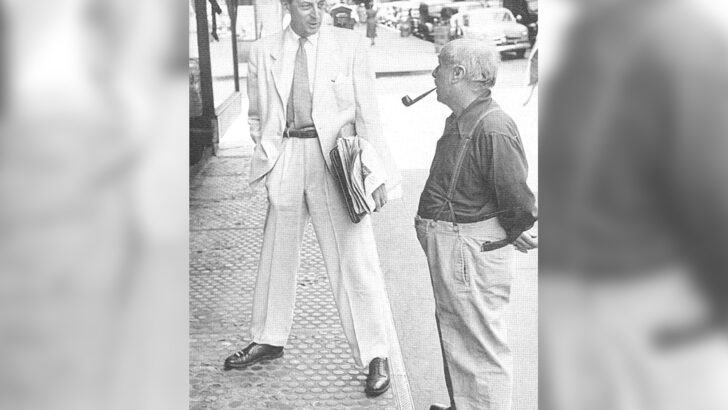
 Alistair Cooke getting “the word on the street” about American matters from a real New Yorker (Leonard McCombe / Time Life pictures)
 Letter from America 1946-2004,
by Alistair Cooke
(Allen Lane / Penguin Books, €14.99pb / £25.00 hb)
Here is a most enthralling book that echoes the great days of radio, when a human voice, albeit of a great journalist, could engage people with current affairs in a way that our snippy-snappy media does not in our more fractured and frenetic times. Alistair Cooke’s Letter from America first broadcast from 1946 to 2004, and belongs like the man himself to another more engaging era of current affairs.
Alistair Cooke was born at Salford, Lancashire, England, on November 20 1908. He attended Blackpool Grammar School and secured a scholarship to Cambridge University. Later on in the US he also attended Yale and Harvard.
From his earliest years he was keen to be a writer. He began his working life as a drama and film critic for the Manchester Guardian and the BBC. Then in 1935 he became the London Correspondent for NBC in New York.
Emigrated
Cooke emigrated to the US in 1937 and became a US citizen in 1941. When World War II began in 1939 he went on a journey through the US recording the lifestyle of ordinary Americans during the war and their reactions to it. This was published as The American Home Front 1941-2 and became an international ‘best seller’.
He joined the staff of the Manchester Guardian in 1945, and was their chief US correspondent from 1946 to 1972. He broadcast the first ‘Letter from America’ on March 24 1946 in the series by which he was to become one of the most renowned journalists in the English-speaking world. At the same time, he continued to act as the foreign correspondent for the Manchester Guardian (now the Guardian).
Cooke broadcast 2869 ‘Letters from America’ beginning in 1946 and ending in February 2004, just six weeks before his death on March 30 2004. The first in the series was a description of the Englishman abroad, the last discussed the then US presidential campaign.
In between he recalled encounters with US presidents: Roosevelt through to Nixon, Reagan, Clinton and Bush Senior and Junior. He gave a shout-out to friends, such as Leonard Bernstein, Philip Larkin, Humphrey Bogart, Charlie Chaplin and Katherine Hepburn. On many occasions he spoke about his golfing hero Bobby Jones.
But he also covered disasters, such as the Vietnam war, the conflict in Iraq and the attack on the Twin-Towers in New York on the infamous 11 September. He also wrote at length on political disasters, such as the Watergate scandal.
For the most part Cooke greatly entertained his millions of listeners all over the world. However, his comments and points of view were sometimes challenged. Reverend Martin Luther King took issue with some of his coverage of the US civil rights campaign.
Vietnam
As the Vietnam war was drawing to its disastrous conclusion and an abysmal defeat for the Americans, Cooke was heavily criticised for leaning in his reports too closely to those emanating from the White House and the Pentagon.
This book is a selection of the finest of Cooke’s ‘Letter from America’ broadcasts. The experienced British journalist Simon Jenkins provides an elegant introduction to it.
Jenkins rightly describes Cooke’s writing as extraordinary. He wrote in conversation and spoke in prose, never writing a dull sentence and never losing touch with his narrative. Jenkins describes how his mellifluous mid-Atlantic voice treated Britain and America as if they were two armchairs talking to each other. He both promoted and embodied the “Special Relationship” between Britain and the US.
And one may ask, from where did Cooke get the “gift of the gab”? His father was an English metalworker and Methodist lay preacher, and his mother was an Irish woman named Mary Byrne.