

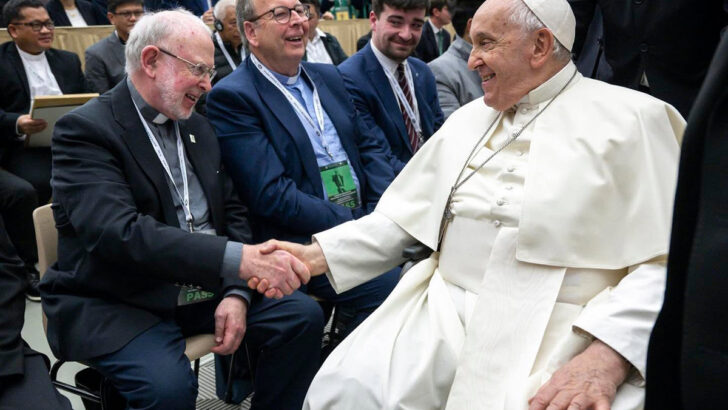
 A meeting with Pope Francis during the International Conference of Rectors and Pastoral Staff of Shrines at the Vatican in November 2023. Photos: Courtesy of Lough Derg.
 For Fr Laurence ‘La’ Flynn, the memory of his ordination is full of light. It was July 4, 1976, the day the United States was marking the bicentenary of its independence. “I wasn’t invited to the celebrations in America,” he laughs, “so I went ahead with my own.”
The summer itself, he remembers, was “particularly glorious”. Three other priests had already been ordained for the Diocese of Clogher that June, but Fr Flynn, had examinations late into the month. As a result, he was ordained separately by Bishop Patrick Mulligan on July 4.
“He [Bishop Mulligan] had been the president of St Michael’s when I was at secondary school, so I would have known him well even before he became bishop,” Fr Flynn recalls. “He was a very, very warm-hearted man, very fatherly.”
Calling
After the ceremony, the newly ordained priest came out of the cathedral into the sunshine. The day was so fine that he gave his first blessings outside, “on the apron of the cathedral”, in the “glorious sunshine”.
Fifty years later, as he marks his golden jubilee of priesthood, Fr Flynn says the call itself was never sudden or dramatic. In fact, he cannot remember a time when he did not want to be a priest.
There was a huge overlap between being a Catholic, between prayer and devotion, and daily life”
“I grew up in a rural parish, a cross-border parish, half of it in Fermanagh and half of it in Monaghan,” he says. His family had a business in the village, and the local priests were part of ordinary life. His mother was a daily Mass-goer, and after he became an altar server at around eight, he would often go with her to morning Mass.
It was a different Ireland, he says, one in which “there was a huge overlap between being a Catholic, between prayer and devotion, and daily life. In fact, it probably would have been harder at that stage, in terms of an adult, not to be regularly going to Mass. You would have needed a bit of courage.”
During his seven years as a boarder at St Michael’s College, that sense of priesthood was reinforced. At the time, there were eight priests on staff. They taught classes, ran clubs, the school magazine and school plays. “There was a lot of interaction with the priests and the staff,” says Fr Flynn. “While we had our fun with them, and we had our fallings out with them, like everybody else, they had their own quirks of personality and temperament.”
Change
From there he went directly to Maynooth in 1969. His first retreat at the beginning of seminary remains with him as “a particularly blessed and deeply happy time”.
“There was a sense that, oh, this was right,” he says. “This was where I was meant to be.”
It was also a time of change in the Church. Maynooth had opened to lay students only a few years before, and from 1972 to 1976 he studied theology in Rome, where the Second Vatican Council was still working its way into Church life.
There was a whole emotion around it that was quite unexpected for me and I found myself very, very moved by that”
For a young seminarian, Fr Flynn says, it was “an exciting time”, marked by confidence, liturgical renewal and a new engagement between the Church and the world. Rome also gave him an experience of the universal Church, with classmates from South America, Asia, North America, Africa and Europe.
On the feast of Candlemas in 1976, while still a deacon, he had the opportunity to serve at Mass with Pope Paul VI. This wasn’t his first encounter with the pope as earlier that year his class had gone to a papal audience.
“I remember we were looking forward to it,” he says, though he adds that he “wasn’t a papist in the sense of being a big man for the Pope”.
“I was quite taken by surprise at the audience,” he says, recalling “the enthusiasm, and the singing, and the applause” of those gathered, particularly “the Italians, the Spaniards, the Mexicans. There was a whole emotion around it that was quite unexpected for me and I found myself very, very moved by that.”
Challenge
Yet the road to ordination is not so simple as that. It was also marked by grief. In January 1975, the year he was ordained a deacon, his mother was diagnosed with cancer and would pass away that November. In May 1976, just weeks before his priestly ordination, he experienced what he describes as “the biggest moment of doubt” on his journey.
Looking back, he believes it was less a crisis of vocation than the pain of coming to terms with his mother’s death. With the support of friends and his spiritual director, he came to see the question more clearly.
“It became very clear to me that the issue wasn’t whether or not I should be a priest,” he says. “The issue was whether or not I really could confirm my faith in Jesus and in the Gospel.”
If he was a follower of Jesus, he knew he wanted to live that out as a priest. “That was absolutely a foundational experience for me,” he says, “and one that I give thanks to God for.”
That foundation carried him through later moments of challenge. In 1990, one of his closest friends, also a priest, decided to leave ministry. Fr Flynn was working on Lough Derg at the time as an assistant priest. On quieter days, he would take the boat to the mainland and walk through the forest path towards St Brigid’s Well, wrestling with the question of what his friend’s decision meant for him.
“If this man whom I admired so much, who was my good friend, had decided to move away from ministry — what about me?” he remembers asking. “Was it still right for me?”
Fr Flynn was only two years ordained when he was first assigned to help on the island in 1978”
Again, he came through with what he calls “a deep, deep assurance” that priesthood was still his way.
By the 90s, Lough Derg had already become a significant part of his life. Although the ancient pilgrimage site has monastic origins, it has been the responsibility of the Diocese of Clogher since 1780, and the priests who serve there are diocesan priests.
Fr Flynn was only two years ordained when he was first assigned to help on the island in 1978. That first season, he spent almost five weeks on Lough Derg. The following year, Bishop Mulligan assigned him to work there for half the season.
At the time, Fr Flynn was teaching at St Macartan’s College in Monaghan, where he taught religion, music and English. The long summer holidays allowed him to spend six weeks each year on the island. And Bishop Mulligan had sensed, it suited him.
“He said to me, ‘I think you like that place. I think it suited you.’”
It gave the young teacher a different kind of ministry: pastoral work with adults. It was there, Fr Flynn says, that he “really learned to listen to people”.
Some came for confession. Others came outside confession, carrying questions, struggles, grief or uncertainty. He soon discovered that priesthood did not mean having all the answers.
“What people valued was the chance to speak with confidence, and to be heard,” he says. “That sense of some support and encouragement.”
Over time, this became one of the central themes of his priesthood. It is one thing, he says, to trust that God hears our prayers and knows our needs. But the experience of another person listening, caring, understanding and supporting can confirm that belief in a deeply human way.
“The human experience of being listened to matters profoundly,” he says.
Conviction
His own experience of spiritual direction deepened this conviction. In 2010, he completed a two-year part-time course at Manresa. That formation, he says, has proved a great gift, especially during his years as Prior of Lough Derg, where “listening to people and accompanying people” are such a significant part of the ministry.
Asked how his understanding of priesthood has changed over 50 years, he says, the development has been from a sense that the priest is called to “give something to people, or do something for people”, towards a deeper understanding of priesthood as “being with people”.
He does not want to oppose the two. “The way that we truly can be for people,” he says, “is by being with them.”
That has marked his work in adult faith development too. Beginning in 2003, he spent 12 years involved with a diocesan team offering the Pathways programme developed by All Hallows.
He still grows animated speaking about it: giving adults a chance to explore their faith, find language for it, grow in confidence, ask their questions and deepen their friendship with Jesus.
He often uses its five signs of holiness at Lough Derg: steadiness and perseverance, joy, community, prayer and boldness”
He speaks just as warmly about Pope Francis’ Rejoice and Be Glad, an apostolic exhortation on the call to holiness in today’s world. It is a text he returns to “again and again”, especially for homilies.
He loves its insistence, rooted in Lumen Gentium, that holiness is not only for priests, bishops or religious, but for every baptised person. He often uses its five signs of holiness at Lough Derg: steadiness and perseverance, joy, community, prayer and boldness.
“People very often say to me afterwards, ‘That was good. What were those five signs again?’” he says. “It engages with people.”
Now, with his golden jubilee year upon him and his 75th birthday already past, Fr Flynn is preparing to move towards retirement. He offered his resignation last year, and Bishop Larry Duffy asked him to take Lough Derg through one more season. He hopes retirement will still leave room for the ministry that has come to define so much of his priesthood.
Consideration
For those considering Lough Derg, and for those simply trying to make space for God in daily life, Fr Flynn’s advice is to begin by listening.
At Lough Derg, many pilgrims speak about the significance of the crossing itself, he says. The boat journey from the mainland takes only five minutes, yet people often feel its meaning, a choice to make a space apart.
“Notice that call, hear that call, respond to that call,” he says. “Come apart and take the space. And trust that it’s God’s work then. It’s not our work.”
The disciplines of the pilgrimage (fasting, barefoot prayer and vigil) are not the point in themselves. They are, he says, “scaffolding” for the real work. “The scaffolding wasn’t for itself,” he says, recalling recent work on the basilica. “The scaffolding was so that the painters could get the paint on the walls.”
After 50 years, Fr La Flynn’s priesthood keeps coming back to the deep and steady trust that God is already at work in our lives: “The person that God wants you to be is the same person that you, in your deepest, truest self, want to be.”