

 Peter Costello
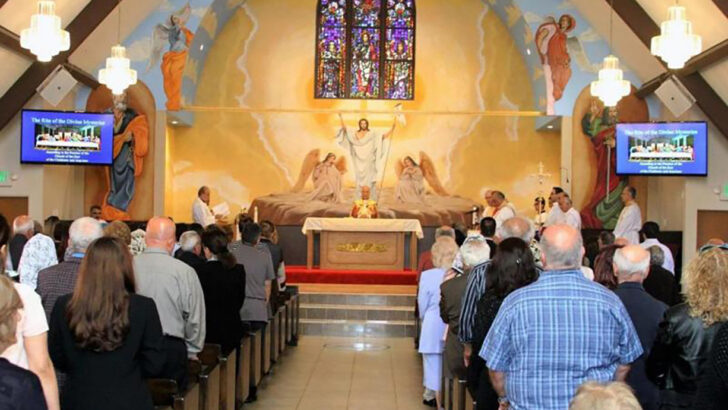 Celebrating mass in a Chaldean Catholic church in recent days. Photo: Wikipedia
 Fountain of Living Water: Poetry, Prayers and Hymns of the Mystics of the Early Church of the East
(Gracewing, £12.99 / €15.50)
When many people read the gospels they think they are hearing the words of Jesus himself. But the gospels were written in a Greek dialect; Jesus actually spoke Aramaic.
Here in Ireland we are very conscious, through our disputes over the use of English and Gaelic, that languages have their own special spirit.
So this anthology, translated from the Aramaic language still in use over parts of the Middle East, as it has been for thousands of years, could be said to bring readers closer to the spirit of Jesus’ speech than do the gospels.
Be that as it may be, Robert Ewan has through his careful selection and discriminating translations offers us the inner spirituality of the early church of the East through poetry, prayers and hymns which are still alive and still in daily use some of them, in now beleaguered Eastern Christian communities. He himself is a Christian Assyrian and speaks fluent Aramaic, Arabic and English. He has previously published Doves in Crimson Fields (Gracewing, 2017) about the Christian martyrs of modern Iraq.
Here I think for many readers is a whole new world of Christian spirituality and devotion, running from Titian the Assyrian who was born in 129AD down to Essa Al-Hazaar who flourished in the early part of 19th century – his poem to Mary is still used on Good Friday in the liturgy of the Chaldean Catholic Church. The centuries in between are covered by some twenty nine other writers, all of whose names were new to me.
I was reminded while reading these pieces of the poems and hymns of Early Christian Ireland, translated by the likes of Frank O’Connor (whose translations from the Irish are still available from Lilliput Press in an exemplary edition.)
But these outpourings of the Eastern Churches really do, as the title suggests, provide a draught of living water to refresh the parched spirituality of the Occident for those who choose to read them. This is an unusual book which can be warmly recommended.