

 Peter Costello
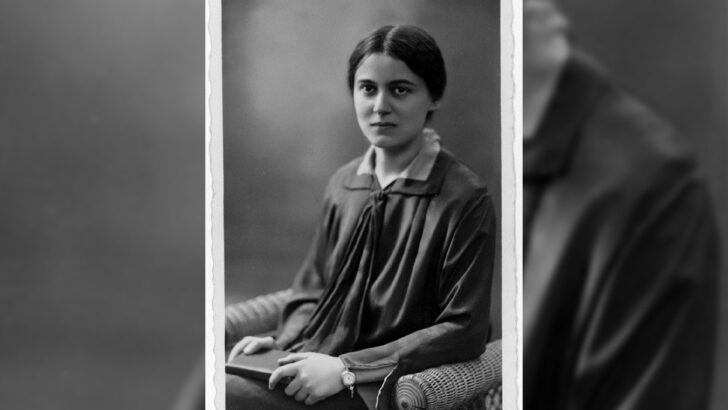 St Edith Stein, as a young Jewish student of Philosophy. Photo: Carmelite archives.
 St Edith Stein’s Aesthetic, Beauty and Sanctity: Masterpiece of the Divine Artist by Elizabeth A. Mitchell (Gracewing, £17.99 / €20.50)

This book offers an exploration in part of the thinking of Edith Stein. The author, Dr Elizabeth A. Mitchell, who for some time worked in the Vatican Press office as translator, is now a teacher at a Catholic school, Trinity Academy, in Wisconsin. But she is also well aware of the wider world, as she is Theological Advisor for Nasarean.org, a society advocating on behalf of persecuted Christians in the Middle East.
The special interest of this book is that she presents new materials from the files of Edith Stein’s surviving archive, which was retrieved from the ruins of her Carmelite convent in Holland at the end of the war in 1945.
As the title suggests, the focus of Dr Mitchell is on Edith Stein’s aesthetics, on the interaction of beauty and sanctity. This is clearly a complicated theme.
Audience
Her intended audience is those Catholics with an interest in Edith Stein as a saint. The text is divided into three parts. The first deals with Stein’s formation in art. This was mainly through German literature, rather than art as such. Stein seems to have been in her reading of French, British or American thought. But Stein was deeply affected by some kinds of painting: She was engaged by Swiss artist Arnold Böcklin’s painting Toteninsel, (“The Island of the Dead”), which was effectively unfinished as he did six versions of the theme in the 1880s, which were famously popular in Germany at one time.
This evokes not a Christian culture, but a classical pagan one – suggesting that care has to be taken in fully understanding Stein’s cultural allusions. She was deeply immersed in German poetry and drama and art, but seems to have had little interest in broader European culture (so it seems to me: though I stand to be corrected).
In this book, there are rare references to English language literature, and these are provided from the author’s point of view, not Stein…Essentially, Stein was a philosopher; that was her career, and the field she published in. For her art was literary rather than visual. She admitted that, as regards art, she was an observer, not a practitioner.
She had little time for second thoughts, let alone the third and fourth thoughts that make up the completion of a philosopher’s career”
But it is this insight which should be kept in mind. Her explanations of visual art seem to have been less intensive than her immediate reaction to literature.
Edith Stein’s writings are certainly of the first importance, as the author claims. And yet we have to bear in mind that the Christian period of her life was essentially a short one, from 1935 to her death. She was still developing her thoughts – and on the model of Edmund Husserl, her great academic mentor – this would have been the work of a full lifetime. She was not given the time by the rampant evil of the day. She had little time for second thoughts, let alone the third and fourth thoughts that make up the completion of a philosopher’s career.
In the comments made here by both Stein and the author, one feels that a working artist, whether painter, sculptor or designer, would see things differently.
Creator
She sees the Creator as an artist, but it might be truer to see Him as a scientist; creation ex nihilo involves a cosmic scheme very different from the representations of creation, which is what an artist attempts to achieve. Undoubtedly a complex study and one which other students of Edith Stein’s life and work will pursue.
For those concerned to understand the life and martyrdom of St Edith, this will be a revealing book. But as I say, in time, the complexity of her thought will inspire many further efforts in placing her in her culture and time, both as a writer and as a martyr.