

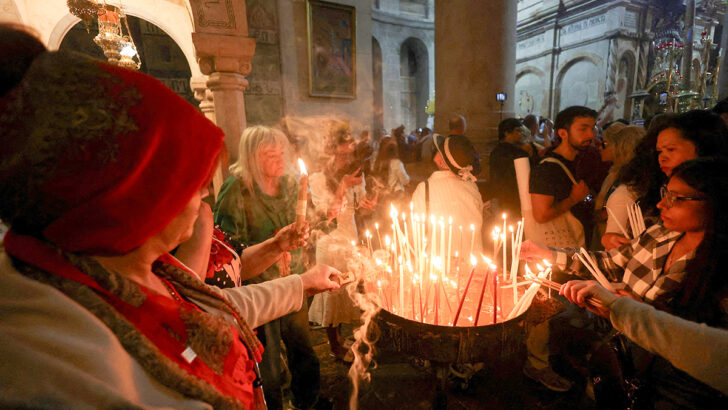
 Christian worshippers light candles on the day of Easter Sunday Mass in the Church of the Holy Sepulchre in Jerusalem’s
Old City. Photo: OSV News/Ronen Zvulun, Reuters.
Christian worshippers light candles on the day of Easter Sunday Mass in the Church of the Holy Sepulchre in Jerusalem’s
Old City. Photo: OSV News/Ronen Zvulun, Reuters. Like Christmas and other Catholic holy days, Easter is often misunderstood. Either its origins are said to be based on pagan holidays, or we reduce it to a cultural celebration – a feast after fasting, marked by food, family and tradition. But for the early Christians, it was neither a borrowed festival nor a simple commemoration. It was the centre of everything.

To understand it properly, we need to return to how the early Christians celebrated the Resurrection.
What was Easter like in the early Church? They didn’t call it “Easter” – that word would have been meaningless to them. The early Christians believed that Jesus’ passion and resurrection were the centre of the whole story of God’s saving activity in the world.
More specifically, the passion and resurrection of Jesus were understood to be the continuation and fulfilment of the Passover and the Exodus. And not coincidentally, they took place at the time of Passover, so the early Christians simply called the celebration Passover.
And so in the early Church, the feast of the Resurrection of the Lord was called Passover, or some translation of that word, as it still is in most languages today. This is where we get the word “paschal” in the Paschal Mystery – literally, “the Passover Mystery.”
Unusual
This is not unusual in Christian language. Just as Pentecost retains its Jewish name while taking on a new meaning in the Church, so too Passover became the name for Christ’s saving work fulfilled.
So what about the English word “Easter”? It comes from an Old German word for “dawn,” as in facing toward the rising sun. The word “Easter” is not derived from a pagan fertility goddess or seasonal ritual. While it is often claimed that Christian feasts borrowed from pagan festivals, the historical record shows otherwise. Early Christians were sharply critical of paganism, and the dating of Easter was always tied to Passover – not to seasonal rites.
It also helps to remember that “Easter” is only used in English. Most languages still use a form of the word for Passover – for example, Pasqua in Italian.
In the liturgy, believers were not simply recalling what God had done; they were entering into it”
Just as the Eucharist is not merely a remembrance, the Pasch was never just an anniversary. The celebration of the Pasch was a way of entering again into the events of Christ’s passion and resurrection, much as the Jewish Passover makes the Exodus present to each generation.
“Past history made present mystery.”
For the early Christians, this was not poetry but reality. In the liturgy, believers were not simply recalling what God had done; they were entering into it. The same saving events – Christ’s death and resurrection – were understood to be present and active, drawing them into the life of God here and now.
This is why the liturgy developed as it did – not as a simple retelling, but as a sacramental participation. The early Christians believed that what Christ accomplished once in history was made present to them through worship, drawing them into the same mystery rather than leaving them as distant observers.
Tradition
In Jewish tradition, God’s saving acts are not isolated moments but part of a pattern that unfolds across history. Early Christians recognised this pattern in Christ.
Rabbinic tradition even speaks of a series of “Passover nights” that reveal this unity. These were not meant as separate historical claims, but as a way of seeing a deeper pattern in God’s work – a pattern that reaches its fulfilment in Christ.
The first is creation itself, understood as an act of divine ordering that sets the stage for salvation. The second is the binding of Isaac, long seen by the Church fathers as a foreshadowing of Christ’s sacrifice – the beloved son offered, yet spared, with a substitute provided.
The Last Supper already anticipates that final banquet, even as it completes the pattern of Passover – a meal that looks both backward to the Exodus and forward to the kingdom of God”
The third is the Exodus, the central Passover event, when Israel is delivered from slavery through the blood of the lamb. And the fourth looks forward: the promised “Day of the Lord,” the fulfilment of God’s saving work in a final banquet.
For Christians, these are not separate stories but one continuous drama, fulfilled in Jesus. The Last Supper already anticipates that final banquet, even as it completes the pattern of Passover – a meal that looks both backward to the Exodus and forward to the kingdom of God.
Mystery
In this sense, the Pasch is not simply remembered – it is entered into, as part of a single, unfolding mystery that stretches from creation to redemption. There was also a sense in which the Pasch marked a new beginning. Lent prepared believers not just for a feast, but for a real conversion of life.
In a Paschal sermon, Pope St Leo the Great urged Christians not to return to their old ways once Lent had ended. His preaching reflects how seriously the early Church took this season. Easter was not simply a celebration to be enjoyed, but a demand placed on the believer – to live differently in light of the Resurrection.
“I want everyone to remember that you are a new creation in Christ… do not let anything that God makes new in you slide back into the old ways… keep following in the path of resurrection that Jesus set for you.”
So on the one hand, the Pasch is not just one day, or even the anniversary of one day; it is part of the recurring rhythm of God’s saving work – and our participation in it. On the other hand, it was also not just one feast day, as in “Easter Sunday.” For the early Christians, it was the whole Triduum. So the Pasch was not just the anniversary of a single event, nor was it limited to Easter Sunday. For the early Christians, it encompassed what we now call the Triduum.
While today the Triduum runs from Holy Thursday to Easter Sunday, early Christians experienced it more as one continuous mystery – stretching from Christ’s betrayal through to the Resurrection. It was not a sequence of separate observances, but a single act of participation in Christ’s passion and rising. In that sense, they did not simply move through Holy Week, but entered into one unified event.
In a world that often reduces Easter to a symbol of renewal or a cultural holiday, this vision stands as a quiet challenge”
And even this does not tell the whole story. For the Church fathers, salvation was not confined to the cross or the empty tomb, but embraced the whole of Christ’s life – from the Incarnation onwards. That is why Christians do not make the “sign of the empty tomb,” but the sign of the cross – a sign that holds together Christ’s life, death and resurrection as one mystery.
Early Christians traced that sign on their foreheads, seeing it as the “lintel” of their lives – echoing the Passover, when blood on the doorposts marked those who would be saved.
In a world that often reduces Easter to a symbol of renewal or a cultural holiday, this vision stands as a quiet challenge. The Resurrection is not just something to be admired or remembered, but something to be lived – a reality that reshapes the believer’s life from within.
The Resurrection, then, was never separated from the Passion, nor the Passion from the Incarnation. Even now, Christians bear that sign as a witness to the world that they “proclaim the death of the Lord until he comes.”
James L. Papandrea, PhD., is the author and professor of ‘Church History and Historical Theology’ on the YouTube channel: ‘The Original Church.’