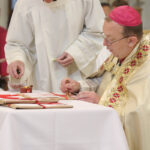
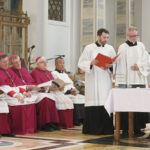
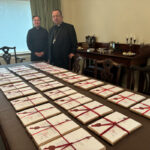
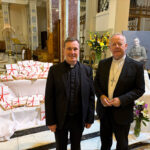
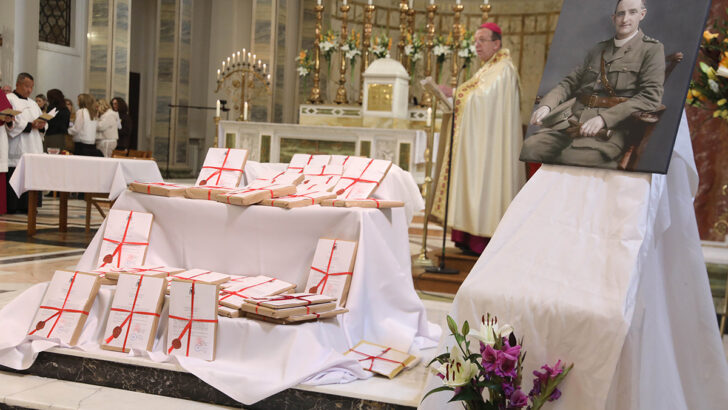
 ishop Tom Deenihan of Meath addresses the gathering at Mullingar Cathedral, with the records of Fr Willie Doyle’s cause for canonisation displayed alongside his portrait. Photos: John McElroy.
Cause advances to Rome after historic ceremony at Mullingar Cathedral
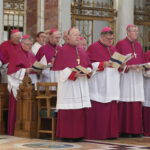
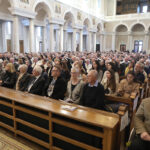
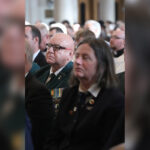
The Cathedral of Christ the King in Mullingar was packed on Sunday afternoon, October 18, for the closing of the diocesan inquiry into the cause for canonisation of Fr Willie Doyle SJ. The choirs sang, standard-bearers of the Royal British Legion stood with their flags, representatives of the Irish Defence Forces and British military gathered alongside a host of priests, religious, members of various chivalric orders and Fr Doyle’s own family.
People had travelled from across Ireland, the UK and the United States for the occasion. An unusual gathering, perhaps, but what could be more fitting for a Jesuit priest who, more than a century ago, crossed the divisions of nationality and creed to minister to the wounded and dying on the hellish battlefields of the First World War?
Fr Willie Doyle became known for his immense courage, venturing into danger to comfort wounded and dying soldiers, administering the sacraments”
According to the Diocese of Meath, this was the first Irish cause to reach this stage in more than 40 years, the last being that of Venerable Nano Nagle, foundress of the Presentation Sisters.
Born in Dalkey, Co. Dublin, in 1873, Willie Doyle entered the Jesuit novitiate at Tullabeg, Rahan, in the Diocese of Meath at age 18. Long before he entered the trenches, he worked as a preacher and retreat giver, ministering particularly to working men and those who had drifted away from the Church.
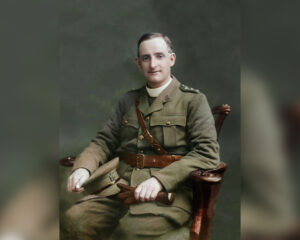
When the First World War came, he volunteered as a chaplain to accompany young men like those he had spent years ministering to. He served in the 16th (Irish) Division of the British Army. Fr Willie Doyle became known for his immense courage, venturing into danger to comfort wounded and dying soldiers, administering the sacraments and refusing to remain behind the lines while his men were under fire. On August 16, 1917, during the Battle of Passchendaele, he was killed while ministering to the men. His body was never recovered.
A life of small sacrifices
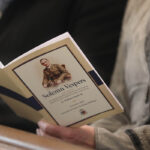
At Sunday’s Vespers, Dominican priest Fr Conor McDonough OP asked how Christians today could imitate a man whose courage on the battlefield seemed beyond ordinary human experience.
His answer was to look to Fr Doyle’s early years in Tullabeg. As a young Jesuit, Fr Doyle had written of beginning a life of “slow martyrdom” through hard work and self-denial. This “slow martyrdom” was lived out through small, everyday sacrifices: going without sugar in his tea, butter on his potatoes, or rising a little earlier to pray.
In a sense he had to become a saint in order to give himself completely on the battlefield”
“Long before he wore a military chaplain’s uniform, long before he needed to be brave in the face of bullets and bombs,” Fr McDonough said, his soul was being formed through “little acts of self-control and charity”.
Speaking to The Irish Catholic ahead of the ceremony, the postulator of the cause, Fr John Hogan, made much the same point. “He didn’t just become a saint on the battlefield,” he explained. “In a sense he had to become a saint in order to give himself completely on the battlefield.”
Fr Hogan recalled one particularly down-to-earth example of Doyle’s self-denial: his fondness for butter. “As an Irishman, he loved his butter. And he used to pile the butter on his bread,” he said. “And in his diary … he’ll say, ‘Didn’t take butter today, didn’t take butter today. I fell, I took butter.’”
“People might smile and laugh at it as well, it’s only butter … but he recognised it’s the small things. That’s where we’re trained.”
Bishop Tom Deenihan of Meath recalled a tribute from a member of the Orange Order, who said Doyle had been as willing to bring water to a wounded Ulsterman as to help a soldier of his own faith”
Despite the intensity of Fr Doyle’s discipline, he was not a dour or distant figure. “He was extraordinarily warm and kind and loving, and people recognised that in him,” Fr Hogan said.
In his address to the gathering, Bishop Tom Deenihan of Meath recalled a tribute from a member of the Orange Order, who said Doyle had been as willing to bring water to a wounded Ulsterman as to help a soldier of his own faith. His service, the bishop said, crossed the divisions of nationality, politics and creed.
“His regard, compassion, sacrifice and witness to all who are suffering, regardless of nationality or creed, is still a lesson for our time,” Bishop Deenihan told those assembled.
The road to Rome
The ceremony also marked the completion of nearly four years of work by the diocesan tribunal, historians and theologians who collected records, examined Fr Doyle’s writings and gathered testimonies about his life and holiness.
‘I’d never heard of Fr Willie before,” he said. ‘I was instantly struck by the holiness of the man’”
The material is to be brought to the Dicastery for the Causes of Saints in Rome next month. From there, further examination will determine whether there exists sufficient grounds for the church to recognise Fr Doyle’s heroic virtue.
For Dr Patrick Kenny, president of the Fr Willie Doyle Association, Sunday’s milestone was also personal. He first encountered Doyle through a biography in 2010, despite living in Dún Laoghaire, only a short distance from Doyle’s native Dalkey.
“I’d never heard of Fr Willie before,” he said. “I was instantly struck by the holiness of the man.”
Passages
Dr Kenny began sharing passages from Doyle’s writings online, a small undertaking which developed into years of work promoting his cause.
Speaking after the ceremony, he described the occasion as “a day of great joy”, but also “just the end of the beginning”, emphasising that much work still lies ahead.
Living the ordinary things in an extraordinary way”
And as the diocesan inquiry draws to a close, Fr Doyle’s example might leave us with a question we all ask ourselves: how might we live extraordinary lives for God? Yet his life also points towards an answer, showing how extraordinary courage can grow from what Pope St John Paul II described as “living the ordinary things in an extraordinary way”.