

 Peter Costello
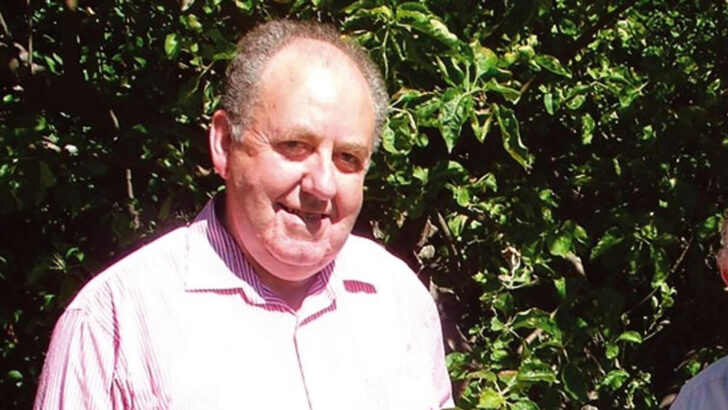 Author John Quinn in his native place. Photo: Westmeath Chronicle.
 Daily Wisdom – Léann an Lae: Irish Proverbs and Sayings for Each Day of the Year, by John Quinn

(Red Stripe Press, €14.99 / £17.50)
Author John Quinn died on New Years Day at the age of 84. This book was originally published some six years ago by the now defunct Veritas Publication, whose disappearance was a sad sign of change to so many people, and to others an example of the inept management that has undermined so many little presses in Ireland over time. But here, from a new press, the book reappears as a tribute to the author whose popularity is without doubt.
For many years John Quinn was an effective broadcaster on RTÉ, as well as being a teacher and author. He was a man of many parts, with a deep feeling for a traditional kind of Ireland that many still retain an affection for in the hectic times we are now all living in.
In its aim to promote the use of Irish, the plan of the book is simplicity itself. Divided into twelve months, for each day of the year Quinn provides a recommendation of a suitable saying, or observation. January 1 in his sampling begins with “táim réidh chun oibre” – I am ready for work (which he admits can be countered by “Bíonn gach tosach lag” – every beginning is weak.
He ends up with New Year’s Eve with the hope for plenty in the coming year – “agus go mbeirimid beo ar an am seo arís” – may we be hale and hearty this time next year. Oddly, he recognises New Year’s Eve, but going back a few days says little to distinguish Christmas Day.
Hasty readers should not miss the end piece of the book, an interesting biographical note on Fr Patrick S. Dinneen, the Kerry man famous for the creation of an Irish dictionary, among a decade of other books. It went out of print in what John Quinn refers to quaintly as “a fire” at the Dublin printers in 1916. A new enlarged edition appeared with government aid in 1927.
Dinneen sat at the same seat in the National Library nearly every working day – it now carries a small brass plaque to his memory; I have often sat at it, as it is most convenient to the issue desk. Quinn quotes the late chief librarian Alf Mac Lochlainn’s comment that the dictionary was “a strange book, in some ways an infuriating book, in others an endearing one.”
Certainly, it was a very individual book, not to be compared with the conventional 1959 dictionary by Tomás de Bhaldraithe that replaced it in the mind of officialdom.
Notoriously Dinneen inserted a multiplicity of meanings for the same word. For example ‘maide’, a stick or piece of wood, can also mean an oar, a treadle, a knife handle, a roof-tie, a crutch, a seesaw, a sugarstick, parts of a bed, a hobbyhorse, a stirabout stick (what the Scots call a ‘spurtle’), and so on.
This (though Quinn does not allude to it) was an aspect of the dictionary that amused Myles na Gopaleen who satirised Dinneen in his newspaper column with similar lists of comic definitions, such as “the smooth skin on the back of a goats leg” – alright I made that up – but readers of At Swim-Two-Birds will be familiar with the aptness of jests.
But leaving these great men aside, many readers will get a great deal of entertainment and information out of John Quinn’s book. Doubtless there will be other reprints to follow, such as a new edition of his much-read Goodnight Ballivor, I’ll Sleep in Trim.