

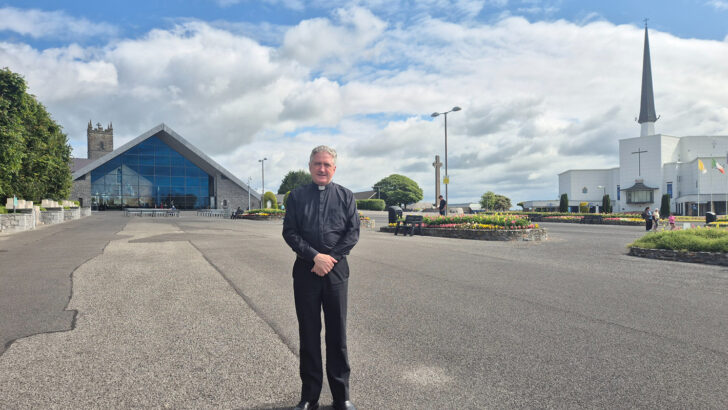
 Fr Richard Gibbons PP, rector of Knock Shrine, pictured on the shrine grounds with the Apparition Chapel and Basilica in the background. Photo: Pedro Esteva.
 Knock was always part of Fr Richard Gibbons’s life, even before it became his work. Growing up in Mayo, his family came each year – mum, dad, six children and, sometimes, his grandfather – everyone piling into a small minibus. This was the 1970s, when the Basilica itself was newly built.
“My memory of it, nearly everybody’s memory, is of rain and wind and nowhere to get in out of it,” the rector of Knock Shrine told The Irish Catholic. “You’d go through a big long Mass and then, as kids, you were kind of given something to keep you quiet, which was always the Knock rock, big sticky candy like that. You’d gnaw on that, full of sugar, bouncing around inside the thing.”
For him, and for many, Knock was simply there. It belonged to the weather, to the road, to the family calendar. That familiarity is both one of the shrine’s strengths and one of its challenges.
“We kind of take the place for granted,” Fr Gibbons said. Growing up near the Mayo islands, he always assumed he could visit them eventually. That meant he rarely did. Knock, he suggested, can suffer the same fate.
Yet the shrine now stands at the beginning of a remarkable sequence of anniversaries. This year marks the golden jubilee of the Basilica. Next year brings 50 years of the National Novena. In 2028, the parish church will celebrate its bicentenary. Then comes “the big one”: the 150th anniversary of the Apparition in 2029.
For Fr Gibbons, these dates are an opportunity to place Knock once more before Irish people who have become distant from the shrine or from the faith itself: “A lot of Irish people have forgotten about Knock and don’t come here. When the faith is falling away or they’re apathetic towards the faith, then Knock goes out of the consciousness, because there’s no need to come. So we have to make sure that we promote it very well for the 150th.”
It is an opportunity to emphasise the living faith and living history of a place where, as Fr Gibbons puts it, “heaven met earth”.
There remains, of course, a devotion to Our Lady of Knock in homes across the country, an inheritance which occasionally surfaces in unexpected places like when the famous hymn is sung from the stands at sporting matches.
The meaning of Knock
But Fr Gibbons believes the real depth of the silent Apparition lies in its theological richness. The Lamb and altar stand at the centre, alongside Our Lady, St Joseph and St John holding the Scriptures.
“There’s so much going on in it and it’s so complex theologically that it speaks to people on various different levels,” he said.
For some, the point of entry is Our Lady. For others it is the Eucharist, St Joseph, Scripture, healing or consolation. Fr Gibbons stresses that the Apparition is Eucharistic before it is Marian, with the Lamb and altar at its centre: “It means it’s Eucharistic, it’s Marian, it promotes the Word of God, it promotes St Joseph as protector of the Church. It’s kind of the whole Paschal mystery there in front of you.” In other words, the Apparition draws the pilgrim into the life of the Church.
Even if nothing happens supernaturally or anything like that, you still have the hope that here heaven met earth”
From that richness, pilgrims arrive with very different needs. Some seek healing; others carry grief, family worries or questions. Not every prayer is answered in the form sought. Not every pilgrim leaves with a miracle. Fr Gibbons’s understanding of Knock does not depend upon promising otherwise:
“Even if nothing happens supernaturally or anything like that, you still have the hope that here heaven met earth. There’s something here now. There’s something more to life than what we’re being told, and it’s not just here. There’s something beyond.”
“It’s a welcoming apparition. It just welcomes you into the life of God. That’s the message.”
This happened at our parish
The fact that Knock is now an international shrine can sometimes obscure something Fr Gibbons was keen to emphasise: it remains a functioning Mayo parish.
He wears two hats, serving both as rector of the National Shrine and parish priest of Knock. Because the Apparition took place at the parish church itself, the two roles are inseparable.
It is also something which distinguishes Knock from Lourdes or Fatima, where the apparition sites developed separately from ordinary parish life. At Knock, the local and the universal have been joined from the beginning.
Fr Gibbons said that gives local people a particular sense of responsibility for the shrine:
“They feel it’s theirs too, like it’s special to them. It happened at the parish church. This happened at our parish. So they have a more connected understanding of the Apparition than, let’s say, in Lourdes or Fatima or elsewhere, because of it being at the parish church itself, the centre of parish life.”
Parish life also keeps the rector grounded. A shrine attracting huge numbers of pilgrims can become an unusually concentrated religious environment, something like a bubble or, as he joked, a “hyper-Catholic situation”.
“You could be ‘bubbleised’.”
Ordinary parish life breaks that bubble. There are funerals, baptisms, weddings, First Communions and Confirmations. There are families known across decades. After more than 20 years at Knock, Fr Gibbons now finds himself marrying people he once baptised.
“So it’s real,” he said. “It keeps you real. It keeps you connected to people’s lives.”
The people behind Knock
There is another contrast between the Knock people imagine and the Knock they find.
Fr Gibbons frequently meets first-time visitors expecting something much smaller. “They think it’s a tiny little place with some statue somewhere,” he said.
Instead, they discover a campus of more than 100 acres, encompassing churches, chapels, pastoral facilities, accommodation and landscaped grounds. Behind those visible structures is another Knock again: staff, seasonal workers, parishioners and volunteers whose work allows the great pilgrimage days to happen.
More than 100 full-time staff serve the shrine, while the Order of Malta supports pilgrims. Young people aged 17 and 18 serve through the VAKS programme, helping with ceremonies and assisting people around the grounds.
“Volunteers – you have to mention the volunteers,” Fr Gibbons said.
He spoke particularly warmly of the young people involved through the shrine’s youth ministry: “We’ve them in every weekend for the season. They’re in uniform and they help out with the ceremony and with people on the grounds, and if they’re needed for helping out. And then parish volunteers, and our staff and our workforce and the parishioners themselves, everybody rallies together when we need to do things in a big way.”
Handing it on
Fr Gibbons is also candid that he did not initially welcome his appointment to Knock in 2003. The shrine had a reputation for work: summers and weekends disappeared while ordinary parish demands continued. “I wasn’t really awfully happy and enamoured about that,” he admitted.
What began as an unwanted assignment gradually became the defining ministry of a priest who had himself entered seminary only intending to stay for a year.
Since becoming rector in 2012, Fr Gibbons has overseen major physical and pastoral renewal, culminating in Knock’s recognition as an international Eucharistic and Marian shrine.
‘We’ve got a lot done,’ Fr Gibbons said, ‘and more to do’”
Yet the next stage may be less about buildings than about transmission. The faith-development staff, youth ministry, Retreat Village and young volunteers are all attempts to create spaces where another generation can encounter Knock on its own terms, rather than merely inherit somebody else’s nostalgia.
“We want the place to be a beacon of hope,” Fr Gibbons said. “We want to have best practice here, even in terms of liturgy, music and retreat programmes.”
The anniversaries will bring ceremonies and remembrance. Their deeper question is whether Knock will be encountered again – not simply as something belonging to grandparents, or something always available for another day, but as a living inheritance.
“We’ve got a lot done,” Fr Gibbons said, “and more to do.”