

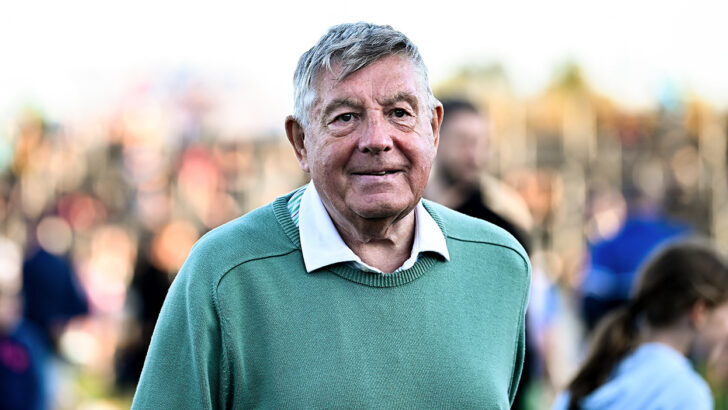
 Former Tipperary hurler and manager
Michael ‘Babs’ Keating in attendance
during the Hurling for Cancer Research
2024 charity match at Netwatch Cullen
Park in Carlow on August 12, 2024. Photo:
Piaras Ó Mídheach/Sportsfile.
Former Tipperary hurler and manager
Michael ‘Babs’ Keating in attendance
during the Hurling for Cancer Research
2024 charity match at Netwatch Cullen
Park in Carlow on August 12, 2024. Photo:
Piaras Ó Mídheach/Sportsfile. There are few names that echo through the GAA with quite the same resonance as Michael ‘Babs’ Keating. The mere mention conjures images of a powerful Tipp man with fire in his eyes – whether barefoot on All-Ireland final day in 1971 or patrolling the sideline in his transformative spell as manager of Tipperary.

From humble beginnings, born just outside of Clonmel, today his is a name spoken in the same breath as Mackey, Ring, and Rackard. And yet, when you meet Babs, you don’t just get a legend. You get a routine.
“I go to Mass regularly,” he says simply. “We were the nearest house to the church at home in Grange, and I was a Mass server from the age of eight or nine. That’s just the way things were. You went to Mass. You helped out.”
At 82, Keating still carries himself with a presence; if he hit you with a shoulder, you’d certainly feel it. There’s a steadiness in his voice, a sharpness in his thinking, and a firm sense of what matters alongside a tremendous sense of humour.
He’s a man rooted in habit – faith in the mornings, exercise in the afternoons, and still time to coach a priest how to drive if needed. Nowadays living in Kildare, the Tipperary legend has a special place in his heart for the Carmelites.
“The Carmelite church in Kildare is a special place. I’d be very friendly with the priests there, and I have great faith in them,” he said. “One of the Indian priests wanted to learn how to drive, so I’ve spent the last couple of months helping him. We’ve become very good friends; I even brought them to the Tipp and Waterford game earlier this year.”
Childhood
Born in the parish of Ardfinnan, along the River Suir, Keating recalls a childhood where swimming holes and parish football matches filled the days. But hurling wasn’t yet dominant in his part of Tipperary.
“Football was always the poor relation in South Tipp, and it still is today,” he reflects. “It was only when a Kerryman teaching in our parish started juvenile hurling that I really got into it.”
He would go on to attend CBS Clonmel, where a Christian Brother from Kilkee changed the course of his life.
“Bro. Collins. A phenomenal coach. I held a hurley the wrong way as a juvenile, and he corrected me. He persevered. I owe him everything. He was probably the best hurling coach I ever had.”
There were three Michael Keatings in my national school. I was the youngest. That’s the only explanation I have”
That quiet gratitude marks many of Keating’s reflections. He didn’t choose the nickname ‘Babs’, for example – it simply stuck, the way things do in a tight-knit schoolyard.
“There were three Michael Keatings in my national school. I was the youngest. That’s the only explanation I have. The other two sadly passed away not so long ago.”
In 1971, Keating walked into GAA folklore. That year, in the All-Ireland final, he famously took to the field barefoot after losing his boots. Whilst the images remain legendary, many don’t know the story behind them.
“I was in London earlier that year, and so I bought myself an expensive pair of glove leather Pumas; they were the best you could buy at the time.”
“On the last night of training before the All-Ireland, we went down for a meal together. I sat in the car to head off, and I threw the gear bag in the door. We went in to eat, and by the time I came out, the bag was stolen. I had to go back to the old boots. And sure enough, didn’t I end up barefoot.”
Resilience
No moment better captures the resilience and spirit that defined Keating’s playing days. And even now, decades later, he remains as passionate as ever about the state of the game. But he’s not impressed by the direction the GAA has taken in recent years – particularly when it comes to the scheduling of the All-Ireland series.
“I’m completely opposed to the split season,” he says bluntly. “It’s an awful drawback to the promotion of hurling. To have the All-Ireland finished by the third week of July – it’s just not the custom.”
Tipperary couldn’t even hold a reception in Dublin on the night of their All-Ireland victory this year, further echoing Keating’s frustration”
The earlier final, he argues, robs the championship of its natural rhythm and meaning.
“Even as a youngster going to school, you remember the All-Ireland falling that last week of August or the first of September. It gave the whole country a lift before school started. Now, you’re playing a semi-final two weeks before the final. There’s no time to plan, to book hotels, or to even celebrate.”
Indeed, Tipperary couldn’t even hold a reception in Dublin on the night of their All-Ireland victory this year, further echoing Keating’s frustration.
“There are certain sporting dates set for as long as time itself. Cheltenham. The Epsom Derby. Wimbledon. The British Open. They’re cast in stone every year. The All-Ireland should be the same.”
Streaming
On the topic of GAA GO, the online streaming platform, which regularly falls in line for controversy, Keating is less critical than some of his contemporaries.
“I don’t object to it. With the way the system is now, there are so many games on at once; if you want to watch them, there’s no other option. I don’t think expense is the issue. It gives people the chance to see matches they otherwise wouldn’t.”
What bothers him more is how tickets are distributed – and how long-standing supporters are often left behind.
“Tickets should only be distributed through the county boards,” he says. “I had good friends—real, staunch supporters – who couldn’t get tickets to this year’s All-Ireland. One of them wrote to the county board and everything.”
“The county board today don’t know the supporters who followed Tipp through thick and thin 30 or 40 years ago. They’re forgotten.”
There are so many former players who could be a huge asset in spending an hour or two with youngsters today”
And it’s not just supporters. Keating believes the GAA has missed a trick – and, in doing so, turned its back on its golden generation.
“I don’t believe that the people in Croke Park today are concerned about spreading the gospel of hurling like they let on. There are so many of my generation who are retired who could be a huge asset to coaching youngsters, but there’s no system for them to do so,” he said.”
“There are so many former players who could be a huge asset in spending an hour or two with youngsters today.”
Today, Michael Babs Keating is one of the last of a golden generation. A man whose days are still defined by faith, by sport, and by service to others. His boots may have been stolen, but despite its flaws, his love and passion for the GAA remains as fierce as ever.