

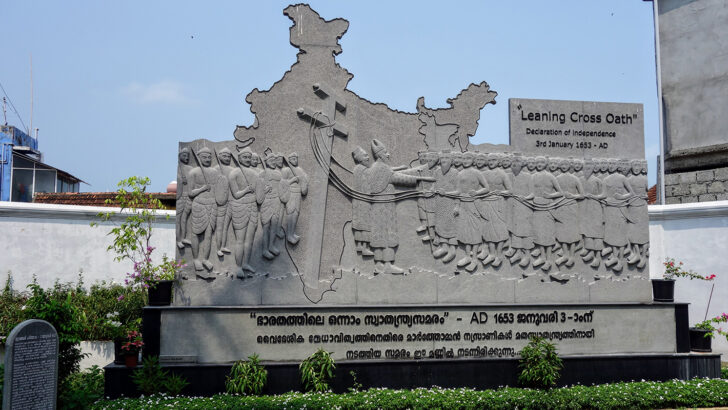
 Coonan Cross Oath Monument at
Koonan kurish Old Syrian Church
at Mattancherry, Kochi, Kerala,
India. Photo: Public Domain
Coonan Cross Oath Monument at
Koonan kurish Old Syrian Church
at Mattancherry, Kochi, Kerala,
India. Photo: Public Domain Whenever I talk about the Syro-Malabar Catholic Church or even mention that it’s an Eastern Catholic Church, there is always a follow-up question. Many often know that Apostle St Thomas had established a church and community back in 52 AD, hence the name St Thomas Christians. Little do people know, there was a huge revolution that took place in the centre of Kochi back in 1653, which resulted in a divide that created the Syro-Malabar Catholic community.

The Portuguese had entered the shores of Kerala in the late 15th century, on a course to find spices and pepper, which were high in value. The Portuguese fleet was led by Vasco Da Gama, who cleverly found a route that took him to India at the time. Vasco Da Gama also had another mission – to find Christians. When he reached the port of Calicut (Kozhikode), the question of his arrival came about, and he famously replied to the locals by simply saying: “Christians and spices”.
Little to his and his fellow travellers’ knowledge, the Christians he was after had nothing to do with Rome. The St Thomas Christians were thriving; they followed what was known as the Thoma Margam (the way of Thomas), which blended with local culture. There were no statues, no Latin prayers, and no traditional church architecture. Most of the churches were inspired by temples, and some of them were mixed with Persian architecture, along with Syriac (Aramaic) scriptures and teachings.
Vasco Da Gama
This did not go well with Vasco Da Gama. To add fuel to the fire, when he first arrived in Calicut, he was greeted with a statue in a temple, thinking it was Mary (it was a Hindu goddess), he knelt down and started praying. The locals laughed, and the story spread. The vengeance was clear: Latinise everyone.
Vasco Da Gama died in 1524, but that did not stop his descendants or his troops. The means of communication to the local St Thomas Christians were with violence, torture, and persecution. What was merely a visit for spices and trade turned into an agenda. This happened for years, which led to the Synod of Diamper (1599). The synod allowed the Portuguese to destroy any intellectual property that had a link to the Eastern ideology, claiming it was a practice of Nestorianism.
The use of Syriac/Aramaic practices was fundamentally imposed, creating a hostile environment for locals, hiding in fear”
The answer to this was burning 1500-year-old books, churches and even some claim houses and shops that did not align with their views. The battle for religious freedom was under threat. The use of Syriac/Aramaic practices was fundamentally imposed, creating a hostile environment for locals, hiding in fear.
The news had spread to Syria, and to stand with the people, Archbishop Ahatallah or Mar Atallah was sent in 1653. The Da Gama platoon got the intel of his arrival, and while the St Thomas Christians were eagerly waiting for their leader to arrive, the wait prolonged. Days went on to weeks, prayers of anxiety turned into the unthinkable. The rumour had reached the villages of Kerala that their beloved leader was no more. It was rumoured that he was captured mid-journey and drowned.
Protest
This reached the ears of Archdeacon Thoma, and in vengeance, called for a major protest against this horrid form of colonial arrogance. On January 3, 1653, thousands marched with him to the Church of Our Lady at Mattancherry, a prominent spice trading port facing the Arabian sea. They tied ropes against a large granite cross, and people would hold the ropes and swear that they would never fall under the Portuguese rule and the Latin Church. If anybody from Kerala is reading this, they would be familiar with the term ‘Sathya Christiani’, which translates to ‘A true Christian’, a term which is even widely used today in a day-to-day context.
The word Coonan Cross means ‘bent cross’, and that’s exactly what happened when over 5000 people started pulling, forcing a bend. It showed the immense power of tradition, culture and the sheer determination that refused to surrender. The protest had reached the ears of Pope Alexander VII. The diplomatic pope was shocked to hear of the Portuguese treatment towards the local St Thomas Christians and demanded immediate talks between them. He ordered the Carmelites to be sent over to Kochi, which was led by Fr Joseph of St Mary’s (Sebastiani).
This eventually led to the Syro-Malabar Catholic Church as it is known today. It has around 5 million devotees and continues to keep tradition with culture”
Instead of bringing peace, these discussions created even more confusion and effectively defenestrated the idea of harmony. After a protracted discussion, the locals and the Carmelites had come to an agreement, keeping the Eastern traditions and the pope as their leader. However, what should have been an easy agreement turned into a split that changed Christianity in India.
The Pazhayakootu (the old alliance) decided to stay with Rome and continue their traditional views and teachings with a proper authority figure. The Puthenkootu (the new alliance) did not want anything to do with Europe anymore and started a new faction of Christianity, which later joined the Orthodox wing.
This eventually led to the Syro-Malabar Catholic Church as it is known today. It has around 5 million devotees and continues to keep tradition with culture. During his 1986 pilgrimage to Kerala, the pope, who spoke so often of the Church “breathing with two lungs”, finally restored the full heritage of the St Thomas Christians. By beatifying their local saints and elevating their Church’s status, he validated the 1653 struggle, proving that one can be fully Indian, fully Eastern, and fully Catholic all at once.
Journey
The journey toward justice reached its peak in 1992, when St John Paul II elevated the Syro-Malabar Church to Major Archiepiscopal status. This decree finally granted the community full self-governance, allowing them to choose their own bishops and safeguard their ancient heritage. It was the ultimate vindication of the Coonan Cross Oath, perhaps the first successful anti-colonial protest in Indian history.
Today, the Syro-Malabar Church is a global powerhouse. As this vibrant community takes its place in Irish pews from Dublin to Galway, they carry with them a faith that survived both time and persecution. It is a living testament to the blessings of St Thomas, a 2,000-year-old light that continues to burn bright across the oceans.